Example: barber
Lecture 7 Protein-Protein Interaction
2 Protein-protein interaction network • Molecular processes are sequences of events mediated by proteins that act in a cooperative manner. This cooperation requires that proteins to interact and form protein complexes. • Protein – protein interaction network: – Nodes – proteins – Edges - …
Tags:
Information
Domain:
Source:
Link to this page:
Documents from same domain

Lecture 8:Motifs and Motifs finding
www.ncbi.nlm.nih.govMotifs • Motif is a region (a subsequence) of protein or DNA sequence that has a specific structure • Motifs are candidates for functionally
Lecture 6a: Introduction to Hidden Markov Models
www.ncbi.nlm.nih.gov• Select a basic method to model a sequence family – what are the states, what are the emitted symbols. • Using a training set – a set of known sequences in the family – estimate the parameters of the model: emission and transition probabilities.

Lecture 10 : Whole genome sequencing and analysis
www.ncbi.nlm.nih.govPolymorphism (SNP): a variation is a single nucleotide in a genome • Typically we have two say alleles (here C and T) minor (less common) and major. • minor allele frequency - the ratio of chromosomes in the population carrying the less common variant to those with the more common variant • A second generation human

Lecture 2 Pairwise sequence alignment.
www.ncbi.nlm.nih.govDiscovering sequence similarity by dot plots Given are two sequence lengths n and m respectively. Do they share a similarity and if so in which region? Dot-plot method: make n x m matrix with D and set D(i,j) = 1 if amino-acid (or nucleotide) position i in first sequence is the same (or similar as described later) as the amino-acid

Lecture 11 Phylogenetic trees
www.ncbi.nlm.nih.govVersion parsimony models: • Character states – Binary: states are 0 and 1 usually interpreted as presence or absence of an attribute (eg. character is a gene and can be

Lecture 5: Multiple sequence alignment
www.ncbi.nlm.nih.govMultiple alignment as generalization of pairwise alignment S1,S2,…,Sk a set of sequences over the same alphabet As for the pair-wise alignment, the goal is to find alignment that maximizes some scoring function:

Hamilton Depression Rating Scale (HDRS)
www.ncbi.nlm.nih.govHamilton Depression Rating Scale (HDRS) Hamilton Depression Rating Scale (HDRS) Study Identification tool Comparator/ caseness Population Results Community Stukenberg et al., 1990 Quality assessed: + HDRS DSM-III-R (SCID) N=177 community dwelling adults over 55 years, age

CareStart COVID-19 Antigen test - Fact Sheet for Patients
www.ncbi.nlm.nih.govtest. This Fact Sheet contains information to help you understand the risks and benefits of using this test for the diagnosis of COVID-19. After reading this Fact Sheet, if you have questions or would like to discussthe information provided, please talk to your healthcare . provider. For the most up to date information on COVID-

Annex 1. Example of the semi‐structured interview guide
www.ncbi.nlm.nih.govAnnex 1. Example of the semi-‐structured interview guide V. iral Hepatitis: Semi-structured interview M / F. Provider / community member / both. Age. Region. 1. …
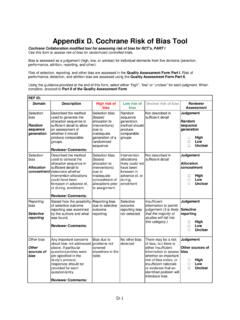
Cochrane Risk of Bias Tool - National Center for ...
www.ncbi.nlm.nih.govD-1 Appendix D. Cochrane Risk of Bias Tool . Cochrane Collaboration modified tool for assessing risk of bias for RCT’s, PART I. Use this form to assess risk of bias for randomized controlled trials
Related documents
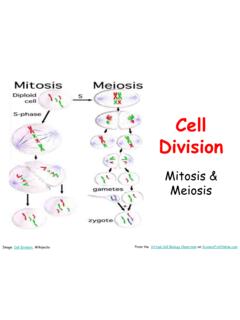
Cell Division - Mitosis & Meiosis Lecture PowerPoint
www.sanjuan.edu• Shuffling the genes (Mix it up!) • See animation “Unique Features of Meiosis” from McGraw-Hill From the Virtual Cell Biology Classroom on ScienceProfOnline.com REVIEW! Animations Comparing Mitosis & Meiosis Quiz 1 and Quiz 2 from McGraw-Hill
Molecular Biology Fundamentals - ESP
www.esp.orgGenes are carried in a linear arrangement in the chromosome, where they occupy stable positions. Genes recombine as discrete units. Genes can mutate to stable new forms. Basically, genes seemed to be particulate objects, arranged on the chromosome like “beads on a string.” The genes are arranged in a manner similar to beads strung on a ...
MOLECULAR BIOLOGY AND APPLIED GENETICS
www.cartercenter.orgThis lecture note is specifically designed for medical laboratory technologists, and includes only those areas of molecular cell biology and Applied Genetics relevant to degree-level understanding of modern laboratory technology. Since genetics is prerequisite course to molecular biology, the lecture note starts with Genetics
Lecture 8:Motifs and Motifs finding
www.ncbi.nlm.nih.govLecture 8:Motifs and Motifs finding (with a section on Chip-Seq) Principles of Computational Biology Teresa Przytycka, PhD . Motifs • Motif is a region (a subsequence) of protein or DNA sequence that has a specific ... • Co-regulated genes – genes to which are regulated by the same transcription factor .
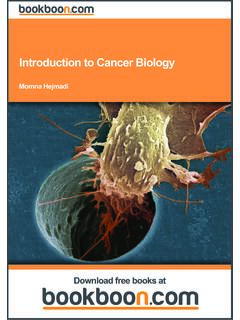
Introduction to Cancer Biology - University of Georgia
csbl.bmb.uga.eduIntroduction to Cancer Biology 5 Contents 3 Sustained growth signals (oncogenes*) 20 3.1 Bibliography28 3.2 Further Reading 28 4 Bypass anti-growth signals (Tumour Suppressor Genes*) 29 4.1 Bibliography33 4.2 Further reading 33 5 Avoidance of cell death (apoptosis) 34 5.1 When does apoptosis occur? 34 5.2 What triggers apoptosis? 35

Biochemistry and Molecular Biology
www.kau.edu.sa6.2 Constructing gene libraries 196 6.3 Cloning vectors 206 6.4 Hybridisation and gene probes 223 6.5 Screening gene libraries 225 6.6 Applications of gene cloning 229 6.7 Expression of foreign genes 234 6.8 Analysing genes and gene expression 240 6.9 Analysing whole genomes 254 6.10 Pharmacogenomics 259 6.11 Molecular biotechnology and ...
Cytogenetics Lecture 1: Introduction to Clinical Cytogenetics
arup.utah.eduincludes genes and non-coding sequence –Genes: n= ~20,000, genome is 1.5% exonic, 26% intronic, ~8% regulatory, distribution is uneven •Repetitive sequence includes tandemly arranged, satellite DNA: α-satellite, minisatellite, microsatellite and dispersed short or long elements (SINEs, LINEs) –α-satellite DNA: 171 bp, centromeres

Lecture 3 - University of California, San Diego
classes.biology.ucsd.edu• Humans have 18 families of cytochrome P450 genes and 43 subfamilies: – CYP1 drug metabolism (3 subfamilies, 3 genes, 1 pseudogene) – CYP2 drug and steroid metabolism (13 subfamilies, 16 genes, 16 pseudogenes) – CYP3 drug metabolism (1 …

Introduction to population genetics & evolution
cme.h-its.org2 μ * ( 1 – H ) : gain due to mutation – There are two alleles. The probability that they are the same is (1-H). Given that they are the same, the probability that either one or the other will mutate is 2 μ. Thus 2 μ (1 – H ) is the gain of heterozygosity due to mutation