Example: bankruptcy
Lecture 7 Protein-Protein Interaction
Protein-protein interaction network • Molecular processes are sequences of events mediated by proteins that act in a cooperative manner. This cooperation requires that proteins to interact and form protein complexes. • Protein – protein interaction network: – Nodes – proteins – Edges - …
Tags:
Information
Domain:
Source:
Link to this page:
Documents from same domain

Lecture 8:Motifs and Motifs finding
www.ncbi.nlm.nih.govMotifs • Motif is a region (a subsequence) of protein or DNA sequence that has a specific structure • Motifs are candidates for functionally

Hamilton Depression Rating Scale (HDRS)
www.ncbi.nlm.nih.govHamilton Depression Rating Scale (HDRS) Hamilton Depression Rating Scale (HDRS) Study Identification tool Comparator/ caseness Population Results Community Stukenberg et al., 1990 Quality assessed: + HDRS DSM-III-R (SCID) N=177 community dwelling adults over 55 years, age
Lecture 6a: Introduction to Hidden Markov Models
www.ncbi.nlm.nih.gov• Select a basic method to model a sequence family – what are the states, what are the emitted symbols. • Using a training set – a set of known sequences in the family – estimate the parameters of the model: emission and transition probabilities.

Lecture 10 : Whole genome sequencing and analysis
www.ncbi.nlm.nih.govPolymorphism (SNP): a variation is a single nucleotide in a genome • Typically we have two say alleles (here C and T) minor (less common) and major. • minor allele frequency - the ratio of chromosomes in the population carrying the less common variant to those with the more common variant • A second generation human

CareStart COVID-19 Antigen test - Fact Sheet for Patients
www.ncbi.nlm.nih.govtest. This Fact Sheet contains information to help you understand the risks and benefits of using this test for the diagnosis of COVID-19. After reading this Fact Sheet, if you have questions or would like to discussthe information provided, please talk to your healthcare . provider. For the most up to date information on COVID-

Lecture 2 Pairwise sequence alignment.
www.ncbi.nlm.nih.govDiscovering sequence similarity by dot plots Given are two sequence lengths n and m respectively. Do they share a similarity and if so in which region? Dot-plot method: make n x m matrix with D and set D(i,j) = 1 if amino-acid (or nucleotide) position i in first sequence is the same (or similar as described later) as the amino-acid

Lecture 11 Phylogenetic trees
www.ncbi.nlm.nih.govVersion parsimony models: • Character states – Binary: states are 0 and 1 usually interpreted as presence or absence of an attribute (eg. character is a gene and can be

Annex 1. Example of the semi‐structured interview guide
www.ncbi.nlm.nih.govAnnex 1. Example of the semi-‐structured interview guide V. iral Hepatitis: Semi-structured interview M / F. Provider / community member / both. Age. Region. 1. …

Lecture 5: Multiple sequence alignment
www.ncbi.nlm.nih.govMultiple alignment as generalization of pairwise alignment S1,S2,…,Sk a set of sequences over the same alphabet As for the pair-wise alignment, the goal is to find alignment that maximizes some scoring function:
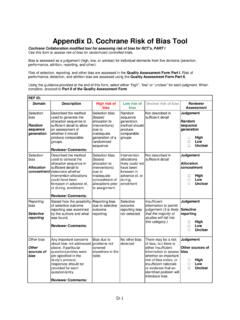
Cochrane Risk of Bias Tool - National Center for ...
www.ncbi.nlm.nih.govD-1 Appendix D. Cochrane Risk of Bias Tool . Cochrane Collaboration modified tool for assessing risk of bias for RCT’s, PART I. Use this form to assess risk of bias for randomized controlled trials
Related documents

Introduction to Proteins and Amino Acids
www.michigan.gov• Each protein has its own unique shape. If the temperature or pH of a protein's environment is changed, or if it is exposed to chemicals, these interactions may be disrupted, causing the protein to lose its three-dimensional structure and turn back into an unstructured string of amino acids. • When a protein loses its higher-order structure,

A Guide to Polyacrylamide Gel Electrophoresis and Detection
www.bio-rad.comSince protein-protein interactions are retained during separation, some proteins may also separate as multisubunit complexes and move in unpredictable ways. Moreover, because native charge is preserved, proteins can migrate towards either electrode, depending on their charge. The result is that native

Overview of tag protein fusions: from molecular and ...
web.mit.edudesired protein sequence (Nagai and Thogerson 1987). ... interactions with ligands. GFP with an Arg. 6-tag on one of its termini can be reversibly and specifically bound via this sequence onto a mica surface, which has been established as a standard substrate for electron and scanning probe microscopy applications (Nock et al. 1997). While the ...

Protein secondary structure elucidation using FTIR ...
assets.thermofisher.comanalysis of protein secondary structure. 3 Table 1 shows the secondary structure band assignments for proteins in water. Note that all assignments are depicted as a range, as the exact position of each peak varies from protein to protein due to the differences in hydrogen bonding interactions and the environment of the proteins.

Protein Structure
dasher.wustl.eduprotein are all determined by the sequence of amino acids that make up its primary sequence. ... interactions (glycine is an exception). Secondary Structure • The primary sequence or main chain of the protein must organize itself to form a compact structure. This is done

using a three-track neural network Accurate prediction of ...
www.ipd.uw.eduThe prediction of protein structure from amino acid sequence information alone has been a longstanding challenge. The bi-annual Critical Assessment of Structure (CASP) meetings have demonstrated that deep learning methods such as Al-phaFold (1, 2) and trRosetta (3), that extract information from the large database of known protein structures in the

PROTEIN BINDING OF DRUGS - Jiwaji University
www.jiwaji.eduThe protein are particularly responsible for such an interaction. The phenomenon of complex formation of drug with protein is called as protein binding of drug As a protein bound drug is neither metabolized nor excreted hence it is pharmacologically inactive due to its pharmacokinetic and Pharmacodynamic inertness. – – – – Protein ...