Transcription of Legislative Branch and Executive Branch …
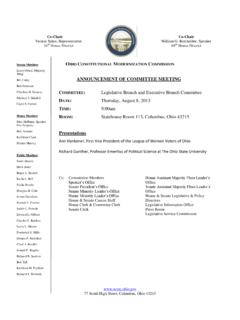
1 OHIO CONSTITUTIONAL MODERNIZATION COMMISSION Legislative Branch and Executive Branch Committee frederick E. Mills, Chair Hon. Paula Brooks, Vice-chair Part I January 12, 2017 Ohio Statehouse Room 018 ChairMr. Fred MillsVice-chairMs. Paula BrooksMr. Herb AsherSen. Bill ColeyMr. Mike CurtinMs. Jo Ann DavidsonRep. Robert McColleyGov. Bob TaftMs. Petee TalleySen. Charleta TavaresMs. Kathleen TraffordFor Internet Access in the Ohio Statehouse: select "oga" from the list of network passcode/password is not Legislative Branch and Executive Branch Committee OHIO CONSTITUTIONAL MODERNIZATION COMMISSION Legislative Branch AND Executive Branch COMMITTEE THURSDAY, JANUARY 12, 2017 11:00 OHIO STATEHOUSE ROOM 018 AGENDA I. Call to Order II. Roll Call III. Approval of Minutes Meeting of December 15, 2016 [Draft Minutes attached] IV. Reports and Recommendations None scheduled V.
2 Presentations Article II, Sections 10 and 12 (Rights and Privileges of Members of the General Assembly) Steven C. Hollon Executive Director [Draft Report and Recommendation to be circulated at meeting] 1 Article II, Sections 15, 16, 26, and 28 (Enacting Laws) Steven C. Hollon Executive Director [Draft Report and Recommendation to be circulated at meeting] Article II, Section 8 (Sessions of the General Assembly) and Article II, Section 15(D) (One Subject Rule) William K. Weisenberg [Testimony of John J. Kulewicz on the One Subject Rule of the Ohio Constitution presented to the Legislative Branch and Executive Branch Committee on November 12, 2015 - attached] VI. Committee Discussion Congressional Redistricting The committee chair will lead discussion on the status of efforts to revise the method for redrawing Congressional districts and receive public comment from interested parties.
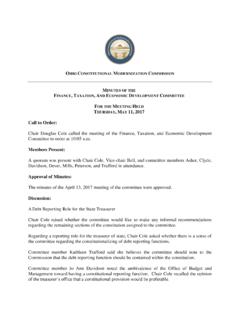
3 VII. Next Steps The committee chair will lead discussion regarding the next steps the committee wishes to take in preparation for upcoming meetings. [Memorandum by Steven C. Hollon titled Grouping of Article II Sections by Topic for Review by the Committee, dated April 7, 2016 attached] [Planning Worksheet attached] VIII. Old Business IX. New Business X. Public Comment XI. Adjourn 2 OHIO CONSTITUTIONAL MODERNIZATION COMMISSION MINUTES OF THE Legislative Branch AND Executive Branch COMMITTEE FOR THE MEETING HELD THURSDAY, DECEMBER 15, 2016 Call to Order: Chair Fred Mills called the meeting of the Legislative Branch and Executive Branch Committee to order at 2:39 Members Present: A quorum was present with Chair Mills, Vice-chair Brooks, and committee members Curtin, Davidson, McColley, Talley, and Tavares in attendance. Approval of Minutes: The minutes of the November 10, 2016 meeting of the committee were approved.
4 Reports and Recommendations: Article II, Sections 3, 4, 5, and 11 (Member Qualifications and Vacancies) Chair Mills recognized Steven C. Hollon, Executive director, for the purpose of presenting to the committee a report and recommendation for Article II, Sections 3, 4, 5, and 11. Mr. Hollon said the report and recommendation reflects the committee s conclusion that the subject sections be retained in their present form. He said the report indicates the sections require legislators to have lived in their districts for one year prior to election, restrict legislators to holding only one public office, prevent persons convicted of embezzlement from serving in the General Assembly, and define how vacancies in the General Assembly are to be filled. Mr. Hollon said the report describes revisions to Sections 4 and 11 that resulted from the activities of the Ohio Constitutional Revision Commission (1970s Commission), as well as discussing litigation relating to the sections.
5 Mr. Hollon said the report and recommendation summarizes the committee s conclusion that the 1970s review resulted in changes that continue to appropriately and effectively guide the legislature s organization and operation, and so the report recommends no change to Article II, Sections 3, 4, 5, and 11. 32 Mr. Hollon having completed his presentation, Chair Mills asked if there were comments or questions. There being none, committee member Jo Ann Davidson moved that the report and recommendation be issued by the committee. The motion was seconded by Senator Charleta Tavares. The committee then voted unanimously to issue the report and recommendation. Article II, Sections 6, 7, 8, 9, 13, and 14 (Conducting Business of the General Assembly) Mr. Hollon then presented a report and recommendation relating to Article II, Sections 6 through 9, and Sections 13 and 14, all relating to the manner in which the General Assembly conducts its business.
6 Mr. Hollon said the report provides summaries of the sections, with Section 6 outlining the powers of each house of the General Assembly, Section 7 allowing for statutes to prescribe the organization of the houses, Section 8 governing the Legislative calendar, Section 9 requiring a journal of proceedings, Section 13 requiring open proceedings, and Section 14 controlling the ability of either house to adjourn. Mr. Hollon continued that the 1970s Commission, in reviewing these sections, issued a comprehensive report recommending the amendment of the Legislative sections of Article II, and that these amendments were adopted by voters and continue to serve the state well. He said the report and recommendation describes the limited litigation related to these sections before setting out the committee s conclusion that the legislature is its own best authority for determining how often and how long it should meet.
7 Thus, Mr. Hollon said, the report and recommendation indicates the committee s view that these sections should be retained in their current form. Mr. Hollon having concluded his presentation, Chair Mills asked if anyone wished to discuss or comment on the report. There being no comments, Sen. Tavares then moved that the committee issue the report and recommendation for Article II, Sections 6, 7, 8, 9, 13, and 11, and committee member Petee Talley seconded the motion. The committee then voted unanimously to issue the report and recommendation for no change to the subject sections. Chair Mills thanked Mr. Hollon for his presentations, and announced that the two reports and recommendations would now be submitted to the Coordinating Committee for its review as to form before being forwarded to the full Commission. Presentations and Discussion: Chair Mills announced that the committee would address the next item on its agenda, which is Congressional redistricting.
8 After providing a brief summary of the committee s work on the topic to date, Chair Mills said the committee would hear from several speakers who wished to address the progress of discussions regarding a proposal for Congressional redistricting. Carrie L. Davis, Executive Director League of Women Voters of Ohio Chair Mills introduced Carrie L. Davis, Executive director of the League of Women Voters of Ohio, who said she was appearing on behalf of the Fair Districts = Fair Elections Coalition, a group that formed in 2015 to work on Issue 1 on the November 2015 ballot relating to Legislative redistricting. She said since the passage of Issue 1, the coalition has shifted its focus to applying the same principles used in relation to Legislative redistricting to methods for drawing Congressional districts. She said the coalition concluded it could not wait indefinitely, so it 43 drafted an alternate proposal which she provided to the She said the purpose of the proposal was to invite public comment.
9 Describing the proposal, Ms. Davis said the group started with Issue 1 as its template, adapting the document to fit the requirements of Congressional redistricting, and suggesting revisions that fit on one page front and back. She said a goal was to keep the proposal short and simple so that voters can understand it. She said the proposal uses the Ohio Redistricting Commission, created by Issue 1, as the body that will determine the Congressional districts. She said the remaining sections remain unchanged, other than being renumbered. She identified a new Section 3 as spelling out criteria for drawing new districts. Ms. Davis identified the two main criteria as being representational fairness and community preservation, both of which are already written into the Ohio Constitution by virtue of Issue 1. She said the proposed change elevates criteria used in Legislative redistricting from aspirational to primary goals when drawing lines for Congress.
10 She said the proposal abandons the complicated rules on splitting, trying to keep it simple and clear. Explaining some of the specific recommendations in the proposal, Ms. Davis said Section 3(A)(1) explains how the number of districts is determined, while Section 3(A)(2) mirrors the current United States Supreme Court standard regarding the ratio of representation. She said Section 3(B) allows for public submission of district plans because the coalition wanted an opportunity for public participation. Ms. Davis said Section 3(C) lists criteria the redistricting commission would have to follow. She said this was in response to the Ohio Supreme Court decision in Wilson v. Kasich, 134 Ohio 221, 2012-Ohio-5367, 981 814. She said the proposal gave priority to these criteria in the order in which they are listed, so there would be no confusion, legal question, or risk.