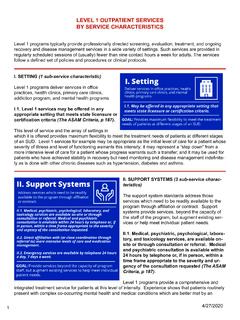
Transcription of Level 2.1 by Service Characteristics
1 Level INTENSIVE OUTPATIENT SERVICESBY Service CHARACTERISTICSL evel intensive outpatient programs (IOP) for adults generally provide 9 19 hours of structured pro-fessionally directed programming per week. The program of services consists primarily of counseling and education about addiction-related and mental health problems. The patient s needs for psychiatric and medical services are addressed through consultation and referral arrangements if the patient is stable and requires only maintenance monitoring of these SETTING (1 sub- Service characteristic) Level programs may be offered in any appropriate setting that meets state licensure or certification Level services may be offered in any appropriate setting that meets state licensure or certification criteria (The ASAM Criteria, p 198).
2 This Level of Service and the array of settings in which it is offered provides maximum flexibility to meet the treatment needs of patients at different stages of an SUD. Level services, for example, may be appropriate as the initial Level of care for a patient whose severity of illness and Level of functioning warrants this intensity; it may represent a step down from a more intensive Level of care (Levels , and Level 4) for a patient whose progress warrants such a transfer; and it may represent a step up for a patient who requires additional structured programming to stabilize addiction and mental health SUPPORT SYSTEMS (3 sub- Service Characteristics )The support system standards address those services which need to be readily available to the program through affiliation or contract.
3 Support systems provide services, beyond the capacity of the staff of the program, but augment existing services or help meet individual patient Medical, psychiatric, psychological, laboratory, and toxicology services, are available on-site or through consultation or referral. Medical and psy-chiatric consultation is available within 24 hours by telephone and within 72 hours in person (The ASAM Criteria, p 198). Level programs provide a comprehensive, structured and integrated treatment Service for patients at this Level of intensity. Experience shows that patients routinely present with complex co-occurring mental health and medical conditions which are better met by an integrated Service Emergency services are available by telephone 24 hours a day, 7 days a week when the treatment program is not in session (The ASAM Criteria, p 198).
4 18/13/2020 (2) Level programs make emergency and crisis services for patients available by telephone 24 hours a day, 7 days a week to assist in stabilizing crisis situations and maintain the patient in Level Direct affiliation with (or close coordination through referral to) more and less intensive levels of care and supportive housing (The ASAM Criteria, p 198). Level should be viewed in the context of a large network of LoCs that can meet the needs of patients at varying stages of treatment. The program should establish relationships with providers to permit smooth, ideally seamless transitions between levels, according to patient status as determined by the ASAM Criteria.
5 Patients in Level can benefit from supportive housing to provide a stable recovery environment that complements the treatment STAFF (2 sub- Service Characteristics ) Level ASAM staff standards address the composition and competencies of professionals on the staff of the Level programs are staffed by an interdisciplinary team of appropriately credentialed addiction treatment professionals including addiction counselors, psychologists, social workers, and addiction-credentialed physicians who assess and treat substance use and other addictive disorders (The ASAM Criteria, p. 198 - 199). Level intensive outpatient services are best delivered by clinicians with the education, training and expertise to intervene using empirically based clinical services with the support and involvement of a licensed medical practitioner.
6 Level clinicians work as a team delivering services in multiple modalities (individual, group and couples counseling; educational groups, and expressive Generalist physicians may be involved in providing general medical evaluations (physical exams) and concurrent/integrated general medical care (eg, services for hepatitis, HIV, tuberculosis, or other co-occurring infectious diseases) during the provision of Level intensive outpatient services (The ASAM Criteria, p. 199). Level programs are designed to provide comprehensive and integrated addiction and medical care at this Level of intensity. Since patients are available between 9 and 16 hours per week for clinical activities, providing general medical care for co-occurring physical conditions during that period of time is considered THERAPIES (4 sub- Service Characteristics )ASAM therapies standards cover the range of therapies that programs need to be capable of offering to ensure they meet the personalized biopsychosocial needs of the patients they treat.)
7 Not all listed 28/13/2020 (2)therapies must be provided to each person served, but the program should have the capacity to provide each of these as Level services include, at a minimum, 9 hours per week of skilled treatment services. Such services may include individual and group counseling, medication management, family therapy, educational groups, occupational and recreational therapy, and other therapies ( art therapy, movement therapy). Such services are provided in an amount, frequency, and intensity appropriate to the objective of the treatment plan (The ASAM Criteria, p. 199). Level programs provide a wide range of therapies that are fit to the patient s assessed multidimensional needs, to create an individualized treatment plan that varies in amount, frequency and intensity to match the patient s progress in treatment.
8 Experience has shown the value of a wide range of treatment services at this Level of care to optimize the response to treatment. Level programs are designed to provide as complete a set of therapeutic interventions as can be provided in a community, outpatient Family therapy, which involves family members or significant others in assessment, treatment and continuing care of the patient (The ASAM Criteria, p. 199). Level programs offer program activities between 9 19 hours a week in a variety of community settings and have the time and staff to involve family members in planning with the patient for their long term recovery in the community.
9 Experience shows that involving family members in a supportive capaci-ty enhances the opportunity for a sustained A planned format of therapies, delivered on an individual and group basis and adapted to the patient s developmental stage and comprehension Level (The ASAM Criteria, p. 199). Level programs are typically structured and implemented with daily schedules that offer a variety of therapies fit to the patient s developmental stage and comprehension Level . Not all patients need to be involved in every therapeutic activity offered, but only those that are included in the patient s individualized treatment Motivational enhancement and engagement strategies are used in preference to confrontation-al therapies (The ASAM Criteria, p.)
10 199 - 200).Rather than confrontation, an approach based in motivational enhancement can be tailored to the patient s stage of change and result in an improved response to ASSESSMENT/TREATMENT PLAN REVIEW (4 sub- Service Characteristics )These sub- Service Characteristics address assessment of the patient for treatment. Identification of 38/13/2020 (2)biopsychosocial needs, strength, deficits, problems, and limitations are integral to the formation of the individual treatment standardized multidimensional assessment and treatment planning process is used. The goal is to establish and maintain relevance to the patient s status as it changes during the course of treatment.