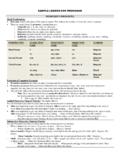
Transcription of Level Descriptors for Writing - GM SEN
1 Level Descriptors for Writing Name: _____ Date of first assessment: _____ Highlight criteria that are evident in the sample of Writing . Highlight box above in same colour, and date. EYFS LINKING SOUNDS AND LETTERS Writing HANDWRITING 22 - 36 months - Distinguish between the different marks they make. - Begin to show some control in their use of tools and equipment. 30 - 50 months - Sometimes give meaning to marks as they draw and paint. - Ascribe meaning to marks that they see in different places. - Draw lines and circles using gross motor movements.
2 40 60 months - Hear and say the initial sound in words and know which letters represent some of the sounds. - Begin to break the flow of speech into words. - Use Writing as a means of recording and communicating. - Begin to use anticlockwise movement and retrace vertical lines. - Begin to form recognisable letters. Early Learning Goals - Hear and say sounds in words in the order in which they occur. - Link sounds to letters, naming and sounding the letters of the alphabet. - Use their phonic knowledge to write simple regular words and make phonetically plausible attempts at more complex words.
3 - Use their phonic knowledge to write simple regular words and make phonetically plausible attempts at more complex words. - Attempt Writing for different purposes, using features of different forms such as lists, stories and instructions. - Write their own names and other things such as labels and captions, and begin to form simple sentences, sometimes using punctuation. - Use a pencil and hold it effectively to form recognisable letters, most of which are correctly formed. Lev SENTENCE STRUCTURE AND PUNCTUATION TEXT STRUCTURE AND ORGANISATION COMPOSITION AND EFFECT SPELLING HANDWRITING 1 Pupils' Writing communicates meaning through simple words and phrases.
4 In their reading or their Writing , pupils begin to show awareness of how full stops are used. Letters are usually clearly shaped and correctly orientated. 1C - Simple words and phrases are written. - Begin to be aware of how full stops are used in Writing or reading. - Punctuation may be used to mark the end of a line rather than a sentence. - Writing may need to be mediated to be understood. - Writing is orientated correctly, (top to bottom, left to right). - Begin to write in different forms; lists, captions, simple stories. - Recognisable letters and simple words and phrases are used to convey meaning - Produce ideas.
5 - Can segment adjacent consonants in words and apply this in spelling. - Letters have clear shape and orientation. 1B - Can compose a sentence orally and attempt to replicate it in Writing . - Some use of capital letters. - Writing begins to how an awareness of how full stops are used. - Some ideas may be linked by and . - Writing can generally be read without mediation. - Simple beginning, middle and end are becoming apparent. - Begin to use story language. - There may be some interesting and appropriate vocabulary linked to the context.
6 - Begin to use alternative ways of spelling phonemes, that the /ae/ sound can be spelt with ai , ay or a-e . - Know some words contain which spelling alternatives - Write most letters, correctly formed. Spacing may be irregular 1A - Can write a simple sentence that makes sense. - Uses full stops and capital letters more consistently. - Ideas are sequenced appropriately, with a beginning, middle and an end or instructions in the correct order. - Writing can be read without mediation. - Information labelled appropriately.
7 - Pupils use appropriate vocabulary, making choices between alternatives supplied, word banks. - Recognise and use alternative ways of spelling the phonemes. - Know words contain which spelling alternatives - Write most letters, correctly formed and orientated. - Write with spaces between words accurately 2 Pupils' Writing communicates meaning in both narrative and non narrative forms, using appropriate and interesting vocabulary, and showing some awareness of the reader. Ideas are developed in a sequence of sentences, sometimes demarcated by capital letters and full stops.
8 Simple, monosyllabic words are usually spelt correctly, and where there are inaccuracies the alternative is phonetically plausible. In handwriting, letters are accurately formed and consistent in size. 2C - Simple and compound sentences are used. - Some sentences demarcated with capital letters and full stops. - Some evidence of the use of other punctuation. - Writing begins to show characteristics of chosen form based on the structure of known texts. - Write chronological and non-chronological texts using simple structures. - Consider and select from alternative word choices related to the subject matter.
9 - Words chosen for effect. - Recognise and use alternative ways of spelling the phonemes. - Know words contain which spelling alternatives - Write with spaces between words accurately 2B - Uses a range of connectives to make a compound sentence and, but because. - Full stops and capital letters and questions marks are used more consistently. - Organisation reflects the purpose of the Writing , Instructions. - Some use of basic layout conventions are used. - Use connectives that signal time, then, after, before, meanwhile. - Variation in word choices, some of which is ambitious.
10 - Detail is used to engage the reader. - Spell with increasing accuracy and confidence, drawing on word recognition and knowledge of word structure, and spelling patterns - Write legibly, using upper and lower case letters appropriately within words, and observing - correct spacing within and between words 2A - Begins to use subordination, If, so, while, though and since. - Use of question marks, and commas to separate items in a list. - Use appropriate language and structures for the text-form.