Transcription of Levothyroxinum natricum - uspbpep.com
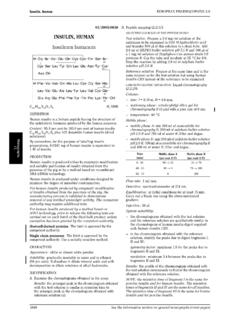
1 EUROPEAN PHARMACOPOEIA sodiumD. 13-ethyl-18,19-dinor-17 -pregn-4-en-20-yn-17-ol, ,R2=C CH: 13-ethyl-3,4-diethynyl-18,19-dinor-17 -pregn-5-en-20-yn-3 ,4 ,17-triol,F. R1=C CH, R2 = OH: 13-ethyl-3,4-diethynyl-18,19-dinor-17 -pregn-5-en-20-yn-3 ,4 , :0401corrected SODIUML evothyroxinum natricumC15H10I4 NNaO4,xH2 OMr799 (anhydrous substance)[55-03-8]DEFINITIONL evothyroxine sodium contains not less than per centand not more than the equivalent of per cent ofsodium (2S)-2-amino-3-[4-(4-hydroxy-3,5-diiodop henoxy)-3,5-diiodophenyl]propanoate, calculated with reference to thedried substance. It contains a variable amount of almost white or slightly brownish-yellow powder, ora fine, crystalline powder, very slightly soluble in water,slightly soluble in ethanol (96 per cent). It dissolves in dilutesolutions of alkali identification: A, B, :A,C,D, It complies with the test for specific optical rotation (seeTests).
2 B. Examine by infrared absorption spectrophotometry( ), comparing with the spectrum obtained withlevothyroxine sodium Examine by thin-layer chromatography ( ), usingsilica gel G Ras the coating in a mixture of 5 volumes ofconcentratedammonia Rand 70 volumes ofmethanol Rand dilute to5 ml with the same mixture of solution (a). Dissolve 5 mg oflevothyroxinesodium CRSin a mixture of 5 volumes ofconcentratedammonia Rand 70 volumes ofmethanol Rand dilute to5 ml with the same mixture of solution (b). Dissolve 5 mg ofliothyroninesodium CRSin a mixture of 5 volumes ofconcentratedammonia Rand 70 volumes ofmethanol Rand dilute to5 ml with the same mixture of solvents. Mix 1 ml of thissolution and 1 ml of the test separately to the plate 5 l of each solution. Developoverapathof15cmusingamixtureof20v olumesofconcentrated ammonia R,35volumesof2-propanol Rand 55 volumes ofethyl acetate R. Allow the plate todry in air and spray withninhydrin solution C until the spots appear.
3 Examine in principal spot in the chromatogram obtained withthe test solution is similar in position, colour and size tothe principal spot in the chromatogram obtained withreference solution (a). The test is not valid unless thechromatogram obtained with reference solution (b) shows2 clearly separated acid Rand heat. Violet vapour is To 200 mg add 2 ml ofdilute sulphuric acid a water-bath and then carefully over a naked flame,increasing the temperature gradually up to about600 50 C. Continue the ignition until most of the R. The solution gives reaction (a) of sodium ( ).TESTSS olution S. Dissolve g in 23 ml of a gently boilingmixture of 1 volume of1 M hydrochloric acidand 4 volumesofethanol (96 per cent) of solution. Freshly prepared solution S is notmore intensely coloured than reference solution BY3( ,Method II).Specific optical rotation( ): + 16 to + 20, determinedon solution S and calculated with reference to the and other related obtained in the assay.
4 In the chromatogramobtained with test solution (a), the area of any peak due toliothyronine is not greater than that of the principal peakin the chromatogram obtained with reference solution (b)( per cent) and the sum of the areas of all the peaks apartfrom the principal peak and any peak due to liothyronineis not greater than the area of the principal peak in thechromatogram obtained with reference solution (a) ( percent). Disregard any peak with an area less than that ofthe peak in the chromatogram obtained with referencesolution (d).Loss on drying( ): per cent to per cent,determined on g by drying in an oven at 105 by liquid chromatography ( ).Protect thesolutions from light throughout the (1)applytoallmonographsandothertexts2267 LidocaineEUROPEAN PHARMACOPOEIA solution (a). Dissolve mg of the substance to beexamined inmethanolic sodium hydroxide solution Randdilute to ml with the same solution (b).
5 Dilute ml of test solution (a) to 200 mlwithmethanolic sodium hydroxide solution solution (a). CRSinmethanolic sodium hydroxide solution Rand dilute to ml with the same solvent. Dilute ml ofthis solution to 200 ml withmethanolic sodium hydroxidesolution solution (b).Dissolve5mgofliothyroninesodium CRSinmethanolic sodium hydroxide solution Rand dilute to ml with the same solvent. Dilute mlof the solution to 50 ml withmethanolic sodium hydroxidesolution R. Dilute ml of this solution to 100 ml withmethanolic sodium hydroxide solution solution (c). Mix equal volumes of referencesolution (a) and reference solution (b).Reference solution (d). Dilute 1 ml of reference solution (a)to 10 ml withmethanolic sodium hydroxide solution chromatographic procedure may be carried out using: a column m long and 4 mm in internal diameterpacked withnitrile silica gel for chromatography R(5-10 m); asmobilephaseataflowrateof1ml/minamixtur eof 1 volume ofphosphoric acid R, 300 volumes ofacetonitrile Rand 700 volumes ofwater R; as detector a spectrophotometer set at 225 nm; a loop separately 50 l of each solution.
6 Continue thechromatography for times the retention time of theprincipal peak. The assay is not valid unless the resolutionbetween the peaks due to levothyroxine and liothyronine inthe chromatogram obtained with reference solution (c) is atleast 4 and the principal peak in the chromatogram obtainedwith reference solution (d) has a signal-to-noise ratio of atleast the percentage content of C15H10I4 NNaO4from thedeclared content oflevothyroxine sodium an airtight container, protected from light, at atemperature of 2 C to 8 [137-58-6]DEFINITION2-(Diethylamino)-N-( 2,6-dimethylphenyl) : per cent to per cent (anhydroussubstance).CHARACTERSA ppearance: white or almost white, crystalline : practically insoluble in water, very soluble inethanol (96 per cent) and in methylene identification: A, :A,C,D, Melting point ( ): 66 C to 70 C, determinedwithout previous Infrared absorption spectrophotometry ( ).
7 Comparison:lidocaine Dissolve g in a mixture of ml ofdilutehydrochloric acid Rand 10 ml ofwater Rwith warmingand add 10 ml ofpicric acid solution R. The precipitate,washed withwater Rand dried, melts ( )atabout230 C, with To about 5 mg add ml offuming nitric acid to dryness on a water-bath, cool and dissolvethe residue in 5 ml ofacetone hydroxide solution R. A green colour Dissolve about g in 1 ml ofethanol (96 per cent) nitrate bluish-green precipitate is of ( )andcolourless ( , Method II).Dissolve g in 3 ml ofdilute hydrochloric acid Randdilute to 10 ml withwater ,6- g inmethanol Rand dilute to 10 ml with thesame solvent. To 2 ml of the solution add 1 ml of a freshlyprepared 10 g/l solution ofdimethylaminobenzaldehyde Rinmethanol Rand 2 ml ofglacial acetic acid Rand allowto stand for 10 min. Any yellow colour in the solution isnot more intense than that in a standard prepared at thesame time and in the same manner using 2 ml of a mg/lsolution of2,6-dimethylaniline Rinmethanol ( ): maximum 35 g in a mixture of 3 ml ofdilute nitric acid Rand 12 ml ofwater ( ): maximum per g in 5 ml ofethanol (96 per cent) Rand diluteto 20 ml withdistilled water metals( ): maximum 20 g complies with test C.
8 Prepare the reference solutionusing 2 ml oflead standard solution (10 ppm Pb) ( ): maximum per cent, determined ash( ): maximum per cent, determinedon g add 50 ml ofanhydrous acetic acid Rand stiruntil dissolution is complete. Titrate M perchloricacid, determining the end-point potentiometrically ( ). M perchloric acidis equivalent to mgof the information section on general monographs (cover pages)