Transcription of Lithium Battery Guidance Document
1 APCS/Cargo Page 1 15/12/2014 Lithium Battery Guidance Document Transport of Lithium Metal and Lithium Ion Batteries Revised for the 2015 Regulations, Rev 1 Introduction This Document is based on the provisions set out in the 2015-2016 Edition of the ICAO Technical Instruction for the Safe Transport of Dangerous Goods by Air and the 56th Edition of the IATA Dangerous Goods Regulations (DGR). The purpose of this Document is to provide Guidance for complying with provisions applicable to the transport by air of Lithium batteries as set out in the DGR. Specifically the Document provides information on: Definitions; Classification (including classification flowcharts); Transport Conditions Exceptions; Special Provisions; Prohibitions; Passenger Provisions; and Frequently Asked Questions IATA Lithium Battery Guidance Document - 2014 APCS/Cargo Page 2 15/12/2014 Definitions Lithium Battery The term Lithium Battery refers to a family of batteries with different chemistries, comprising many types of cathodes and electrolytes.
2 For the purposes of the DGR they are separated into: Lithium metal batteries. Are generally primary (non-rechargeable) batteries that have Lithium metal or Lithium compounds as an anode. Lithium metal batteries are generally used to power devices such as watches, calculators, cameras, temperature data loggers. Note: As of 1 January 2015 Lithium metal batteries packed by themselves (not contained in or packed with equipment) are forbidden for transport as cargo on passenger aircraft). Figure 1 - Example of Lithium Metal Batteries Lithium -ion batteries (sometimes abbreviated Li-ion batteries) are a type of secondary (rechargeable) Battery commonly used in consumer electronics. Also included within the category of Lithium -ion batteries are Lithium polymer batteries. Lithium -ion batteries are generally found in mobile telephones, laptop computers, etc.
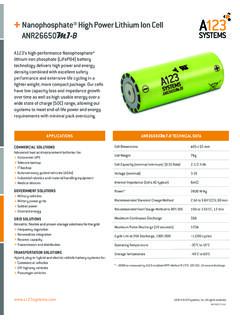
3 Figure 2 - Example of a Lithium Ion Battery The technical definition of a Battery and cell, as indicated in the UN Manual of Tests and Criteria, is as follows: IATA Lithium Battery Guidance Document - 2014 APCS/Cargo Page 3 15/12/2014 Battery means two or more cells which are electrically connected together and fitted with devices necessary for use, for example, case, terminals, marking and protective devices. A single cell Lithium Battery is considered a "cell" and must be tested according to the testing requirements for "cells" for the purposes of these Regulations and the provisions of subsection of the UN Manual of Tests and Criteria (see also the definition for "cell"). Note: Units that are commonly referred to as Battery packs , modules or Battery assemblies having the primary function of providing a source of power to another piece of equipment are for the purposes of these Regulations and the provisions of Subsection of the UN Manual of Tests and Criteria treated as batteries.
4 Cell means a single encased electrochemical unit (one positive and one negative electrode) which exhibits a voltage differential across its two terminals. Under these Regulations and the UN Manual of Tests and Criteria, to the extent the encased electrochemical unit meets the definition of cell herein, it is a cell , not a Battery , regardless of whether the unit is termed a Battery or a single cell Battery outside of these Regulations and the UN Manual of Tests and Criteria Button cell or Battery means a round small cell or Battery when the overall height is less than the diameter. Classification (DGR ) Lithium batteries are classified in Class 9 Miscellaneous dangerous goods as: UN 3090, Lithium metal batteries; and UN 3480, Lithium ion batteries or, if inside a piece of equipment or packed separately with a piece of equipment as: UN 3091, Lithium metal batteries contained in equipment; or UN 3091, Lithium metal batteries packed with equipment; and UN 3481, Lithium ion batteries contained in equipment; or UN 3481, Lithium ion batteries packed with equipment.
5 In the absence of exceptions, these batteries must be shipped in quantities that comply with the limitations contained in the DGR (see DGR Table and the applicable packing instruction). They must be contained in a UN specification packaging as prescribed by the applicable packing instruction in the DGR. A completed package must display a Class 9 hazard label in addition to markings that identify the applicable proper shipping name and UN number. A shipper must Document the shipment using a Shipper s Declaration for Dangerous Goods. Beginning 1 Jan 2013 the classification criteria for Lithium batteries stipulates that cells and batteries must be manufactured under a quality management program. DGR (LBSG ) includes the elements that must be included in such a program. IATA Lithium Battery Guidance Document - 2014 APCS/Cargo Page 4 15/12/2014 Transport Conditions The following information is a summary of the conditions that apply to various sizes of batteries for air transport.
6 More details on the exceptions are found in the next section of this Document . 1. Section I / IA Packing Instructions 965 970 Lithium ion and Lithium metal cells and batteries (PI 965 & PI 968, Section IA and PI 966, PI 967, PI 969 & PI 970, Section I) are subject to all of the applicable requirements in the DGR. These requirements are as follows: (a) dangerous goods training (DGR ); (b) limitations on consolidations (DGR and ); (c) classification (DGR ); (d) limits on the net quantity of Lithium batteries per package (DGR and applicable packing instruction); (e) UN specification packaging (applicable packing instruction, see also DGR Section 6); Note: UN specification packaging does not apply to PI 967 and PI 970. (f) marking and labelling of packages (DGR Section 7) Note: packages must not bear the Lithium Battery handling label.
7 , Packages must only bear the Class 9 hazard label and Cargo Aircraft Only label, when applicable. If packages are assembled into an overpack the requirements for overpacks in DGR and apply; (g) Shipper s Declaration for Dangerous Goods (DGR Section 8); 2. Section IB - Packing Instructions 965 & 968 Lithium ion and Lithium metal cells and batteries that meet the Watt-hour or Lithium content limits set out in Section II of PI 965 and PI 968 respectively, but that exceed the weight or quantity limits set out in Table 956-II or Table 968-II are subject to all of the applicable requirements in the DGR except for the requirements for UN specification packagings. The requirements applicable are as follows: (a) dangerous goods training (DGR ); (b) limitations on consolidations for Lithium metal batteries (DGR and ); (c) classification (DGR ); (d) limits on the total weight per package (applicable packing instruction); (e) strong outer packagings (see Section IB of applicable packing instruction); (f) marking and labelling of packages (DGR Section 7) Note: packages must bear both the Lithium Battery handling label and the Class 9 hazard label and Cargo Aircraft Only label, when applicable.
8 If packages are assembled into an overpack the requirements for overpacks in DGR and apply; (g) Shipper s Declaration for Dangerous Goods (Section IB of PI 965 or PI 968); Note 1: IB must be added to the DGD following the packing instruction number. This can be done either with the PI number, 965 IB, or as IATA Lithium Battery Guidance Document - 2014 APCS/Cargo Page 5 15/12/2014 shown in Dangerous Goods Regulations Figure , in the authorisations column. Refer to Section 8 of the IATA Dangerous Goods Regulations for full details. Note 2: if packages of Section IB are consolidated with other cargo, the provisions of DGR and apply. If packages are assembled into an overpack the requirements for overpacks in DGR , Step 7 apply. 3. Section II - Packing Instructions 965 970 Small Lithium ion and Lithium metal cells and batteries that meet the Watt-hour or Lithium content limits set out in Section II of PI 965 to PI 970 are only subject to certain parts of the DGR when shipped as cargo.
9 The bulk of the requirements for these small Lithium batteries are contained within the General Requirements at the start of each packing instruction which apply to all Lithium batteries and then the specific requirements set out in Section II of each packing instruction, which are as follows: (a) classification (DGR ); (b) limitations on consolidations for Lithium metal batteries in PI968 only (DGR and ); (c) limits on the quantity of Lithium cells or batteries per package (Table II of the applicable packing instruction); (d) strong outer packagings (see Section II of applicable packing instruction); (e) marking and labelling of packages (Additional Requirements of Section II of the applicable packing instruction); (f) the details of the consignment must be described (Additional Requirements of Section II of the applicable packing instruction).
10 Exceptions Small Lithium metal and Lithium ion batteries are not subject to all of the provisions of the DGR provided that they comply with all of the requirements set out in Section II of Packing Instructions 965, 966 and 967 for Lithium ion batteries and Section II of Packing Instructions 968, 969 and 970 for Lithium metal batteries in the 56th Edition of the IATA DGR. Packages containing Lithium batteries, or Lithium batteries contained in, or packed with, equipment that meet the provisions of Section II of these packing instructions are not required to have a Class 9 hazard label and there is no requirement for a Shipper s Declaration for Dangerous Goods for consignments of these batteries. However, in the event of an incident involving these batteries, the incident reporting requirements apply. Note: Only batteries that have successfully passed the test procedures of Part III, Sub-Section of the UN Manual of Tests and Criteria qualify under this exception.