Example: barber
LOGNORMAL MODEL FOR STOCK PRICES
the Central Limit Theorem, under mild additional conditions—for example, if logX 1 has finite variance, then logX 1 must have a normal distribution. Therefore, it is reasonable to hypothesize that the X k are lognormal, and we may write X k Dexp.˙Z k C /, where the Z k are IID standard normal. The first issue is the estimation of the ...
Tags:
Information
Domain:
Source:
Link to this page:
Documents from same domain

Normal Distribution Calculations Using Technology
www.math.ucsd.eduNormal Distribution Calculations Using Technology All of the calculations that we will do in Math 180A involving the normal distribution can be done using tables.

20D - Homework Assignment 5 - UCSD …
www.math.ucsd.eduBrian Bowers (TA for Hui Sun) MATH 20D Homework Assignment 5 November 8, 2013 20D - Homework Assignment 5 First, I present the list of all matrix row operations.
Basic Algebra Rules - UCSD Mathematics
www.math.ucsd.eduBasic Algebra Rules 1. Fractions. Let a,b,c, and d be numbers. (a) You can break up a fraction from a sum in the numerator, but not in the denom-

Proof of the Binomial Theorem 12.3 - UCSD …
www.math.ucsd.eduProof of the Binomial Theorem 12.3.1 The Binomial Theorem says that: For all real numbers a and b and non-negative integers n, (a+ b)n = Xn r=0 n r arbn r: For example,

MATH 120A COMPLEX VARIABLES NOTES: REVISED …
www.math.ucsd.eduMATH 120A COMPLEX VARIABLES NOTES: REVISED December 3, 2003 3 Remark 1.4 (Not Done in Class). Here is a way to understand some of the basic properties of C …
First Order Linear Differential Equations - UCSD Mathematics
www.math.ucsd.eduFirst Order Linear Differential Equations A first order ordinary differential equation is linear if it can be written in the form y′ + p(t) y = g(t) where p and g are arbitrary functions of t. ... y| = e (2 t + C ) = e C e 2t = C 1 e 2t Where C 1 = e C is an arbitrary, but always positive constant.

The Fundamental Theorem of Galois Theory
www.math.ucsd.eduThe Fundamental Theorem of Galois Theory Theorem 12.1 (The Fundamental Theorem of Galois Theory). Let L=Kbe a nite Galois extension. Then there is an inclusion reversing bijection between the subgroups of the Galois group Gal(L=K) and in-termediary sub elds L=M=K.
Honors Vector Calculus Syllabus (revised September 2016)
www.math.ucsd.eduThe Math 31H Honors Calculus sequence is a rigorous treatment of multivariable calculus, including linear algebra and di erential forms, for a self-selected population of students who have scored a 5 on

Math 280 (Probability Theory) Lecture Notes
www.math.ucsd.edu• Look at the following Exercise from the Lecture Notes: 19.4. • Hand in the following Exercises from the Lecture Notes: 19.3. • Resnick Chapter 10: Hand in 15, 28, and 33.

Math 280 (Probability Theory) Lecture Notes
www.math.ucsd.eduBruce K. Driver Math 280 (Probability Theory) Lecture Notes April 4, 2007 File:prob.tex
Related documents
Calculus: 3 ~ Limit Theorems - Math - The University of Utah
www.math.utah.eduLimit Theorems is a positive integer. is a real number have limits as x → c. 3B Limit Theorems 3 EX 1 EX 2 EX 3 If find. 3B Limit Theorems 4 Substitution Theorem If f(x) is a polynomial or a rational function, then assuming f(c) is defined. Ex 4 Ex 5. 3B Limit Theorems 5 EX 6 H i n t: raolz eh um . 3B Limit Theorems 6 f(x)=x2
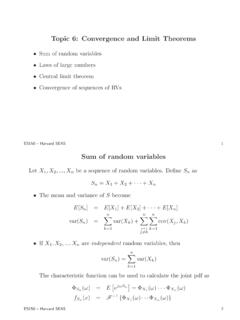
Topic 6: Convergence and Limit Theorems
www.ece.tufts.eduTopic 6: Convergence and Limit Theorems ... – This is the Central Limit Theorem (CLT) and is widely used in EE. ES150 – Harvard SEAS 7 • Examples: 1. Suppose that cell-phone call durations are iid RVs with μ = 8 and σ = 2 (minutes). – Estimate the probability of 100 calls taking over 840 minutes.

3.2 Limits and Continuity of Functions of Two or More ...
ksuweb.kennesaw.edulimit rules and theorems. We will see that these rules and theorems are similar to those used with functions of one variable. We present them without proof, and illustrate them with examples. = 2 2 2 2 = 1 = 3 p. = = =. = ). =. and + + + ...

AP Calculus AB Exam Review Limits and Continuity MULTIPLE ...
rancho-hs.enschool.orgAug 26, 2016 · Determine the limit by substitution. 2) lim x→4 x2 + 14x + 49 A)121 B)Does not exist C)± 11 D)11 2) Determine the limit algebraically, if it exists. 3) lim x→0 ... Indicate which theorems are needed and which functions are assumed to be continuous for all …
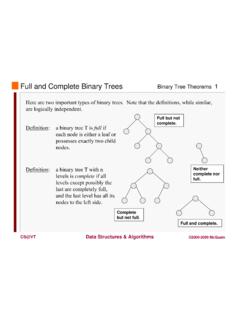
Full and Complete Binary Trees Binary Tree Theorems 1
courses.cs.vt.eduBinary Tree Theorems 4 CS@VT Data Structures & Algorithms ©2000-2009 McQuain Limit on the Number of Leaves Theorem: Let T be a binary tree with levels. Then the number of leaves is at most 2 -1. proof: We will use strong induction on the number of levels, .

Probability Theory: STAT310/MATH230;August 27, 2013
web.stanford.edutheorems and their application to the construction of Lebesgue measure. 1.1.1. The probability space (Ω,F, P). We use 2Ω to denote the set of all possible subsets of Ω. The event space is thus a subset F of 2Ω, consisting of all allowed events, that is, those subsets of Ω to which we shall assign probabilities.

Lecture 16 :The Mean Value Theorem Rolle’s Theorem
www3.nd.eduat 50 mph. Can we prove that the car was breaking the speed limit (75 m.p.h.) at some point along the road? We can also use this theorem to make inferences about the growth of a function from knowledge about its derivative: Example If f(0) = 1, f0(x) exists for all values of x and f0(x) 4 for all x, how large can f(2) possibly be?
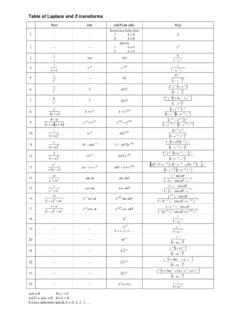
Table of Laplace and Z-transforms
control.dii.unisi.itTable of Laplace and Z-transforms X(s) x(t) x(kT) or x(k) X(z) 1. – – Kronecker delta δ0(k) 1 k = 0 0 k ≠ 0 1 2. – – δ0(n-k) 1 n = k 0 n ≠ k z-k 3. s 1 1(t) 1(k) 1 1 1 −z− 4. s +a 1 e-at e-akT 1 1 1 −e−aT z− 5. 2 1 s t kT ()2 1 1 1 − − −z Tz 6. 3 2 s t2 (kT)2 ()1 3 2 1 1