Transcription of Low-pass Filter
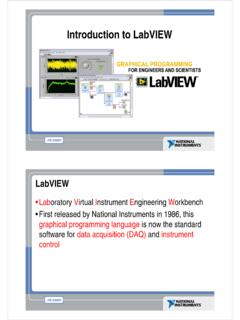
1 Low-pass FilterHans-Petter Introduction to Filters Overview of different Filters What is a Low-pass Filter ? Why do we need a Lowpass Filter ? Using a built-in Lowpass Filter in labview Create your own Lowpass Filter from scratchFilters A Filters are typically used in frequency response analysis A Filter is used to remove given frequencies or an interval of frequencies from a signal. Such an application would typically be to remove noise from a signal. The most common is the low pass Filter . We have 4 types of Filter : Low-pass Filter High-pass Filter Band-pass Filter Band-stop FilterFiltersLow-pass FilterHigh frequencies (above !") are removed (or attenuated)#$=1'$+1=11!"$+1 Low-pass Filter in LabVIEWLow-pass Filter In Measurement systems and Control Systems we typically need to deal with noise Noise is something we typically don t want Noise is high-frequency signals Low-pass Filters are used to remove noise from the measured signalsHigh-pass FilterLow frequencies (below !)
2 ") are removed (or attenuated)#$=&$&$+1=1!)$1!)$+1 High-pass Filter in LabVIEWBand-pass FilterandHigh frequencies (above !") are removed (or attenuated)Low frequencies (below !#) are removed (or attenuated)Band-pass Filter in LabVIEWBand-stop FilterFrequencies between !"and !#are removedBand-stop Filter in LabVIEWU sing a built-in Low-pass Filter in LabVIEWHans-Petter a Low-pass Filter to reduce NoiseFunctions palette: Express -> Signal Analysis -> Simulate SignalFunctions palette: Express -> Signal Analysis -> FilterHere we use one of the built-in ( Low-pass ) FiltersPropertiesUsing a Low-pass Filter to reduce NoiseUsing a Low-pass Filter to reduce NoiseWe see the noise from the signal has been reducedCreate your own Low-pass Filter from scratchHans-Petter Filter !"=$(")'(")=1)*"+1A Low-pass Filter has the following Transfer Function: In labview we can implement a Low-pass Filter in many we want to implement the Low-pass Filter in a text-based programming or using , the Formula Node in labview we typically need to find a discrete version of the Filter .
3 !"'(")$(")InputOutputLow-pass Filter !"=$(")'(")=1)*"+1A Low-pass Filter has the following Transfer Function We can find the Differential Equation for this Filter using Inverse LaplaceWeget:$")*"+1='")*$""+$"='"Finall y we get the following differential equation:)* $+$='We apply Euler on the Differential Equation in order to find the Discrete Differential equationDiscretization of Low-pass FilterWe have the following differential equation:!" $+$='We use Euler Backward method: ( *+,*+, we get:!"$0 $0 1!3+$0='0 This gives:$0=. $0 1+./. '0We define:!3!"+!3 7 This finally gives:$0=1 7$0 1+7'0 This equation can easily be implemented in labview or another programming languageDiscrete Low-pass Filter ExampleWe use the Euler Backward method:Inverse Laplace the differential Equation:This gives:Lowpass Filter Transfer function:We define:This gives:This algorithm can be easly implemented in a Programming languageFilter outputNoisy input signalLow-pass Filter /Measurement Filter -ExampleTesting the FilterIn this example we add noise to a Sine function.
4 We then use the Measurement Filter to see if we can remove the noise you can see this gives good results. The Filter removes the noise from the HalvorsenUniversity of South-Eastern.