Transcription of LTE eNodeB startup and UE setup (summary)
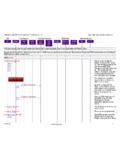
1 Summary: eNodeB startup and RRC Connection UE1 eNodeB MME LTE eNodeB startup and UE setup (summary) This sequence diagram describes how an eNodeB performs an S1 setup with the EPC and then initiates MIB and SIB broadcast to the flow also shows how the eNodeB sends UE specific configuration information via the RRC Connection setup message. Click on message names in the sequence diagram to see field level details for individual messages. 1:S1AP S1 setup RequesteNodeB initiates an S1 connection with the MME. 2:S1AP S1 setup ResponseThe MME accepts the S1 connection 3:BCCH-BCH: MIBM aster Information Block carries PHY related information about the LTEcell.
2 This information is essential for further decoding of the systeminformation. 4:BCCH-DL-SCH: SIB1 System Information Block Type 1 contains information relevant whenevaluating if a UE can access a cell and defines the scheduling of othersystem information. 5:BCCH-DL-SCH: SIB2 The IE System Information Block Type 2 contains radio resourceconfiguration information that is common for all UEs. 6:BCCH-DL-SCH: SIB3 The IE System Information Block Type 3 contains cell re-selectioninformation common for intra-frequency, inter- frequency and/ orinter-RAT cell re-selection ( applicable for more than one type of cellre-selection but not necessarily all) as well as intra-frequency cellre-selection information other than neighboring cell related.
3 7:BCCH-DL-SCH: SIB4 The IE System Information Block Type 4 contains neighboring cellrelated information relevant only for intra-frequency cell IE includes cells with specific re-selection parameters as well asblacklisted cells. 8:BCCH-DL-SCH: SIB5 The IE System Information Block Type 5 contains information relevantonly for inter-frequency cell re-selection information about otherE-UTRA frequencies and inter-frequency neighboring cells relevant forcell re-selection. The IE includes cell re-selection parameters commonfor a frequency as well as cell specific re-selection parameters. 9:BCCH-DL-SCH: SIB6 The IE System Information Block Type 6 contains information relevantonly for inter-RAT cell re-selection information about UTRA frequencies and UTRA neighboring cells relevant for cell IE includes cell re-selection parameters common for a frequency.
4 10:BCCH-DL-SCH: SIB7 The IE System Information Block Type 7 contains information relevantonly for inter-RAT cell re-selection information about GERAN frequencies relevant for cell re-selection. The IE includes cellre-selection parameters for each frequency. 11:BCCH-DL-SCH: SIB8 The IE System Information Block Type 8 contains information relevantonly for inter-RAT cell re-selection information about CDMA2000frequencies and CDMA2000 neighboring cells relevant for cellre-selection. The IE includes cell re-selection parameters common for afrequency as well as cell specific re-selection parameters. 12:BCCH-DL-SCH: SIB9 The IE SystemInformationBlockType9 contains a home eNB name (HNBName).
5 Random Access Procedure (click to learn more) UE and eNodeB perform the random-access procedure to synchronizethe UT and assign resources for transmission of the RRC connectionsetup message. 13:UL-CCCH: RRC Connection RequestUE uses the uplink grant assigned in the random access procedure torequest the eNodeB to establish an RRC connection. 14:DL-CCCH: RRC Connection SetupThe eNodeB sets up SRB1 and passes UE specific configuration via theRRC Connection setup message. Attach and DRB setup (click to learn more) The UE then proceed to attach and setup the default bearer. 128-May-17(c) : eNodeB startup and RRC Connection UE1 eNodeB MME LTE eNodeB startup and UE setup (detailed) We will now analyze the complete flow with field level detail.
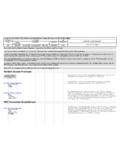
6 Important parameters in each message are explained. You can also click on themessage titles to see the complete structure of the messages. 1:S1AP S1 setup RequesteNodeB initiates an S1 connection with the MME. Global-eNB-ID: Global eNodeB identifier S1AP PLMN ID PLMN id associated with the eNodeB MCC Mobile country code MNC Mobile network code eNodeB Id eNodeB id within the networkSupported Tracking Areas: List of supported tracking areas in the eNodeB Tracking Area [0] Tracking Area Code Code assigned to the tracking area Broadcast PLMNs.
7 List of PLMNs being broadcast from this eNodeB { PLMN Id1, MCC, MNC } { PLMN Id2, MCC, MNC } DefaultPagingDRX The default paging discontinuous transmission configuration2:S1AP S1 setup ResponseThe MME accepts the S1 connection Served GUMMEIs List of served GUMMEIs (One entry for each Radio AccessTechnology) Served GUMMEI 0 LTE pool information is listed as the first entry Served PLMN { PLMN Id, MCC, MNC } PLMN being served Served Group Id MME Group identifier Served MMECs MME codes belonging to this group MME Code Identifies individual MMEs within the groupRelative MME Capacity Relative processing capacity of an MME with respect to the other MMEs in the :BCCH-BCH: MIBM aster Information Block carries PHY related information about the LTEcell.
8 This information is essential for further decoding of the systeminformation. Master Information Block (MIB): Downlink Bandwidth Downlink bandwidth for the cell PHICH Configuration: PHICH Duration Normal or extended PHICH PHICH Resource PHICH group value (Ng) System Frame Number Used to frame synchronize the UE scheduling Information for SIB1 BR R13 (PDSCH repetitions)4:BCCH-DL-SCH: SIB1 System Information Block Type 1 contains information relevant whenevaluating if a UE can access a cell and defines the scheduling of othersystem information.
9 System Information Block 1 (SIB): Cell Access Related Information: PLMN Identity List List of PLMNs supported by this cell { PLMN Id1, MCC, MNC } PLMN identifier, Mobile country code and network codes { PLMN Id2, MCC, MNC } Tracking Area Code Cell Barred Flag Cell Selection Information: q_RxLevMin Minimum Required Signal Quality in the Cell q_RxLevMinOffset Adjustment applied to the minimum required signal quality in the search for a higher priority PLMN when the UT is camped on a VPLMN (Visited PLMN).
10 P-Max Maximum UT power permitted in the cell SI scheduling Information List Specifies the periodicity of SIB elements Item 0: SI Periodicity: rf16 (16 frames) Mapping Information: {SIB3, SIB4} Item 1: SI Periodicity: rf32 (32 frames) Mapping Information: {SIB5} Item 2: SI Periodicity: rf64 (64 frames) Mapping Information: {SIB6, SIB7, SIB8, SIB9}228-May-17(c) : eNodeB startup and RRC Connection UE1 eNodeB MME SI Window length: 5ms Window for transmission of an SI message. Only one message and its repetitions may be sent in an SI :BCCH-DL-SCH: SIB2 The IE System Information Block Type 2 contains radio resourceconfiguration information that is common for all UEs.