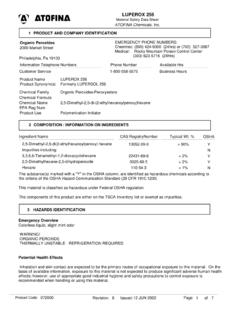
Transcription of LUPEROX HP101XLP Material Safety Data Sheet
1 1 Page of Product Code:796000 Revision: 702 JAN 2007 Issued:8 Material Safety data SheetPRODUCT AND COMPANY IDENTIFICATION1 EMERGENCY PHONE NUMBERS:Chemtrec: (800) 424-9300 (24hrs) or (703) 527-3887 Medical: Rocky Mountain Poison Control Center (866) 767-5089 (24 Hrs) Customer Service NumberInformation Telephone Numbers(800) 331-7654 Phone Number8:00 AM - 5:00 PM ESTA vailable HrsIngredient NameCAS RegistryNumberTypical %OSHA 2 COMPOSITION / INFORMATION ON INGREDIENTSThe substance(s) marked with a "Y" in the OSHA column, are identified as hazardous chemicals according to thecriteria of the OSHA Hazard Communication Standard (29 CFR )The components of this product are either on the TSCA Inventory list or exempt as IDENTIFICATIONA rkema HP101 XLPE mergency OverviewPotential Health EffectsBrown powder, Menthol odor CAUTION!
2 ORGANIC PEROXIDE MAY CAUSE EYE AND SKIN IRRITATION. MAY CAUSE ALLERGIC SKIN REACTION. MAY CAUSE RESPIRATORY TRACT IRRITATION. Inhalation and skin contact are expected to be the primary routes of occupational exposure to this Material . Based on its composition, it is anticipated to be slightly to moderately irritating to the eyes, skin and respiratory tract. Inhalation ofFunctional Additives2000 Market Street21st FloorPhiladelphia, PA 19103-3222 LUPEROX HP101 XLPP roduct NameProduct Synonym(s) Organic Peroxide - DialkylChemical FamilyChemical FormulaEPA Reg NumPolymerization InitiatorProduct UseChemical Name44-45% By By By Wt.<or= 6% By By By ,5-Dimethyl-2,5-di(t-butylperoxy) hexaneSilica gelCalcium carbonateProprietary Inert Fillers3,3,6,6-Tetramethyl-1,2-dioxacycl ohexaneDi-tert-butyl peroxide78-63-7112926-00-8471-34-1 Proprietary22431-89-6110-05-4 This Material is classified as hazardous under Federal OSHA of Product Code:796000 Revision: 702 JAN 2007 Issued:8 Material Safety data Sheet4 FIRST AID MEASURESIF IN EYES, immediately flush with plenty of water.
3 Get medical attention if irritation ON SKIN, flush the area with plenty of water. Remove contaminated clothing and shoes. Wash clothing before reuse. Get medical attention if irritation develops and SWALLOWED, induce vomiting as directed by medical personnel. Get medical attention. NEVER GIVE ANYTHING BY MOUTH TO AN UNCONSCIOUS INHALED, remove to fresh air. If breathing is difficult, get medical attention. 5 FIRE FIGHTING MEASURESNEAuto-Ignition TemperatureNAFlash PointFlash Point MethodNEFlammable Limits- UpperNELowerExtinguishing MediaFire Fighting InstructionsFire and Explosion Hazards Use water spray, foam or dry chemical . Fight fire with large amounts of water from a safe distance. Use water spray to cool containers exposed to fire. Fire fighters and others who may be exposed to products of combustion should wear full fire fighting turn out gear (full Bunker Gear) and self-contained breathing apparatus (pressure demand NIOSH approved or equivalent).
4 Fire fighting equipment should be thoroughly decontaminated after use. After a fire, wait until the Material has cooled to room temperature before initiating clean up activities. Contact with incompatible materials or exposure to temperatures exceeding the SADT may result in a self accelerating decomposition reaction with release of flammable vapors which may autoignite. Arkema HP101 XLPFire and Explosive Propertiesdust may cause drying of mucous membranes of the eyes, nose and throat (due to absorption of moisture and oils) which may result in irritation and occasional nosebleeds. Repeated or prolonged exposure may cause an allergic skin RELEASE MEASURESHANDLING AND STORAGEIn Case of Spill or Leak Wet down (dampen) the spilled peroxide with water. Sweep or scoop up using non-sparking tools and placeinto a polyethylene bag for disposal.
5 The sweepings should be wetted down further with water. Dispose of immediately. After all of the Material has been collected, wash down the area with detergent and water. Consult a regulatory specialist to determine appropriate state or local reporting requirements, for assistance in waste characterization and/or hazardous waste disposal and other requirements listed in pertinent environmental permits. 3 Page of Product Code:796000 Revision: 702 JAN 2007 Issued:8 Material Safety data SheetArkema HP101 XLPC alcium carbonateSilica gelACGIH TWAOSHA TWA PELE xposure Limit--10 mg/m320 mppcf / mg/m3 ValueAirborne Exposure Guidelines for Ingredients 78 HANDLING AND STORAGEEXPOSURE CONTROLS / PERSONAL PROTECTIONH andlingStorageEngineering ControlsEye / Face ProtectionSkin ProtectionRespiratory Protection Contact with incompatible materials or exposure to temperatures exceeding SADT (See Section (9) may result in a self accelerating decomposition reaction with release of flammable vapors which may autoignite.)
6 Keep away from heat sparks and flame. Avoid contamination. Use only with adequate ventilation. Use explosion proof equipment. Keep container closed. Do not reuse container as it may retain hazardous product residue. Avoid creating dust in handling, transfer or clean-up. Avoid breathing dust. Wash thoroughly after handling. Store below 38 C/100 F to maintain stability and active oxygen content. Detached storage is preferred. Store out of direct sunlight in a cool well-ventilated place. Store away from combustibles and incompatible materials. Refer also to National Fire Protection Agency (NFPA) Code 432, Code for the Storage of Organic Peroxide Formulations. Investigate engineering techniques to reduce exposures below airborne exposure limits. Provide ventilation if necessary to control exposure levels below airborne exposure limits (see below).
7 If practical, use local mechanical exhaust ventilation at sources of air contamination such as open process equipment. Where there is potential for eye contact, wear chemical goggles and have eye flushing equipment available. Wear appropriate chemical resistant protective clothing and chemical resistant gloves to prevent skin contact. Consult glove manufacturer to determine appropriate type glove Material for given application. Rinse contaminated skin promptly. Wash contaminated clothing and clean protective equipment before reuse. Wash skin thoroughly after handling. Avoid breathing dust. When airborne exposure limits are exceeded (see below), use NIOSH approved respiratory protection equipment appropriate to the Material and/or its components. Consult respirator manufacturer to determine appropriate type equipment for given application.
8 Observe respirator use limitations specified by NIOSH or the manufacturer. For emergency and other conditions where exposure limit may be significantly exceeded, use an approved full face positive-pressure, self-contained breathing apparatus or positive-pressure airline with auxiliary self-contained air supply. Respiratory protection programs must comply with 29 CFR 4 Page of Product Code:796000 Revision: 702 JAN 2007 Issued:8 Material Safety data Sheet9 PHYSICAL AND chemical PROPERTIESA ppearance/OdorNEpHNES pecific GravityNEVapor PressureNAVapor DensityNEMelting PointNEFreezing PointNEBoiling PointInsolubleSolubility In Water82 C (est)SADTA ctive Oxygen Content = Physical DataThis Material is chemically unstable and should only be handled under specified conditions. See HANDLING AND STORAGE sectionof this MSDS for specified - Self Accelerating Decomposition Temperature.
9 Lowest temperature at which the tested package size will undergo a self-accelerating decomposition reaction. This reaction will generate flammable vapors which may autoignite. The length of time to generated a decomposition reaction, after the SADT has been reached or exceeded, is dependent upon how much the SADT has been exceeded and the length of time needed for the reaction exotherm (heat spike from increasing decomposition rate) to initiate a rapid decomposition reaction. Typically, SADT is inversely proportional to package size. Larger packages will have a lower SADT due to smaller ratio to heat transfer area to volume of AND REACTIVITYS tabilityHazardous Polymerization This Material is chemically unstable and should only be handled under specified conditions. See HANDLING AND STORAGE section of this MSDS for specified conditions.
10 Does not occur. 11 TOXICOLOGICAL INFORMATIONT oxicological Information data on this Material and/or its components are summarized below. Arkema HP101 XLPC ontact with foreign materials, such as, strong acids and strong oxidizers may result in a violent decomposition reaciton or in product at or above the SADT can result the release of hazardous decomposition products which are flammable and may Decomposition Products-Only those components with exposure limits are printed in this contact limits designated with a "Y" above have skin contact effect. Air sampling alone is insufficient to accurately quantitate exposure. Measures to prevent significant cutaneous absorption may be Sensitizer designator with a value of "Y" above means that exposure to this Material may cause allergic Sensitizer designator with a value of "Y" above means that exposure to this Material may cause allergic skin powder, Menthol odor5 Page of Product Code:796000 Revision: 702 JAN 2007 Issued:8 Material Safety data Sheet1112 TOXICOLOGICAL INFORMATIONECOLOGICAL INFORMATION 2,5-Dimethyl-2,5-di(t-butylperoxy) hexaneSingle exposure (acute) studies indicate that this Material is no more than slightly toxic if swallowed (rat LD50 >2,000 mg/kg), slightly toxic if absorbed through skin (rabbit LD50 4,100 mg/kg), slightly irritating to rabbit skin (4-hr exposure, ) and practically non-irritating to rabbit eyes ( ).