Transcription of MAGNESIUM STEARATE - uspbpep.com
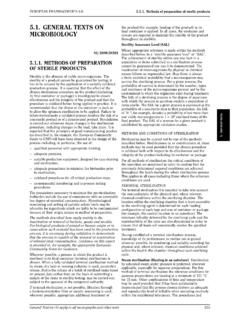
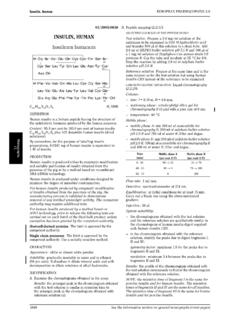
1 EUROPEAN PHARMACOPOEIA stearateColumn: size:l= , = , stationary phase:octadecylsilyl silica gel forchromatography R(5 m).Mobile phase: dissolve g ofsodium dihydrogenphosphate Rin 1000 ml ofwater Rand adjust to pH witha10percentV/Vsolution ofphosphoric acid : spectrophotometer at 210 : 10 l loop injector; inject the test solution andreference solutions (b), (c), (d) and (e).Run time: 4 times the retention time of pidolic times: pidolic acid = about min;impurity B = about suitability: reference solution (e): resolution: minimum 10 between the peaks due to pidolicacid and to impurity : impurity B: not more than the area of the principal peakin the chromatogram obtained with reference solution (b)( per cent), total of other impurities: not more than half of the areaof the principal peak in the chromatogram obtained withreference solution (b) ( per cent), disregard limit: not more than times the area ofthe principal peak in the chromatogram obtained withreference solution (c) ( per cent); disregard any peakcorresponding to the nitrate ion (NO3 ).
2 Impurity ( ).Test solution. Dissolve g of the substance to beexamined in 4 ml ofwater Rand dilute to ml withmethanol solution (a). Dissolve mg ofglutamic acid Rin 50 ml ofwater Rand dilute to ml withmethanol ml of the solution to ml withmethanol solution (b).Dissolve10mgofglutamic acid Rand 10 mg ofaspartic acid Rinwater Rand dilute to 25 :TLC silica gel plate phase:glacial acetic acid R,water R,butanol R(20:20:60V/V/V).Application:5 :over2 :spraywithninhydrin solution Rand heat at100-105 C for 15 suitability: the test is not valid unless thechromatogram obtained with reference solution (b) shows 2clearly separated : impurity A: any spot corresponding to impurity A in thechromatogram obtained with the test solution is not moreintense that the spot in the chromatogram obtained withreference solution (a) ( per cent).
3 Chlorides( ): maximum 500 ml of solution S to ml ofwater complies with the limit test for Examine the chromatogram obtained with the testsolution in the test for related : nitrates: not more than the area of the principal peak inthe chromatogram obtained with reference solution (d)(200 ppm).Sulphates( ): maximum per ml of solution S to ml withdistilled water solution complies with ( ): maximum 2 ml of solution S complies with limit test ( ): maximum 200 ml of solution S to 10 ml ofwater with the limit test for metals( ): maximum 20 ml of solution S complies with limit test A. Prepare thestandard usinglead standard solution (2 ppm Pb) ( ): maximum per cent, determined g in 50 ml ofwater titration of MAGNESIUM ( ). M sodium edetateis equivalent to mg of an airtight glutamic acid,B.
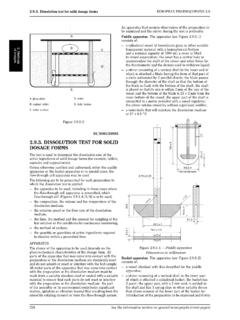
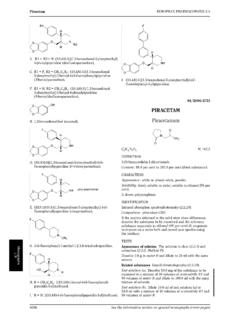
4 (2S)-2-[[[(2S)-5-oxopyrrolidin-2-yl]carb onyl]amino]pen-tanedioic :0229corrected STEARATEM agnesii stearasDEFINITIONM agnesium STEARATE is a mixture of MAGNESIUM saltsof different fatty acids consisting mainly of stearic(octadecanoic) acid [(C17H35 COO)2Mg; ] and palmitic(hexadecanoic) acid [(C15H31 COO)2Mg; ] with minorproportions of other fatty acids. It contains not less per cent and not more than per cent of Mg ( ),calculated with reference to the dried substance. The fattyacid fraction contains not less than per cent of stearicacid and the sum of stearic acid and palmitic acid is not lessthan per white or almost white, very fine, light powder, greasy tothe touch, practically insoluble in water and in identification: C, (1)applytoallmonographsandothertexts2323 MAGNESIUM stearateEUROPEAN PHARMACOPOEIA identification: A, B, The residue obtained in the preparation of solution S (seeTests) has a freezing point ( )notlowerthan53 ( )is195to210,determined on g of the residue obtained in thepreparation of solution S dissolved in 25 ml of theprescribed mixture of Examine the chromatograms obtained in the test for fattyacid composition.
5 The retention times of the principalpeaks in the chromatogram obtained with the testsolution are approximately the same as those of theprincipal peaks in the chromatogram obtained with thereference 1 ml of solution S gives the reaction of MAGNESIUM ( ).TESTSS olution ether R,20 ml ofdilute nitric acid Rand 20 ml ofdistilled water Rand heat under a reflux condenser until dissolution iscomplete. Allow to cool. In a separating funnel, separate theaqueous layer and shake the ether layer with 2 quantities,each of 4 ml, ofdistilled water ,washwith15mlofperoxide-free ether Rand diluteto 50 ml withdistilled water R(solution S). Evaporate theorganic layer to dryness and dry the residue at 100-105 the residue for identification tests A and or water Rand boil for 1 min with blue solution M hydrochloric M sodium hydroxideisrequired to change the colour of the ( ).
6 Ml of solution S diluted to 15 ml withwater Rcomplies with the limit test for chlorides ( percent).Sulphates( ). water Rcomplies with the limit test for sulphates( per cent).Cadmium. Not more than ppm of Cd, determined byatomic absorption spectrometry ( , Method II).Test a polytetrafluoroethylene digestion bomb and acid Rand5volumesofcadmium- and lead-free nitric acid at 170 C for 5 h. Allow to cool. Dissolve the residueinwater solutions. Prepare the reference solutions usingcadmium standard solution (10 ppm Cd) R,dilutedasnecessary with a 1 per centV/Vsolution ofhydrochloricacid the absorbance at nm, using a cadmiumhollow-cathode lamp as a source of radiation and a graphitefurnace as atomic Not more than ppm of Pb, determined by atomicabsorption spectrometry ( , Method II).Test solution. Use the solution described in the test solutions.
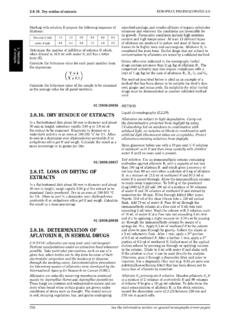
7 Prepare the reference solutions usinglead standard solution (10 ppm Pb) R, diluted as necessarywithwater the absorbance at nm, using a leadhollow-cathode lamp as a source of radiation and a graphitefurnace as atomic generator, depending on the Not more than ppm of Ni, determined by atomicabsorption spectrometry ( , Method II).Test solution. Use the solution described in the test solutions. Prepare the reference solutions usingnickel standard solution (10 ppm Ni) R,dilutedasnecessarywithwater the absorbance at nm, using a nickelhollow-cathode lamp as a source of radiation and a graphitefurnace as atomic on drying( ). Not more than per cent, contamination. Total viable aerobic count ( )not more than 103micro-organisms per gram, determinedby plate count. It complies with the test forEscherichiacoli( ).ASSAYM agnesium.
8 To g in a 250 ml conical flask add 50 mlof a mixture of equal volumes ofbutanol Randethanol R,5mlofconcentrated ammonia R,3mlofammoniumchloride buffer solution pH R, M sodiumedetateand 15 mg ofmordant black 11 triturate C until the solution is clear and titrate Mzinc sulphateuntil the colour changes from blue to out a blank M sodium edetateis equivalent to mg of acid composition. Examine by gas chromatography( ).Test solution. In a conical flask fitted with a refluxcondenser, dissolve g of the substance to be examined in5mlofboron trifluoride-methanol solution condenser for 10 min. Add 4 ml ofheptane Rthroughthe condenser and boil again under a reflux condenser for10 min. Allow to cool. Add 20 ml of asaturated sodiumchloride solution R. Shake and allow the layers to about 2 ml of the organic layer and dry over g ofanhydrous sodium sulphate R.
9 Dilute ml of the solutionto ml withheptane solution. Prepare the reference solution in thesame manner as the test solution using mg ofpalmiticacid CRSand mg ofstearic acid CRSinstead ofmagnesium chromatographic procedure may be carried out using: a fused-silica column 30 m long and mm in internaldiameter coated withmacrogol 20 000 R(film m), helium for chromatography Ras the carrier gas at a flowrate of ml/min, a flame-ionisation detector,with the following temperature programme:Time(min)Temperature( C)Rate( C/min)CommentColumn0-270 isothermal2-36 70 2405linear gradient36 - 41240 isothermalInjection port220 Detector260 Inject 1 l of the reference solution. When the chromatogramis recorded in the prescribed conditions, the relative retentionof methyl palmitate to that of methyl STEARATE is about test is not valid unless, in the chromatogram obtained2324 See the information section on general monographs (cover pages)EUROPEAN PHARMACOPOEIA trisilicatewith the reference solution, the resolution between the peakscorresponding to methyl STEARATE and methyl palmitate is atleast 1 l of the test solution.
10 Calculate the percentagecontent of stearic acid and palmitic acid from the areas of thepeaks in the chromatogram obtained with the test solutionby the normalisation procedure, disregarding the peak dueto the CHARACTERISTICSThis section provides information on characteristicsthat are recognised as being relevant control parametersfor one or more functions of the substance when usedas an excipient. This section is a non-mandatory partof the monograph and it is not necessary to verify thecharacteristics to demonstrate compliance. Control ofthese characteristics can however contribute to the qualityof a medicinal product by improving the consistency ofthe manufacturing process and the performance of themedicinal product during use. Where control methods arecited, they are recognised as being suitable for the purpose,but other methods can also be used.