Transcription of MANUFACTURER’S INSTALLATION INSTRUCTIONS - …
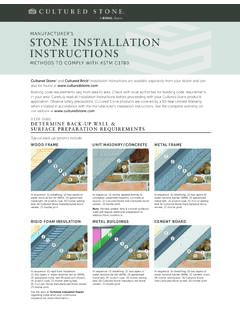
1 Build something great . MANUFACTURER'S INSTALLATION INSTRUCTIONS - METHODS TO COMPLY WITH ASTM C1780. Cultured Stone and Cultured Brick product INSTALLATION INSTRUCTIONS are available separately from your Dealer and can also . be found at Building code requirements vary from area to area. Check with local authorities for building code requirements in your area. Carefully read all INSTALLATION INSTRUCTIONS before proceeding with your Cultured Stone products application. Observe . safety precautions. Cultured Stone products are covered by a 50-Year Limited Warranty when installed in accordance . with the manufacturer's INSTALLATION INSTRUCTIONS . See complete warranty on our website at STEP ONE: DETERMINE BACK-UP WALL AND SURFACE PREPARATION REQUIREMENTS. TYPICAL BACK-UP SYSTEMS INCLUDE: Wood frame: Unit Masonry or Concrete: Metal Frame: 1 1. 2 1 2. 3 2 3. 4 4. 5 3 5. 7 7. 6 6. In sequence: (1) sheathing, (2) two layers of water In sequence: (1) mortar applied directly to In sequence: (1) sheathing, (2) two layers of water resistive barrier (WRB), (3) galvanized metal lath, untreated, unpainted masonry, concrete or stucco, resistive barrier (WRB), (3) galvanized metal lath, (4) scratch coat, (5) mortar setting bed (6) Cultured (2) Cultured Stone manufactured stone veneer.
2 (4) scratch coat, (5) mortar setting bed (6) Cultured Stone manufactured stone veneer, (7) mortar joint.. (3) mortar joint. Stone manufactured stone veneer, (7) mortar joint.. Note: Painted, sealed, dirty, smooth surfaces or walls with residual form release agents will require additional preparation to address these conditions. Rigid Foam Insulation: Metal Buildings: 1 1. 2. 3 2. 4 3. 4. 5 7 5 7. 6 6. In sequence: (1) rigid foam insulation, (2) two layers In sequence: (1) metal building siding RIB, (2) two of water resistive barrier (WRB) (3) galvanized layers of water resistive barrier (WRB), 3) galvanized metal lath (Ribbed Lath shown), (4) scratch metal lath, (4) scratch coat, (5) mortar setting bed, coat, (5) mortar setting bed, (6) Cultured Stone . (6) Cultured Stone manufactured stone veneer, . manufactured stone veneer, (7) mortar joint. (7) mortar joint See special Technical Evaluation Report regarding INSTALLATION over continuous insulation for more information.
3 1. TABLE 1. PREPARATION REQUIREMENTS. WALL SYSTEM/BACK UP 2 Layers Scratch Roughen/. Cleaning Lath Notes WRB Coat Texture Sheathing N/A. Plywood N/A. OSB N/A. Wood Frame 16 oc Cement Board N/A. Wallboard N/A. 1/2 Foam Board * N/A. Sheathing N/A. Exterior Gypsum N/A. Metal frame 16 oc OSB N/A. Plywood N/A. 1/2 Foam Board * N/A. Unit Masonry Site Engineer Review recommended ** optional optional optional (Brick or Block) Evaluation for existing unit masonry Poured See ASTM C1780 for ** optional optional optional . Concrete roughness evaluation Open Stud 48 hour scratch coat cure. Use N/A. Construction paper backed lath. lb rib lath 48 hour scratch coat cure. Use Metal Building N/A. paper backed lath. lb rib lath SPECIAL CONDITIONS. Application direct to cement board Interior is available in addition to standard ** 1 layer optional INSTALLATION wall preparation however Polymer modified mortar is required See TER for lath fastener selection Continuous * N/A available for framed or masonry Insulation applications.
4 Engineer review recommended if Stucco ** . going over existing stucco Note: Optional surface preparation utilizing a rainscreen may be added. See General Information section for more information. *Some foam products may qualify as WRB. See foam manufacturer INSTRUCTIONS . ** Cleaning can be as simple as rinsing dust off the surface with clear water or as involved as bead blasting. You are removing form release agents, dirt, paint, sealers or anything that may inhibit bond. This process may also be the method to roughen the surface to create bond ready texture. See ASTM C1780 for more information. Cultured Stone by Boral . Manufacturer's INSTALLATION INSTRUCTIONS 2. STEP TWO: WALL SURFACE PREPARATION. Exterior Applications Make sure that the application of Cultured Stone products and the structure they are being applied to incorporate good . building practices. Corrosion-resistant flashing shall be installed at all wall penetrations.
5 Flashing type and locations shall be in accordance with the requirements of the applicable building code. On exterior applications, the incorrect INSTALLATION or absence of flashing, cant strips, gutters and downspouts may result in diversion of water run-off onto finished surface areas. Masonry and other building products subjected to these conditions may develop staining and, when combined with severe freeze-thaw conditions, may eventually cause damage. The application of Cultured Stone products under these . conditions is not recommended. Flashing 1. To maintain the weather-resistance of the exterior wall on which stone products are installed, corrosion-resistant Flashing/Weepscreed and a means of drainage shall be installed at all penetrations and terminations of the stone cladding. Flashing type and locations shall be in accordance with the requirements of the applicable building code. 2. For additional recommendations regarding flashing, refer to the following trade associations, standards, organizations and resources: a.
6 Masonry Veneer Manufacturers Association (MVMA) INSTALLATION guide for adhered concrete masonry veneer, available at b. Architect or engineer c. ASTM E 2112. d. Asphalt Roofing Manufacturers Association (ARMA). e. Brick Institute of America (BIA). f. The American Plywood Association (APA). g. Local building department Clearance Maintain 4 clearance between Cultured Stone and grade or 2 clearance above a paved surface. Most building . codes require the use of a weepscreed in framed applications. In framed applications this distance is measured from the beak of the weep screed. When a weep screed is not required, application over masonry as an example, a 2 x 4 leveling/ledger board may be used as a temporary level straight edge to start your INSTALLATION . See MVMA. INSTALLATION Guide for some conditions that allow for a reduction in clearance requirements. Water Resistive Barrier (WRB) INSTALLATION Where a WRB is required, it shall be installed as two separate layers, in shingle fashion.
7 Fasteners, fastening schedule, vertical and horizontal lap requirements shall follow the manufacturer's INSTALLATION INSTRUCTIONS . The WRB layers must be continuous through inside and outside corners, typically extending 16 to the next framing member. See Material Selection . section for more specific WRB material requirements. Example for building paper: 2 horizontal lap, 6 verticle lap. INTERIOR GYPSUM BOARD Corner Preparation: BATT INSULATION. WOOD FRAMING 1. EXTERIOR GRADE SHEATHING. (2) LAYERS OF WRB. LATH 2. LATH FASTENERS - TYPE &. SPACING PER ASTM C1063. MORTAR SCRATCH COAT. MORTAR SETTING BED 3. ADHERED CONCRETE MASONRY. VENEER. MORTAR JOINT. WRB LAPPED OVER WEEP. SCREED. Water resistive barrier and lath must continuously WEEP SCREED. wrap a minimum of 16 at outside and inside corners and fasten at a framing member. (1) wall substrate, (2) two layers of water resistive barrier, (3) metal lath. Cultured Stone by Boral . Manufacturer's INSTALLATION INSTRUCTIONS 3.
8 Lath INSTALLATION Where lath is required, it shall be installed in accordance with ASTM C1063. Typically this will require corrosion resistant fasteners every 6 on center vertically, and 16 on center horizontally, fastened to framing. If an alternative lath is used, install it in accordance with the manufacturer's INSTALLATION INSTRUCTIONS and evaluation report. See Material Selection . section for more specific lath requirements. NOTE: Fasteners installed between framing should be limited as they may extend into the wall's insulation cavity. Scratch Coat Using a trowel or spray application, install mortar scratch coat of minimum thickness of 1/2 up to 3/4 . Use sufficient material and pressure to fully engage and encapsulate the lath. No lath material should be visible after scratch coat INSTALLATION . NOTE: Proper encapsulation and scratch coat thickness are key aspects to lath corrosion resistance and physical performance characteristics.
9 STEP THREE: MATERIAL SELECTION. Water Resistive Barrier (WRB) - select a material meeting one or more of the following standards: ASTM D226 Type 1 Asphalt Felt, intended for wall application ASTM E2556/E2556M. ICC ES AC-38. Current Evaluation Report, by an ANSI accredited evaluation service, showing compliance to ICC ES Acceptance Criteria #38. Lath select a material meeting one or more of the following standards: ASTM C847, minimum lb/yard expanded metal lath ASTM C847, minimum lb/yard, 3/8 rib, expanded metal lath ASTM C1032, minimum 18 gauge, woven wire mesh ASTM C933, welded wire lath Non-Metallic Lath, with a current evaluation report, by an ANSI accredited evaluation service, confirming alternative to one of the above lath products. All lath products must be self-furred, or use furring fasters, to provide 1/4 clearance between lath and substrate, for the purposes of mortar embedment encapsulating lath. Lath Fasteners select fasteners that meet the requirements of the following standard: ASTM C1063.
10 1. Galvanized nails, staples, concrete nails. Penetration depth into wood framing is 3/4 minimum. 2. Corrosion-resistant, self-drilling, self-tapping pancake-head screw with 7 16 head, of 1-1 4 length or suitable to obtain 3 8 penetration beyond inside surface of metal. (Used for installing to metal surfaces such as metal studs or metal building siding.). Applications over continuous insulation, refer to Technical Evaluation Reports 1312-02 or 1302-01 available at Mortar select a material meeting one or more of the following standards: ASTM C270 Type N or Type S. ASTM C1714 Type N or Type S. ANSI or Mortar Admixtures: Comply with ASTM C1384. Bonding Agents: Comply with ASTM C1059 or C932. Coloring Pigment: Comply with ASTM C979. Cultured Stone by Boral . Manufacturer's INSTALLATION INSTRUCTIONS 4. All mortar, additives, bonding agents and pigments must be stored, mixed and used in strict accordance with the manufacturer's INSTRUCTIONS and appropriate standards referenced above.