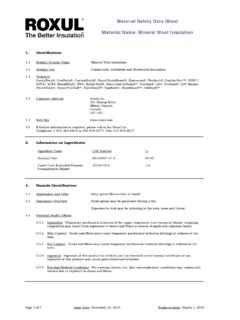
Transcription of MATERIAL SAFETY DATA SHEET
1 MATERIAL SAFETY data SHEET _____ Page 1/ 7 NFPA WHMIS Personal Protective Equipment Transport Symbol not regulated Preparation Date: 16-December-1997 Revision Date 17-July-2007 Revision Number 20 1. product and COMPANY IDENTIFICATION Generic product Name Low Density Fiber Glass insulation / insulation Board Unfaced Products Common name Acoustical Backing Board, Advanced ThermaCube Plus , Blended Blowing Wool, Cathedral Batt insulation , Cavity Wall, Cold Storage Wall, Curtain Wall 225, Flexible Marine, Flexible Type 75 AF-FDM, HV-24, HV-26, H2V-1000, H2V-2000, insulation Batts, Manufactured Housing insulation , Masonry Wall insulation , Metal Building (all types), Metal Framing Batts, Metal Framing insulation , Multi-purpose insulation , Noise Stop Board, Pink insulation , Pink Pak, QuietZone Acoustic Batt, RA Series, Shaft Wall, Sill Sealer, Sonobatts , Sound Attenuation Batts, Standard Blend, Super Pink R Blowing Wool, ThermaGlas , Marine Board, Unfaced Duct Wrap, Warm-N-Dri , YELLOW JACKET Fiber Glass insulation , and YELLOW JACKET Loose Fill MSDS No.
2 13614-NAM-EN Recommended Use insulation Contact manufacturer Owens Corning Insulating Systems, LLC One Owens Corning Parkway Toledo, OH 43659 Emergency telephone number Emergencies Only (after 5 pm AND weekends) 1-419-248-5330 CHEMTREC (24 hours everyday) 1-800-424-9300 CAUNTEC (Canada 24 hours everyday) 1-613-996-6666 Health and Technical contacts Health Issues Information (8am-5pm ET): 1-419-248-8234 Technical product Information (8am-5pm ET): 1-800-GET-PINK or 1-800-438-7465 2. HAZARD IDENTIFICATION Emergency Overview Exposure to dust may be irritating to eyes, nose and throat. Appearance: Pink, Yellow, Tan Physical State: Solid, Fibrous Odor: Faint Resin Low Density Fiber Glass insulation / insulation Board Unfaced Products MSDS No. 13614-NAM-EN Potential Health Effects Principle Routes of Exposure Eye Skin Contact Inhalation Acute Effects x Eyes May cause slight irritation x Skin May cause slight skin irritation x Inhalation May cause irritation of respiratory tract x Ingestion Ingestion of MATERIAL is unlikely Chronic Effects There is no known chronic health effect connected with long-term use or contact with these products Aggravated Medical Conditions Chronic respiratory or skin conditions may temporarily worsen from exposure to this product Carcinogenic Status This product contains a component which is listed by IARC, OSHA or NTP.
3 See Section 11 OSHA Regulatory Status This MATERIAL is considered hazardous by the OSHA Hazard Communication Standard (29 CFR ) Potential Environmental Effects There is no known ecological information for this product 3. COMPOSITION/INFORMATION ON INGREDIENTS CAS # Component Percent by Wt. 65997-17-3 Glass Fiber, Wool 85-100 25104-55-6 Urea, polymer with formaldehyde and phenol 0-15 Non-Hazardous Statement The remaining components of this product are non-hazardous or are in small enough quantities as to not meet regulatory thresholds for disclosure. These components contain no substances or impurities which would influence the classification of this product . 4. FIRST AID MEASURES Eye contact Rinse immediately with plenty of water, also under the eyelids, for at least 15 Minutes Do not rub or scratch eyes If eye irritation persists, consult a specialist Skin contact Wash off immediately with soap and cold water.
4 DO NOT use warm water because this will open up the pores of the skin, which will cause further penetration of the fibers. DO NOT rub or scratch affected areas. Use a wash cloth to help remove fibers or apply and remove an adhesive tape so that the fibers adhere to the tape and are pulled out of the skin. Remove contaminated clothing. If skin irritation persists, call a physician Never use compressed air to remove fibers from skin Page 2/ 7 Revision Date 17-July-2007 Low Density Fiber Glass insulation / insulation Board Unfaced Products MSDS No. 13614-NAM-EN Ingestion Accidental ingestion of this MATERIAL is unlikely If this does occur, watch person for several days to make sure intestinal blockage does not occur Rinse mouth with water to remove fibers from the throat If symptoms persist, call a physician Inhalation Move to fresh air If symptoms persist, call a physician 5.
5 FIRE-FIGHTING MEASURES Flammability/Combustibility Properties Non-flammable Suitable extinguishing media dry chemical foam carbon dioxide (CO2) water fog Unsuitable Extinguishing Media None Hazardous Combustion Products Carbon Monoxide Carbon Dioxide (CO2) Ammonia Other undetermined compounds could be released in small quantities Explosion data Sensitivity to Mechanical Impact Not available Sensitivity to Static Discharge Not available Special Hazards Arising from the Chemical No unusual fire and explosions hazards are expected from this product Protective Equipment and Precautions for Firefighters Wear self-contained breathing apparatus (SCBA) and full fire fighting protective gear 6. ACCIDENTAL RELEASE MEASURES Personal precautions Avoid contact with the skin and the eyes. Methods for Containment MATERIAL will settle out of air Prevent from spreading by covering or other means Methods for Clean-up Use an industrial vacuum cleaner with a high efficiency filter to clean up dust and fiber contamination Avoid dry sweeping After cleaning, flush away traces with water Pick up and transfer to properly labeled containers 7.
6 HANDLING AND STORAGE Handling Avoid dust formation Do not breathe dust Wear personal protective equipment Storage Keep product in its packaging until use to minimize potential dust generation. MATERIAL should be kept dry and covered Page 3/ 7 Revision Date 17-July-2007 Low Density Fiber Glass insulation / insulation Board Unfaced Products MSDS No. 13614-NAM-EN 8. EXPOSURE CONTROLS / PERSONAL PROTECTION ACGIH TLV OSHA PEL Ontario TWAEV Mexico Glass Fiber Wool 65997-17-3 1 f/cc (respirable) 10 mg/m3 (inhalable synthetic vitreous fibers) 3 mg/m3 (respirable fraction - PNOC 1 f/cc (respirable) STEL mg/m3 TWA mg/m3 TWA 1 f/cc TWA mg/m3 Engineering Controls Provide local exhaust and/or general ventilation to maintain exposure below regulatory and recommended limits. Dust collection system must be used in transferring operations, cutting or machining or other dust generating process.)
7 Vacuum or wet clean-up methods should be used Personal protective equipment Respiratory protection When workers are facing concentrations above the exposure limit they must use appropriate certified respirators such as 3M model 8210 (3M model 8271 in high humidity environments) Eye/face Protection SAFETY glasses with side-shields Skin Protection Protective gloves Long sleeved shirt and long pants General Hygiene Considerations Wash hands before breaks and immediately after handling the product Avoid contact with skin, eyes and clothing Avoid getting dust into boots and gloves through wrist bands and pant tucks Remove and wash contaminated clothing before re-use 9. PHYSICAL AND CHEMICAL PROPERTIES Appearance Pink, yellow, tan Odor Faint resin (organic) Physical State Solid, fibrous pH Does not apply Flash point Not available Autoignition temperature Does not apply Boiling Point Does not apply Melting point/range Not available Flammability Limits in Air lower / upper / Explosive properties Does not apply Oxidizing properties Does not apply Vapor Pressure Does not apply Specific Gravity Does not apply Water solubility Insoluble VOC content Not available 10.
8 STABILITY AND REACTIVITY Chemical Stability Stable Conditions to avoid None expected Incompatible Materials None expected Hazardous decomposition products See Section 5 for hazardous decomposition products during a fire Page 4/ 7 Revision Date 17-July-2007 Low Density Fiber Glass insulation / insulation Board Unfaced Products MSDS No. 13614-NAM-EN Possibility of Hazardous Reactions Hazardous polymerization does not occur 11. TOXICOLOGICAL INFORMATION Acute toxicity General product Information Dusts may cause mechanical irritation to eyes and skin. Ingestion may cause transient irritation of throat, stomach and gastrointestinal tract. Inhalation may cause coughing, nose and throat irritation, and sneezing. Higher exposures may cause difficulty breathing, congestion and chest tightness. Component Analysis LD50/LC50 LD50 Oral Urea, polymer with formaldehyde and phenol 7 g/kg Rat Chronic toxicity Fiber Glass Wool: In October 2001, the International Agency for Research on Cancer (IARC) classified fiber glass wool as Group 3, not classifiable as to its carcinogenicity to humans.
9 The 2001 decision was based on human studies and animal research that have not shown an association between inhalation exposure to dust from fiber glass wool and the development of respiratory disease. This classification replaces the IARC finding in 1987 of a Group B designation possibly carcinogenic to humans. In May 1997, the American Conference of Governmental Industrial Hygienists (ACGIH) adopted an A3 carcinogen classification for glass wool fibers. The ACGIH A3 classification considers glass wool to be carcinogenic in experimental animals at relatively high doses, by routes of administration, at sites, or by mechanisms that it does not consider relevant to worker exposure. It also reviewed the available epidemiological studies and concluded that they do not confirm an increased risk of cancer in exposed humans. Overall, the ACGIH found that the available medical/scientific evidence suggests that glass wool is not likely to cause cancer in humans except under uncommon or unlikely routes or levels of exposure.
10 In 1994, the National Toxicology Program (NTP) classified glass wool (respirable size) as reasonably anticipated to be a human carcinogen. This classification was primarily based upon the 1987 IARC classification. NTP is currently considering reclassifying this MATERIAL . Component Analysis ACGIH IARC OSHA NTP Mexico Fiber Glass, Wool 65997-17-3 A3 animal carcinogen Group 3 not classifiable X Reasonably Anticipated A3 animal carcinogen Allergy No information available Neurological Effects No information available Mutagenic Effects No information available Reproductive Effects No information available Developmental Effects No information available Target Organ Effects No information available 12. ECOLOGICAL INFORMATION Ecotoxicity: This MATERIAL is not expected to cause harm to animals, plants or fish Chemical Fate Persistance/Degradability Not available Bioaccumulation/Accumulation Not available Mobility in Environmental Media Not available Page 5/ 7 Revision Date 17-July-2007 Low Density Fiber Glass insulation / insulation Board Unfaced Products MSDS No.