Transcription of Material Safety Data Sheet - Acme-Hardesty
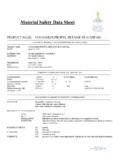
1 Material Safety data Sheet PRODUCT NAME: LAURYL ALCOHOL ETHOXYLATE (2 MOL). ======================================== ======================================== =============. CHEMICAL PRODUCT AND DISTRIBUTOR IDENTIFICATION. ======================================== ======================================== =============. TRADE NAME: LAURYL ALCOHOL ETHOXYLATE (2 MOLE). CAS#: 68439-50-9. EINECS#: 500-213-3. DATE: December 1, 2009. DISTRIBUTOR: Acme-Hardesty COMPANY. ADDRESS: 450 Sentry Parkway Blue Bell, PA 19422. TELEPHONE: (800) 223 - 7054. FAX: (215) 591 3620. EMERGENCY: CHEMTREC (800) 424-9300.
2 ======================================== ======================================== =============. COMPOSITION / INFORMATION ON INGREDIENTS. ======================================== ======================================== =============. INFORMATION ON HAZARDOUS INGREDIENTS: CHEMICAL NAME: Lauryl Alcohol Ethoxylate % COMPOUND: ~ 100. CAS#: 68439-50-9. EINECS #: 500-213-3. ======================================== ======================================== =============. HAZARDOUS INGREDIENTS/IDENTITY INFORMATION. ======================================== ======================================== =============.
3 ENVIRONMENTAL HAZARDS: Very toxic to aquatic organisms HUMAN HEALTH HAZARDS: Harmful if swallowed Risk of serious damage to eyes ======================================== ======================================== =============. FIRST AID MEASURES. ======================================== ======================================== =============. EFFECT AND SYMPTOMS: INGESTION: Harmful if ingested. Causes irritation. INHALATION: Inhalation does not cause problems. SKIN CONTACT: May cause irritation. EYE CONTACT: Irritating. FIRST AID MEASURES: INGESTION: Induce vomiting and seek medical attention.
4 INHALATION: If difficulties occur after vapor/aerosol has been inhaled, remove to fresh air and seek medical attention SKIN CONTACT: Flush with water for at least 15 minutes. EYE CONTACT: Flush with water for at least 15 minutes. Consult eye specialist. Material Safety data Sheet . Lauryl Alcohol Ethoxylate (2 MOL). December 1, 2009. Page 2 of 5. ======================================== ======================================== =============. FIRE FIGHTING MEASURES. ======================================== ======================================== =============. EXTINGUISHING MEDIA: SUITABLE: Water, dry extinguishing media, foam, carbon dioxide.
5 NOT SUITABLE: Not applicable SPECIAL FIRE FIGHTING PROCEDURES: Wear protective equipment and self contained breathing apparatus. UNUSUAL FIRE/EXPLOSION HAZARDS: In case of fire, harmful vapors may be released PROTECTION OF FIREFIGHTERS: As in special fire fighting procedures given above HAZARDOUS THERMAL DECOMP. PROD: Does not occur OTHER INFORMATION: The degree of risk is governed by the burning substance and the fire conditions. Contaminated extinguishing water must be disposed of in accordance with official regulations. ======================================== ======================================== =============.
6 ACCIDENTAL RELEASE MEASURES. ======================================== ======================================== =============. PERSONAL PRECAUTIONS: Use personal protective equipments (PPE).Avoid contact with skin, eyes and clothing. METHOD OF CLEANING UP: Flush spill with water for minor spills. For large spillage collect the product. Residues can be removed by using suitable absorbent Material . Dispose the absorbed Material in accordance with regulations. ENVIRONMENTAL PRECAUTIONS: Contain contaminated water/ fire fighting water. Do not discharge into drains / surface water / ground water ======================================== ======================================== =============.
7 HANDLING AND STORAGE. ======================================== ======================================== =============. HANDLING: Avoid contact with eyes, open cuts. Wash thoroughly after handling. Keep away from food, domestic water supplies STORAGE: Keep in close container. Product can absorb moisture if exposed to atmosphere. Store at 30-40 C. If stored at 6 C for a longer time, it becomes a hazy white semi-solid. Warm it before use. Prolonged storage may show settling of salt at the bottom. Mix the product before use. SUITABLE PACKING MATERIALS: HDPE drums/ epoxy coated (Lacquer) MS drums.
8 Keep container tightly closed. NOT SUITABLE PACKING MATERIALS: Not applicable ======================================== ======================================== =============. EXPOSURE CONTROLS/PERSONAL PROTECTION. ======================================== ======================================== =============. RESPIRATORY SYSTEM PROTECTION: None required, when adequate ventilation is available. If airborne concentration is high, use a mask or respirator. SKIN AND BODY PROTECTION: Uniform, apron, protective boots HAND PROTECTION: Rubber gloves EYE PROTECTION: Safety goggles and face shield Material Safety data Sheet .
9 Lauryl Alcohol Ethoxylate (2 MOL). December 1, 2009. Page 3 of 5. ======================================== ======================================== ===========. STABILITY AND REACTIVITY. ======================================== ======================================== ===========. CONDITIONS TO AVOID: Heat, flame and other sources of ignition. MATERIALS TO AVOID: Do not subject to acidic pH / moisture strong acids and oxidizing agents. HAZARDOUS DECOMP PROD: Will not occur ======================================== ======================================== =============. PHYSICAL AND CHEMICAL PROPERTIES.
10 ======================================== ======================================== =============. PHYSICAL STATE: Liquid with tendency to show settling COLOR: Colorless to pale yellow ODOR: Characteristic pH (1% Aqueous Solution): Mole No.: 2. HLB VALUE: 6 7. FLASH POINT, C: 162 C. SOLIDIFICATION POINT, C: 6 10 C. POUR POINT C: 6 C. DENSITY @ 20 C g/ml: SOLUBILITY WATER: Insoluble in water ======================================== ======================================== =============. TOXICOLOGICAL INFORMATION. ======================================== ======================================== =============.