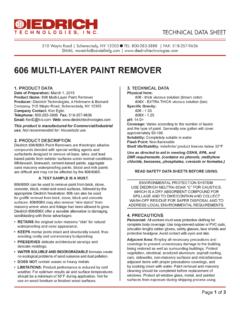
Transcription of MATERIAL SAFETY DATA SHEET - Diedrich …
1 MATERIAL SAFETY data SHEET Page: 1 of 4 pages: 505 Special Coatings Stripper - MSDS 505 SPECIAL COATINGS STRIPPER SECTION I - PRODUCT IDENTIFICATION MANUFACTURER'S NAME: Diedrich TECHNOLOGIES INC. EMERGENY TELEPHONE NUMBER: AND ADDRESS: A Hohmann & Barnard Company 8:00 AM 5:00 PM EST Monday Friday: 800-283-3888 310 Wayto Road, Schenectady, NY 12303 NON-BUSINESS HOURS (CHEMTREC): 800-424-9300 PRODUCT NAME: 505 SPECIAL COATINGS STRIPPER 11/2011 SECTION II - HAZARDOUS INGREDIENTS CHEMICAL NAME CAS NO. NFPA CODE TLV PEL Methylene Chloride 75-09-2 1/0/0/- 100 ppm 500 ppm SPECIFIC CHEMICAL IDENTITY AND PERCENTAGE CONTENT OF INGREDIENTS WITHHELD AS TRADE SECRET PURSUANT TO MASSACHUSETTS REGULATIONS. REPORTING REQUIREMENTS OF SECTION 313 TITLE III OF THE SUPERFUND AMENDMENTS AND REAUTHORIZATION ACT OF 1986 AND 10 CFR PART 373 APPLY.
2 SECTION III - PHYSICAL data BOILING POINT ( F): 150-400 F SPECIFIC GRAVITY (H2O=1): VAPOR PRESSURE (mmHg): 350 % VOLATILE (by weight): 72 VAPOR DENSITY (Air=1): EVAPORATION RATE (Ether=1): SOLUBILITY IN WATER: Moderate APPEARANCE AND ODOR: Viscous, white opaque Ether like odor. VOLATILE ORGANIC COMPONENTS: N/A SECTION IV - FIRE AND EXPLOSION HAZARD data FLASH POINT: No flash point to boiling FLAMMABLE LIMITS: LEL = N/A UEL = N/A EXTINGUISHING MEDIA: Dry chemical, carbon dioxide, foam or water spray/fog. Avoid use of a direct water stream. SPECIAL FIRE FIGHTING PROCEDURES: Do not allow access to fire area without proper protective equipment. Use NIOSH/MSHA approved air supplied breathing apparatus. Exposed containers, surrounding equipment and structures exposed to fire should be cooled with water.
3 UNUSUAL FIRE AND EXPLOSION HAZARDS: At high temperature, methylene chloride can decompose giving off hydrogen chloride gas, phosgene, and other toxic substances and irritating vapors. Vapors can be ignited by high energy ignition source. SECTION V - HEALTH HAZARD data PRIMARY ROUTES OF EXPOSURE: Inhalation, skin, eyes, ingestion. CARCINOGENIC INFORMATION: NTP study found methylene chloride to produce tumors in some laboratory mice. MEDICAL CONDITIONS AGGRAVATED BY OVEREXPOSURE: No applicable information found. EFFECTS OF OVEREXPOSURE: The following effects have been observed in laboratory animals: Brain and nervous system damage, damage to eyes, lungs, kidneys and spleen, liver abnormalities and anemia. Possible cause of the following in humans: Cardiac abnormality, confusion, depression, fatigue, headaches, appetite loss, nausea, vomiting cough, impairment of vision and balance.
4 May be diarrhea, urine suppression, facial swelling, blood in urine and jaundice, Severe overexposure can cause drowsiness, unconsciousness, and even death in extreme cases. CHRONIC: Repeated or prolonged exposure to high concentrations can cause neural dysfunction. Can elevate carboxyhemoglobin level. Toxic hazards can be increased by alcohol consumption, smoking, the presence of carbon monoxide and performance of heavy labor. MATERIAL SAFETY data SHEET Page: 2 of 4 pages: 505 Special Coatings Stripper - MSDS EYE CONTACT: Severe persistent irritation results from direct contact with liquid. SKIN CONTACT: Contact with skin will result in severe irritation, reddening, drying and cracking of affected skin. Prolonged and repeated contact may cause dermatitis. INHALATION: Exposure to high concentrations or prolonged exposure to lower concentrations may be slightly irritating to mucous membranes, cause dizziness, weakness, fatigue, nausea, headache, unconsciousness and even asphyxiation.
5 Exposure may also lead to kidney and lung damage and possible death. INGESTION: .Ingestion of liquid may result in vomiting; aspiration of liquid into the lungs must be avoided as contact with lungs can result in chemical pneumonitis and pulmonary edema/hemorrhage. Can cause irritation of gastrointestinal tract, nausea, vomiting, and diarrhea. Because the body metabolizes methylene chloride to carbon monoxide the oxygen carrying capacity of blood will be reduced. May be fatal if swallowed. EMERGENCY AND FIRST AID PROCEDURES: EYE CONTACT: Immediately flush with copious amounts of water lifting both upper and lower lids to insure thorough rinsing. Seek immediate medical attention. Get medical attention if irritation persists. SKIN CONTACT: Wash with soap and water. Remove contaminated clothing and do not reuse until laundered. If irritation persists, seek medial attention.
6 INHALATION: Remove to fresh air. Give artificial respiration if not breathing. Keep victim warm and quiet, seek immediate medical attention. DO NOT GIVE STIMULANTS, epinephrine or ephedrine may affect the heart with fatal results. INGESTION: If conscious, immediately induce vomiting by giving two glasses of water sticking a finger down the throat. Keep head below hips to prevent aspiration of liquid into lungs, administer additional water. Seek immediate medical attention. SECTION VI - REACTIVITY data STABILITY: Stable CONDITIONS TO AVOID: Contact with open flames, electric arc and hot surfaces. INCOMPATIBILITY: Oxidizing or reducing agents, alkalis, water moist air, titanium, aluminum, pure oxygen, alkali metals,k chromic anhydride, lead perchlorate and perchloric acids. HAZARDOUS/THERMAL DECOMPOSITION PRODUCTS: Exposure to high temperatures or open flames generate hydrogen chloride and small amounts of phosgene and chloride, carbon monoxide, and other unidentified organic compounds.
7 SECTION VII - SPILL OR LEAK PROCEDURES SPILL, LEAK AND WASTE DISPOSAL PROCEDURES: LARGE SPILLS: Evacuate area. Use proper protective equipment. Shut off source of leak only if safe to do so. Dike area to contain spill. Sweep, mop, wipe or soak up immediately. Use Diedrich Neutra-Soak AS@ or other noncombustible absorbent such as clay or vermiculite for diking and absorption; place in drums for proper disposal. Flush area with water to remove any residue; dispose of flush solution in drums. Keep out of water supply. SMALL SPILLS: Soak up with Diedrich Neutra-Soak AS@ or other noncombustible absorbent such as clay or vermiculite and place in drums for proper disposal. Flush area with water to remove residue; dispose of flush solution in drums. WASTE DISPOSAL METHODS: Allow solvent to evaporate to atmosphere at safe distance from inhabited buildings.
8 Dispose of in a facility approved under RCRA regulations for hazardous waste and in accordance with Federal, State, and local regulatins. MATERIAL SAFETY data SHEET Page: 3 of 4 pages: 505 Special Coatings Stripper - MSDS SECTION VIII - SPECIAL PROTECTION INFORMATION RESPIRATORY PROTECTION: Below 500 ppm - none. Respiratory protection required in the absence of environmental control. For levels up to 2% or 2 hour or less, a suitable full face mask with organic canister should be used. Above 2% and for emergencies, use a self contained breathing apparatus. Overexposure prevention must be in compliance with 29 CFR VENTILATION: Provide sufficient general and/or local exhaust ventilation to maintain exposure below TLV(s). Ventilation is require to control vapor concentrations below TLV. Vapors are heavier than air, exhaust at floor level. PROTECTIVE CLOTHING: Wear full body protective chemical resistant clothing as required to prevent skin contact.
9 PROTECTIVE GLOVES: Solvent resistant gloves, such as nitrile rubber. EYE PROTECTION: Chemical splash goggles in compliance with OSHA regulations. OSHA regulations may permit alternative SAFETY glass, consult with your local SAFETY supplier. OTHER PROTECTIVE EQUIPMENT: Apply Diedrich recommended skin barrier cream for additional protection. Solvent resistant boots and hardhat. SAFETY shower and eyewash or fresh running water close at hand. SECTION IX - SPECIAL PRECAUTIONS PRECAUTIONS TO BE TAKEN IN HANDLING AND STORAGE: Keep away from heat, sparks, and open flames. Use with adequate ventilation. Store away from oxidizing materials. Avoid prolonged or repeated contact with skin. After this container has been emptied it may contain explosive and/or harmful vapors and residue. OTHER PRECAUTIONS: *Note to physician: Overexposure to many of the chlorinated solvents especially if accompanied by anoxia, may temporarily increase cardiac irritability.
10 Maintain adequate oxygenation until recovery. Avoid sympathomimetic amines, such as epinephrine which may precipitate arrhythmia. Methylene Chloride type stripper residue must not be allowed to go into the soil because it will not evaporate out of the soil and is not biodegradable. Contain and collect washoff residue with plastic sheets or canvas tarps. Do not roll up active MATERIAL , allow 24-48 hours for the methylene chloride to evaporate/dissipate. When odor is no longer evident, the residue is inactive and can be disposed of according to local regulations. Conduct a Toxicity Characteristic Leaching Procedure (TCLP) test for lead before disposal of liquid or solid waste. RECOMMENDATIONS TO ASSIST IN MEETING DNR, EPA, OSHA RULINGS AND GUIDELINES ON POLLUTION PREPAREDNESS & CONTINGENCY PLAN (PPC): When removing lead based paint, the lead particles must be collected, handled and disposed of as hazardous waste.