Transcription of Material Safety Data Sheet ECO-CLEAN ALL 1. …
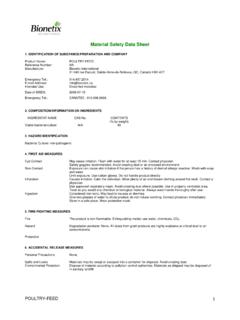
1 Material Safety data Sheet ECO-CLEAN ALL 1. product identification Form: LIGHT BLUE LIQUID Odor: CITRUS PINE 2. Hazardous Ingredients Hazardous Components: None Material CAS # Exposure Limit Viable bacteria culture 90% Bacterial Amalyase N/A Odor Control #10175 N/A None Established Modified Mixed Alcohol Ethoxylate Proprietary None Established Water 7732-18-5 None Established 3. Physical / Chemical data Water Solubility: Moderate - disperses in water 4.
2 Fire and Explosion data pH: to when mixed with water Flash Point: N/A Special Fire Fighting Procedures: None Extinguishing Media: Water 5. Reactivity data Stability: Stable Conditions to Avoid: Accumulation of product in confined area Hazardous Byproducts: None Hazardous Polymerization: Will not occur Incompatibility: Normally unreactive; however, avoid strong bases at high temperatures, strong acids, strong oxidizing agents and materials reactive with hydroxyl compounds. 6. Health Hazard data Eye Contact: Excess redness and swelling of the conjunctiva may occur. Causes moderate to severe irritation, experienced as discomfort or pain, excess blinking and tear production, with marked excess redness and swelling.
3 Corneal injury may occur. First Aid: Immediately flush with water for at least 15 minutes. DO NOT remove contact lenses, if worn. Obtain medical attention without delay, preferably from an ophthalmologist. Recommended Precautions: Safety goggles. Avoid creating mist or an enclosed environment. Skin Contact: Exposure can cause irritation if a person has a history of dermal allergic reaction. First Aid: Wash with soap and water. Recommended Precautions: Limit exposure. Use rubber gloves. Do not handle product directly. Ingestion: Considered non-toxic but can lead to nausea or diarrhea. First Aid: Give two glasses of water to dilute product , do not induce vomiting. Contact physician immediately. Recommended Precautions: Store in safe place. Wear protective mask. Inhalation: Causes Irritation.
4 First Aid: Calm the individual, allow plenty of fresh air, and loosen clothing around neck. Contact physician. Recommended Precautions: Use approved respiratory mask. Avoid creating mist where possible. Use in properly ventilated area. General Precautions: Treat as you would any chemical or biological Material . Always wash hands thoroughly after use. Effects of Repeated Overexposure: Repeated skin contact may cause dermatitis. NOTES TO PHYSICIAN: There is no specific antidote. Treatment of overexposure should be directed at the control of symptoms and the clinical condition of the patient. In case of massive overexposure, victim should be observed for several days for delayed effects. Any Material aspirated during vomiting may cause lung injury. Therefore, emosis should not be induced mechanically or pharmacologically. If it is considered necessary to evacuate the stomach contents, this should be done by means least likely to cause aspiration ( gastric lavage after endotracheal intubations).
5 Studies involving the sustained occluded contact of undiluted similar Material with rabbit skin indicate that such conditions may result in the development of inflammatory changes in the lungs. This Material can cause lung injury if deposited as a liquid directly into the lung. However, no lung injury was observed in rats inhaling aerosols of this surfactant for four hours. 7. Storage and Handling Recommended Storage: Store in cool, dry conditions. Storage temperature should be between 41 degrees F and 104 degrees F (5 C and 40 C). Precautions on Handling: No danger from handling packaged Material . Ensure packaged containers remain sealed. Waste Disposal: Small spillages can be washed away with large amounts of water. Large spillages, if contained, can be returned to container. Check local and state authority requirements in the case of disposing of large quantities. 8. Biological Hazard data Microbial Formulation: The product formulation contains a range of naturally-occurring microorganisms which are known to be non-pathogenic to man or animals.
6 Other: The product has been shown to be free of Salmonella and Shigella using the procedures outlined by AOAC and the USDA. This product does not contain the strain pseudomonas aeruginosa. Prepared by: MSDS Coordinator, October 14,2011 The information presented in this data Sheet is believed to be reliable. This information is provided as representative only and there are no warranties, expressed or implied, regarding its performance. Since neither distributor nor manufacturer has any control over handling, storage, use and application conditions, neither distributor nor manufacturer shall be responsible for any claims, liabilities, losses, damages, costs or expenses of any kind arising out of or in any way connected with the handling, storage, or use of the product described. Manufactured by: Bionetix International 21040 rue Daoust, Sainte-Anne-de-Bellevue,QC H9X 4C7 Tel: 514-457-2914