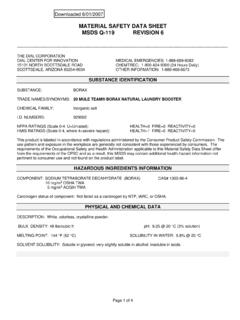
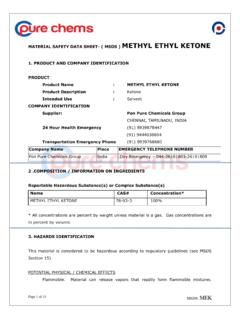
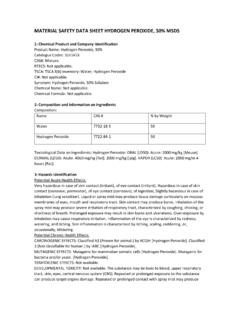
Transcription of Material Safety Data Sheet (MSDS) - WD-40
1 Page 1 of 5 Safety data Sheet 1 - Identification Trade Name: WD-40 Aerosol Product Use: Lubricant, Penetrant, Drives Out Moisture, Removes and Protects Surfaces From Corrosion Restrictions on Use: None identified SDS Date Of Preparation: August 2, 2021 Canadian Office: WD-40 Products [Canada] Ltd. Box 220 Toronto, Ontario M9C 4V3 Information Phone #: (416) 622-9881 Emergency Phone # 24 hr: Canutec: (613) 996-6666 - Designated for use only in the event of chemical emergencies involving a spill, leak, fire exposure or accident involving chemicals 2 Hazards Identification WHMIS 2015/GHS Classification: Flammable Aerosol Category 1 Gas Under Pressure: Compressed Gas Aspiration Toxicity Category 1 Specific Target Organ Toxicity Single Exposure Category 3 (nervous system effects) Note: This product is a consumer product and is labeled in accordance with the Consumer Chemicals and Containers Regulations (CCCR) which take precedence over WHMIS 2015 labeling.
2 The actual container label will not include the label elements below. The labeling below applies to industrial/professional products. Label Elements: DANGER! Extremely flammable aerosol. Contains gas under pressure; may explode if heated. May be fatal if swallowed and enters airways. May cause drowsiness or dizziness. Prevention Keep away from heat, hot surfaces, sparks, open flames and other ignition sources. No smoking. Do not spray on an open flame or other ignition source. Do not pierce or burn, even after use. Avoid breathing mist or vapors. Use only outdoors or in a well-ventilated area. Response IF SWALLOWED: Immediately call a POISON CENTER or physician. Do NOT induce vomiting. IF INHALED: Remove person to fresh air and keep comfortable for breathing. Call a POISON CENTER or doctor if you fell unwell. Storage Store locked up. Protect from sunlight. Do not expose to temperatures exceeding 50 C/122 F. Store in a well-ventilated place.
3 Disposal Page 2 of 5 Dispose of contents and container in accordance with local and national regulations. 3 - Composition/Information on Ingredients Ingredient CAS # Weight Percent WHMIS 2015/ GHS Classification Aliphatic Hydrocarbon 64742-47-8 50-70% Flammable Liquid Category 3 Aspiration Toxicity Category 1 Specific Target Organ Toxicity Single Exposure Category 3 (nervous system effects) Petroleum Base Oil Mixture 30-35% Not Hazardous Carbon Dioxide 124-38-9 2-3% Simple Asphyxiant 4 First Aid Measures Ingestion (Swallowed): Aspiration Hazard. DO NOT induce vomiting. Call physician, poison control center or the WD-40 Safety Hotline at 1-888-324-7596 immediately. Eye Contact: Flush thoroughly with water. Remove contact lenses if present after the first 5 minutes and continue flushing for several more minutes. Get medical attention if irritation persists. Skin Contact: Wash with soap and water. If irritation develops and persists, get medical attention.
4 Inhalation (Breathing): If irritation is experienced, move to fresh air. Get medical attention if irritation or other symptoms develop and persist. Signs and Symptoms of Exposure: Harmful or fatal is swallowed. If swallowed, may be aspirated and cause lung damage. May cause eye irritation. Inhalation of mists or vapors may cause nasal and respiratory tract irritation and central nervous system effects such as headache, dizziness and nausea. Skin contact may cause drying of the skin. Indication of Immediate Medical Attention/Special Treatment Needed: Immediate medical attention is needed for ingestion. 5 Fire Fighting Measures Suitable (and unsuitable) Extinguishing Media: Use water fog, dry chemical, carbon dioxide or foam. Do not use water jet or flooding amounts of water. Burning product will float on the surface and spread fire. Specific Hazards Arising from the Chemical: Contents under pressure. Keep away from ignition sources and open flames.
5 Exposure of containers to extreme heat and flames can cause them to rupture often with violent force. Vapors are heavier than air and may travel along surfaces to remote ignition sources and flash back. Combustion will produce oxides of carbon and hydrocarbons. Special Protective Equipment and Precautions for Fire-Fighters: Firefighters should always wear positive pressure self-contained breathing apparatus and full protective clothing. Cool fire-exposed containers with water. Use shielding to protect against bursting containers. 6 Accidental Release Measures Personal Precautions, Protective Equipment and Emergency Procedures: Wear appropriate protective clothing (see Section 8). Eliminate all sources of ignition and ventilate area. Methods and Materials for Containment/Cleanup: Leaking cans should be placed in a plastic bag or open pail until the pressure has dissipated. Contain and collect liquid with an inert absorbent and place in a container for disposal.
6 Clean spill area thoroughly. Report spills to authorities as required. 7 Handling and Storage Precautions for Safe Handling: Avoid contact with eyes. Avoid prolonged contact with skin. Avoid breathing vapors or aerosols. Use only with adequate ventilation. Keep away from heat, sparks, pilot lights, hot surfaces and open flames. Unplug electrical tools, motors and appliances before spraying or bringing the can near any source of electricity. Electricity can burn a hole in the can and cause contents to burst into flames. To avoid serious burn injury, do not let the can touch battery terminals, electrical connections on motors or appliances or any other source of electricity. Wash thoroughly with soap and water after handling. Keep containers closed when not in use. Keep out of the reach of children. Do not puncture, crush or incinerate containers, even when empty. Page 3 of 5 Conditions for Safe Storage: Store in a cool, well-ventilated area, away from incompatible materials.
7 Do not store above 120 F or in direct sunlight. (NFPA 30B) Level 3 Aerosol. Store away from oxidizers. 8 Exposure Controls/Personal Protection Chemical Occupational Exposure limits Aliphatic Hydrocarbon 1200 mg/m3 TWA (manufacturer recommended) Petroleum Base Oil 5 mg/m3 TWA (Inhalable) ACGIH TLV (as mineral oil) 5 mg/m3 TWA, 10 mg/m3 STEL Canada- Qu bec (as oil mist, mineral) 5 mg/m3 TWA, 10 mg/m3 STEL Canada- Ontario (as oil mist, mineral) 1 mg/m3 TWA British Columbia (as Oil mist-mineral, severely refined) Carbon Dioxide 5000 ppm TWA, 30,000 ppm STEL ACGIH TLV 5000 ppm TWA, 30,000 ppm STEL Canada-Ontario 5000 ppm TWA, 30,000 ppm STEL Canada-Qu bec 5000 ppm TWA, 15,000 ppm STEL British Columbia The Following Controls are Recommended for Normal Consumer Use of this Product Appropriate Engineering Controls: Use in a well-ventilated area. Personal Protection: Eye Protection: Avoid eye contact. Always spray away from your face. Skin Protection: Avoid prolonged skin contact.
8 Chemical resistant gloves recommended for operations where skin contact is likely. Respiratory Protection: None needed for normal use with adequate ventilation. For Bulk Processing or Workplace Use the Following Controls are Recommended Appropriate Engineering Controls: Use adequate general and local exhaust ventilation to maintain exposure levels below that occupational exposure limits. Personal Protection: Eye Protection: Safety goggles recommended where eye contact is possible. Skin Protection: Wear chemical resistant gloves. Respiratory Protection: None required if ventilation is adequate. If the occupational exposure limits are exceeded, wear a NIOSH approved organic vapor/particulate or supplied air respirator in accordance with local and national regulations. Respirator selection and use should be based on contaminant type, form and concentration. Follow applicable regulations and good Industrial Hygiene practice. Work/Hygiene Practices: Wash with soap and water after handling.
9 9 Physical and Chemical Properties Appearance: Light green to amber liquid Flammable Limits: (Solvent Portion) LEL: UEL: 8% Odor: Mild petroleum odor Vapor Pressure: 95-115 PSI @ 70 F Odor Threshold: Not established Vapor Density: Greater than 1 (air=1) pH: Not Applicable Relative Density: @ 60 F Melting/Freezing Point: Not established Solubilities: Insoluble in water Boiling Point/Range: 361 - 369 F (183 - 187 C) Partition Coefficient; n-octanol/water: Not established Flash Point: 122 F (49 C) Tag Open Cup (liquid) Autoignition Temperature: Not established Evaporation Rate: Not established Decomposition Temperature: Not established Flammability (solid, gas): Flammable Aerosol Viscosity: cSt @ 100 F VOC: 65% Pour Point: -63 C ( F ) ASTM D-97 10 Stability and Reactivity Reactivity: Not reactive under normal conditions Page 4 of 5 Chemical Stability: Stable Possibility of Hazardous Reactions: May react with strong oxidizers generating heat.
10 Conditions to Avoid: Avoid heat, sparks, flames and other sources of ignition. Do not puncture or incinerate containers. Incompatible Materials: Strong oxidizing agents. Hazardous Decomposition Products: Carbon monoxide and carbon dioxide. 11 Toxicological Information Symptoms of Overexposure: Inhalation: High concentrations may cause nasal and respiratory irritation and central nervous system effects such as headache, dizziness and nausea. Intentional abuse may be harmful or fatal. Skin Contact: Prolonged and/or repeated contact may produce mild irritation and defatting with possible dermatitis. Eye Contact: Contact may be irritating to eyes. May cause redness and tearing. Ingestion: This product has low oral toxicity. Swallowing may cause gastrointestinal irritation, nausea, vomiting and diarrhea. This product is an aspiration hazard. If swallowed, can enter the lungs and may cause chemical pneumonitis, severe lung damage and death.