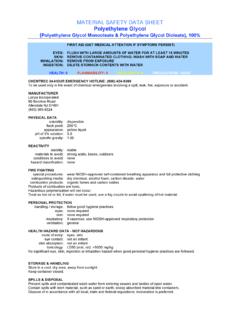
Transcription of MATERIAL SAFETY DATA SHEET Quaternary Ammonium
1 MATERIAL SAFETY data SHEET . Quaternary Ammonium (Dimethyl Ammonium Chloride & Dimethyl Benzyl Ammonium Chloride). FIRST AID. EYES: FLUSH WITH LARGE AMOUNTS OF WATER FOR AT LEAST 15 MINUTES. SKIN: REMOVE CONTAMINATED CLOTHING; WASH WITH SOAP AND WATER. INHALATION: REMOVE FROM EXPOSURE. INGESTION: DILUTE STOMACH CONTENTS WITH MILK OR WATER; DO NOT INDUCE VOMITING;. CONTACT PHYSICIAN IMMEDIATELY. HEALTH: 3 FLAMMABILITY: 1 REACTIVITY: 0 PRECAUTIONS: CORROSIVE. MANUFACTURER. Lonza Incorporated 1717 Route 208. Fair Lawn NJ 07410. PHYSICAL data REACTIVITY. volatile: 20% (by weight) stability: stable viscosity: < 100 cps materials to avoid: strong acids, strong oxidizers solubility: soluble in water conditions to avoid: extremely high temperatures flash point: 47 C hazard classification: corrosive appearance: yellow liquid freezing point: 20 C. specific gravity: @ 25 C. pH of 10% solution: - FIRE FIGHTING. special procedures: wear NIOSH-approved self-contained breathing apparatus and full protective clothing extinguishing media: dry chemical, alcohol foam, carbon dioxide, water combustion products: amines, ammonia, hydrogen chloride, organic chlorides Products of combustion are toxic.
2 Use water-spray to keep containers cool and to knock down fumes. Heated solvent vapors can travel to an ignition source and flash back. PERSONAL PROTECTION. handling / storage: follow good hygiene practices / do not store near water, food or feed eyes: SAFETY goggles skin: full work-clothing, impervious gloves respiratory: if vaporous, use NIOSH-approved respiratory protection ventilation: none specified by manufacturer HEALTH HAZARD data - HAZARDOUS. route of entry: eyes, skin, ingestion, inhalation eye contact: direct contact may cause severe damage skin absorption: prolonged contact may cause severe irritation ingestion: may cause severe irritation and swelling of mucous membranes; may be fatal inhalation: vapors may cause irritation and headache toxicology: LD50 (oral, rat): 366 mg/kg, LD50 (dermal, rabbit): 421 mg/kg STORAGE & HANDLING. Store in a cool, dry area, away from acids or oxidizers. Protect from physical damage. Keep container closed.
3 SPILLS & DISPOSAL. Floors may be slippery. Prevent spills and contaminated wash water from entering sewers and bodies of open water. Contain spills with inert MATERIAL , such as sand or earth; scoop absorbed MATERIAL into containers. Dispose of in accordance with all local, state and federal regulations; incineration is preferred. NOTE TO PHYSICIAN. Probable mucosal damage may contraindicate the use of gastric ravage. Measures against circulatory shock, as well as oxygen and measures to support breathing may be needed. If persistent, convulsions may be controlled by the cautious intravenous injection of a short-acting barbiturate drug.