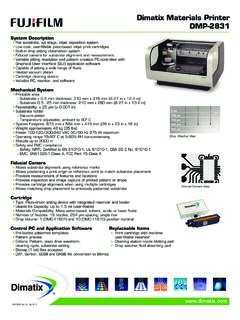
Transcription of Materials Printer & Cartridge DMP-2800 Series Printer ...
1 FAQ00001 11/03/2008 Page 1 of 5 Materials Printer & Cartridge DMP-2800 Series Printer & DMC-11600 Series Cartridge 1. What types of fluids can the Dimatix Materials Printer (DMP) jet? It is possible to jet a wide variety of fluids with the DMP, including aqueous and solvent-based fluids, solutions and particle suspensions. Ideal fluid characteristics are viscosity of 10 centipoise ( Pa*sec) and surface tension of 30 dynes/cm. Particles should not aggregate or settle. 2. What fluid viscosity range is jettable? 2 - 30 cps fluids 3. What material is the Cartridge composed of, and what Materials come in contact with my fluid?
2 DMC-11610/DMC-11601 DMCLCP-11610/DMCLCP-11601 Chemically resistant epoxy Chemically resistant epoxy Peroxide treated EPDM Kalrez Polypropylene LCP (Liquid Crystal Polymer) Silicon Silicon Silicon dioxide Silicon dioxide 4. Is the Cartridge compatible with most organic solvents and acrylate Materials ? Yes, in general there is good compatibility with most solvents: a) Aliphatic alcohols (high boiling point better than low in all cases) b) Aromatic hydrocarbons such as anisole, trimethylbenzene c) Aliphatic hydrocarbons such as hexane, dodecane, d) Cellusolves e) Glycols f) Lactate esters g) Aliphatic and aromatic ketones including tetrahydrofuran (evaporates quickly) h) Polyethylene glycols, polypropylene glycols 5.
3 How do I fill a Cartridge ? The fluid module is filled using a slip fit end syringe blunt end needle. You simply fill the syringe with fluid, insert the needle into the fill port on the fluid module and inject the fluid. A filter may be used between the syringe and the module if you are not sure that the fluid has been filtered. 6. What is the maximum and minimum volume that I can put in a Cartridge ? The maximum volume a Cartridge can hold is ml. The minimum volume is about ml. Under-filling may not allow jet priming. 7. How long will a Cartridge last? Excluding a small amount of fluid used in priming the printhead, 1 ml will provide 1x10⁸ 10 picoliter drops.
4 8. The fluid volume in the Cartridge is small. How much fluid is expressed with each purge? About 5 ul per second FAQs FAQ00001 11/03/2008 Page 2 of 5 How is it controlled or adjusted? The purge time can be adjusted in the Cleaning Cycle editor in second increments. 9. Could we increase the volume of the Cartridge if needed? ml is the maximum volume the Cartridge can hold. 10. What is the maximum temperature of the ink jet head Cartridge heater? 70 C 11. Can the Cartridge (fluid supply) be sterilized in a conventional autoclave? We have not verified whether it is possible. That would be for the end user to try.
5 However, it may be possible to use another chemical sterilization process, , UV. 12. What is the drop size repeatability and accuracy? Drop size repeatability is within untuned and about tuned. 13. What is the smallest size spot or line that I can make? Spot size and line width are dependant on the fluid and substrate interaction. Generally, a 40 m spot can be produced with a 10 pL drop. 14. What is the largest drop that I can make? Nominal drop size is 10 pL. But running in burst mode, you add about 10 pL per pulse. Eight pulse jetting is easily achieved with the Dimatix Model Fluid which produces approximately an 80 picoliter drop.
6 15. What is orifice size of the silicon nozzle? Approximately m 16. Can proteins jet out the silicon MEMS structure? Yes 17. How do I make a pattern to print? The DMP software has a few pre-loaded test patterns. It also has a user interface called the Pattern Generator in which you can create your own pattern. The Pattern Generator has a preview feature which allows you to see the pattern (down to the individual drops) before it is printed. DXF, Gerber, GDSII, OASIS and Bitmap files can also be imported for printing. 18. What drop placement accuracy can I achieve if I replace cartridges and want to jet a drop on a location that I already jetted on?
7 To get the best accuracy you must use the DMP with the Fiducial Camera option, which will allow you to calibrate the position of the nozzle in your new Cartridge and align to a spot that was previously deposited. The system repeatability is 25 microns. 19. What is the spacing between nozzles? Nozzle to nozzle spacing is 254 microns (100 dpi) in a single row. 20. What is the maximum resolution of the DMP? Patterns that are to be jetted are resolved into 5 micron pixels. This means that the smallest increment between one drop and the next can be 5 microns which is equivalent to 5080 dpi. At this spacing you will get drop overlap on your substrate because most spots will be at least 40 microns in diameter.
8 The stages use 1um encoders. 21. What is the controllable frequency range on the printheads? It depends on the fluid, but generally to 80 kHz for ink jet tuned fluids. These fluids are specifically formulated to maximize jetting performance. Other fluids have lower capabilities. FAQ00001 11/03/2008 Page 3 of 5 22. Does the liquid reservoir allow for heating AND cooling or other closed loop type thermal control? The Cartridge has a built-in heater which is capable of heating the fluid to a maximum temperature of 70 C in the jetting structure. The reservoir of fluid is not heated. There is not a built-in cooling mechanism.
9 23. What is the maximum z-axis adjustment? 25 mm 24. What is the temperature range for the heated platen? The platen heats to 60 C. 25. What is the minimum substrate size (will 50mm x 50 mm work)? A 50 mm substrate will be fine. There are vacuum holes on the platen to hold substrates in place. With small substrates, most of the platen s vacuum holes will be open and you may have to tape the substrate down or use a fixture. 26. Can you print on plastic (7 mil PET) with this platen? The platen is designed to handle a variety of substrates. Flexible films work fine because the vacuum system in the platen will hold the material securely.
10 27. Would the system be compatible with a dry box environment? Depending on the fluid you are jetting, in a dry box (0% relative humidity or RH) you may get excessive evaporation of the fluid at the nozzle which may cause problems with jetting. 28. Define adjustable nozzle angle. This feature enables the user to set the drop spacing (resolution) in the y axis to adjust printing resolution or density. When creating a print pattern the user selects a desired drop spacing. Since the nozzles are in a single row, the Cartridge can be set to various angles to adjust the effective spacing of the nozzles for printing.