Example: quiz answers
Math 113 HW #11 Solutions
Math 113 HW #11 Solutions §5.1 4. (a) Estimate the area under the graph of f(x) = √ x from x = 0 to x = 4 using four approx-imating rectangles and right endpoints.
Tags:
Information
Domain:
Source:
Link to this page:
Documents from same domain

Math 113 HW #9 Solutions - Colorado State University
www.math.colostate.eduMath 113 HW #9 Solutions §4.1 50. Find the absolute maximum and absolute minimum values of f(x) = x3 −6x2 +9x+2 on the interval [−1,4]. Answer: First, we find the critical points of f.
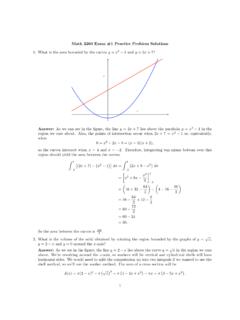
Math 2260 Exam #1 Practice Problem Solutions
www.math.colostate.eduMath 2260 Exam #1 Practice Problem Solutions 1.What is the area bounded by the curves y= x2 1 and y= 2x+ 7? Answer: As we can see in the gure, the line y= 2x+ 7 lies above the parabola y= x2 1 in the region we care about.

Math 113 HW #6 Solutions - Colorado State University
www.math.colostate.eduTherefore, plugging in x = 0 gives the slope of the tangent line at (0,1): e 0 cos0−e 0 sin0 = 1−0 = 1. Therefore, by the point-slope formula, the equation of the tangent line is

Math 115 HW #4 Solutions - Colorado State University
www.math.colostate.eduin other words, we want to show that n+1 √ e n+1 < n √ e n. But certainly n+1 e < n e and n + 1 > n, so the above inequality is true, which implies that the first inequality is true and that the terms are decreasing in absolute value.

Math 215 HW #6 Solutions - Colorado State University
www.math.colostate.edu7. Problem 3.2.8. The methane molecule CH 4 is arranged as if the carbon atom were at the center of a regular tetrahedron with four hydrogen atoms at the vertices. If vertices are placed at (0,0,0), (1,1,0), (1,0,1), and (0,1,1)—note that all six edges have length √ 2,
Math 2260 Exam #1 Practice Problem Solutions
www.math.colostate.eduThe shell is clearly preferable, since the vertical sides will simply run from y= 4 x2 to y= x2 4, whereas for washers the inner and outer sides would both be determined by y= 4 x2 on the top half of the solid and by y= x2 4 on the bottom half of the solid. Since we’re using cylindrical shells and the region runs from x= 2 to x= 2, the volume ...
MATHEMATICAL MODELING A Comprehensive Introduction
www.math.colostate.eduC H A P T E R 1 Mathematical Modeling Mathematical modeling is becoming an increasingly important subject as comput-ers expand our ability to translate mathematical equations and formulations into

9.3-4: Phase Plane Portraits
www.math.colostate.eduSubcases of Case A Saddle λ1 > 0 > λ2 Half line trajectories y x L 1 L 2 Generic Trajectories L 1 L 2 x y • Generic trajectory in each region approaches • L1 for t → ∞ • L2 for t → −∞ Nodal source
8 Some Additional Examples Laplace Transform
www.math.colostate.eduThe Laplace transform is defined for all functions of exponential type. That is, any function f t which is (a) piecewise continuous has at most finitely many finite jump discontinuities on any interval of finite length (b) has exponential growth: for some positive constants M and k

Asymptotic Expansion of Bessel Functions; Applications to ...
www.math.colostate.eduAsymptotic Expansion of Bessel Functions; Applications to Electromagnetics Nada Sekeljic where Jn(z) are Bessel functions of the flrst kind, of order n (n is an integer). Expanding the exponentials, we have a product of two absolutely convergent series in …
Related documents

1. Math 113 Homework 3 Solutions
math.stanford.edu1. Math 113 Homework 3 Solutions By Guanyang Wang, with edits by Prof. Church. Exercises from the book. Exercise 3B.2 Suppose V is a vector space and S;T2L(V;V) are such that
Math 113 HW #9 Solutions - Colorado State University
www.math.colostate.eduMath 113 HW #9 Solutions §4.1 50. Find the absolute maximum and absolute minimum values of f(x) = x3 −6x2 +9x+2 on the interval [−1,4]. Answer: First, we find the critical points of f.