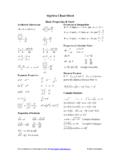
Transcription of Math for Chemistry Cheat Sheet
1 math for Chemistry Cheat Sheet 2005 All Rights Reserved This quick math review outlines the basic rules (left) and Chemistry applications (right) of each term. Unit Conversion The rocess of converting a given unit to a desired unit using conversion factors. Using Conversion Factor: DesiredUnit=Factor x GivenUnit = DesiredUnitxGivenUnitGivenUnit Common Conversion Factors: 1 cal = J; 1 = 10-10m 1 atm = 760 mmHg; 1kg= = C + F = (9/5) x C + 32 1 L = 1 dm3 = 10-3 m3 1 in3 = x 10-6 m3 Metric Conversion: Uses multipliers to convert from one sized unit to another . mega- M 106 kilo- k 103 deci- d 10-1 centi- c 10-2 milli- m 10-3 micro- 10-6 nano- n 10-9 pico- p 10-12 Unit Conversion is used in every aspect of Chemistry .
2 Example 1: How many meters (m) in 123 ft? ()()() Example 2: What is the Fahrenheit at 25 degrees of Celsius? ? F = 32 + (9/5) x C = 32 + 9x25/5 = 77 F Example 3: What is the volume in L of 100 grams of motor oil with a density of g/cm3 ? 3331001? /1000gLLcmxLgcmcm==== Significant Figures The digits in a measurement that are reliable, irrespective of the decimal place s location. Exponents - The number that gives reference to the repeated multiplication required, that is, in xn, n is the exponent. Rule of 1: (a) Any number raised to the power of one equals itself, x1=x. (b) One raised to any power is one, 1n=1. Product Rule: When multipling two powers with the same base, just add the exponents, xm xn = xm+n. Power Rule: To raise a power to a power, just multiply the exponents, (xm )n = xmxn.
3 Quotient Rule: To divide two powers with the same base, just subtract their exponents, (xm ) xn = xm-n. Zero Rule: Any nonzero numbers raised to the power of zeroequals 1, x0 = 1; x 0. Nagative Rule: Any nonzero number raised to a negative power equals its reciprocal raised to the oppositive positive power, x-n = 1/xn; x 0. Exponents is being used everywhere in Chemistry , most noticeably in metric unit conversions and exponential notations. Rule of 1: ; 13=1 Product Rule: 10-12 10-4 = 10(-12)+(-4) = 10-16 Power Rule: (10-12 )2 = 10(-12)x2 = 10-24 Quotient Rule: 108 103 = x8-3= 105 Zero Rule: 100 = 1 Negative Rule: 10-2 = 1/102 = 1/100 = Common Student Errors: #1: -102 (-10)2 . The square of any negative is positive. #2: 22 83 (2x8)2+3 . Product rule applies to same base only. #3: 102+ 103 (10)2+3.
4 Product rule does not apply to the sum. Scientific (Exponential) Notations A exponential form with a number (1-10) times some power of 10, n x 10m Addition: (M x 10n) + (N x 10n) = (M + N) x 10n Subtraction: (M x 10n) - (N x 10n) = (M - N) x 10n Multiplication: (M x 10m) x (N x 10n) = (M x N) x 10m+n Division: (M x 10m) (N x 10n) = (M x N) x 10m-n Power: (N x 10n) m = (N)m x 10n m Root: 1/2/210( 10 )10nnnNxNxN x== #1: ( ) + ( ) = ( + )x10-5 = x10-5 #2: ( ) + ( ) = ( )x10-3 = x10-3 #3: ( ) x ( ) = ( )x10-3+7 = x103 #4: ( ) ( ) = ( )x10(-3)-(+7) = x10-10 #5: ( x 10-3) 2 = ( )2 x 10-3x2 = 10-6 #6: 441/2 4 10( 10 ) 10xxx x=== Logarithm - The logarithm of y with respect to a base b is the exponent to which we have to raise b to obtain y. Definition: x = logby <-> bx = y (Logarithm <->Exponent) Operations: log(x y) = log x + log y log(x/y) = log x log y log(xn) = n log x Natural Logarithm: ln x = logex, where e = Sigficant Figures in logarithm: Only the resulting numbers tothe right of the decimal place are signficant.
5 Log ( ) = Applications: pH = -log[H+], pKa, G= G +RTln(Q) Example: What is the H+ concentration in pH= Solution: (Illustrated by the KUDOS method) Step 1 - Known: pH= Step 2 Unknown: [H+]=?M Step 3 Definition: pH = -log[H+], that is, [H+]=10-(pH) Step 4 Output: [H+]=10-(pH = Step 5 Substantiation: Unit, and value are reasonable. Quadratic Equation - A polynomial equation of the second degree in the form of ax2 + bx + c = 0 Equation: ax2+bx+c=0 Roots: 242bb acxa = - It always has two roots (or solutions) x1 & x2 - For most chemical problems (mass, temperature, concentration etc.), ignore the negative root. Example: equilibrum concentration equation x2 + 3x - 10 = 0. Solution: 223341(10)434922(1)2xxbb acxax === x1=2 and x2=-5, ignore the negative root, so the answer x=2)