Transcription of Mathematics Florida Standards (MAFS) Grade 1
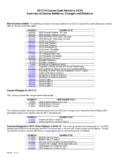
1 | #FLStandards 2014, Florida Department of Education. All Rights Reserved. Mathematics Florida Standards (MAFS) Grade 1 Domain: OPERATIONS AND ALGEBRAIC THINKING Cluster 1: Represent and solve problems involving addition and subtraction . STANDARD CODE STANDARD Use addition and subtraction within 20 to solve word problems1 involving situations of adding to, taking from, putting together, taking apart, and comparing, with unknowns in all positions, , by using objects, drawings, and equations with a symbol for the unknown number to represent the problem (1 Students are not required to independently read the word problems.)
2 Cognitive Complexity: Level 2: Basic Application of Skills & Concepts Solve word problems that call for addition of three whole numbers whose sum is less than or equal to 20, , by using objects, drawings, and equations with a symbol for the unknown number to represent the problem. Cognitive Complexity: Level 2: Basic Application of Skills & Concepts Cluster 2: Understand and apply properties of operations and the relationship between addition and subtraction . STANDARD CODE STANDARD Apply properties of operations as strategies to add and subtract. Examples: If 8 + 3 = 11 is known, then 3 + 8 = 11 is also known.
3 (Commutative property of addition.) To add 2 + 6 + 4, the second two numbers can be added to make a ten, so 2 + 6 + 4 = 2 + 10 = 12. (Associative property of addition.) Cognitive Complexity: Level 2: Basic Application of Skills & Concepts Understand subtraction as an unknown-addend problem. For example, subtract 10 8 by finding the number that makes 10 when added to 8. Cognitive Complexity: Level 2: Basic Application of Skills & Concepts Cluster 3: Add and subtract within 20. STANDARD CODE STANDARD Relate counting to addition and subtraction ( , by counting on 2 to add 2). Cognitive Complexity: Level 1: Recall Add and subtract within 20, demonstrating fluency for addition and subtraction within 10.
4 Use strategies such as counting on; making ten ( , 8 + 6 = 8 + 2 + 4 = 10 + 4 | #FLStandards 2014, Florida Department of Education. All Rights Reserved. = 14); decomposing a number leading to a ten ( , 13 4 = 13 3 1 = 10 1 = 9); using the relationship between addition and subtraction ( , knowing that 8 + 4 = 12, one knows 12 8 = 4); and creating equivalent but easier or known sums ( , adding 6 + 7 by creating the known equivalent 6 + 6 + 1 = 12 + 1 = 13). Cognitive Complexity: Level 2: Basic Application of Skills & Concepts Cluster 4: Work with addition and subtraction equations. STANDARD CODE STANDARD Understand the meaning of the equal sign, and determine if equations involving addition and subtraction are true or false.
5 For example, which of the following equations are true and which are false? 6 = 6, 7 = 8 1, 5 + 2 = 2 + 5, 4 + 1 = 5 + 2. Cognitive Complexity: Level 2: Basic Application of Skills & Concepts Determine the unknown whole number in an addition or subtraction equation relating to three whole numbers. For example, determine the unknown number that makes the equation true in each of the equations 8 + ? = 11, 5 = [] 3, 6 + 6 = []. Cognitive Complexity: Level 2: Basic Application of Skills & Concepts Domain: NUMBER AND OPERATIONS IN BASE TEN Cluster 1: Extend the counting sequence. STANDARD CODE STANDARD Count to 120, starting at any number less than 120.
6 In this range, read and write numerals and represent a number of objects with a written numeral. Cognitive Complexity: Level 1: Recall Cluster 2: Understand place value. STANDARD CODE STANDARD Understand that the two digits of a two-digit number represent amounts of tens and ones. a. 10 can be thought of as a bundle of ten ones called a ten. b. The numbers from 11 to 19 are composed of a ten and one, two, three, four, five, six, seven, eight, or nine ones. c. The numbers 10, 20, 30, 40, 50, 60, 70, 80, 90 refer to one, two, three, four, five, six, seven, eight, or nine tens (and 0 ones). d.
7 Decompose two-digit numbers in multiple ways ( , 64 can be decomposed into 6 tens and 4 ones or into 5 tens and 14 ones). Cognitive Complexity: Level 2: Basic Application of Skills & Concepts | #FLStandards 2014, Florida Department of Education. All Rights Reserved. Compare two two-digit numbers based on meanings of the tens and ones digits, recording the results of comparisons with the symbols >, =, and <. Cognitive Complexity: Level 2: Basic Application of Skills & Concepts Cluster 3: Use place value understanding and properties of operations to add and subtract. (Additional Cluster) Don t sort clusters from Major to Supporting, and then teach them in that order.
8 To do so would strip the coherence of the mathematical ideas and miss the opportunity to enhance the major work of the Grade with the supporting clusters. STANDARD CODE STANDARD Add within 100, including adding a two-digit number and a one-digit number, and adding a two-digit number and a multiple of 10, using concrete models or drawings and strategies based on place value, properties of operations, and/or the relationship between addition and subtraction ; relate the strategy to a written method and explain the reasoning used. Understand that in adding two-digit numbers, one adds tens and tens, ones and ones; and sometimes it is necessary to compose a ten.
9 Cognitive Complexity: Level 2: Basic Application of Skills & Concepts Given a two-digit number, mentally find 10 more or 10 less than the number, without having to count; explain the reasoning used. Cognitive Complexity: Level 2: Basic Application of Skills & Concepts Subtract multiples of 10 in the range 10-90 from multiples of 10 in the range 10-90 (positive or zero differences), using concrete models or drawings and strategies based on place value, properties of operations, and/or the relationship between addition and subtraction ; relate the strategy to a written method and explain the reasoning used.
10 Cognitive Complexity: Level 2: Basic Application of Skills & Concepts Domain: MEASUREMENT AND DATA Cluster 1: Measure lengths indirectly and by iterating length units. STANDARD CODE STANDARD Order three objects by length; compare the lengths of two objects indirectly by using a third object. Cognitive Complexity: Level 2: Basic Application of Skills & Concepts Understand how to use a ruler to measure length to the nearest inch. a. Recognize that the ruler is a tool that can be used to measure the attribute of length. b. Understand the importance of the zero point and end point and that the length measure is the span between two points.