Transcription of MBEYA REGION SOCIO-ECONOMIC PROFILE - …
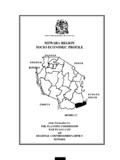
1 KENYAUGANDARWANDABURUNDIZAMBIAMSUMBIJITH E UNITED REPUBLIC OF TANZANIAMBEYA REGIONSOCIO- economic PROFILEJ oint Publication by:THE PLANNING COMMISSIONDAR ES SALAAMandREGIONAL COMMISSIONER'S OFFICEMBEYAMBEYA iTABLE OF CONTENTS Pages SECTION LAND POPULATION AND CLIMATE:..1 GEOGRAPHICAL LOCATION:..1 REGIONAL AREA AND ADMINISTRATIVE ADMINISTRATIVE DIVISIONS:..2 LAND USE:..4 (III) ETHNIC GROUPS:..7 (IV) POPULATION SIZE AND GROWTH:..7 POPULATION DENSITY AND DISTRIBUTION:..12 MIGRATION:..19 TOPOGRAPHY.
2 23 SECTION THE REGIONAL ECONOMY:..25 PRODUCTIVE Agriculture:..40 A. FOOD CASH CROPS:..45 IRRIGATION:..52 FARM IMPLEMENTS:..53 FARM INPUTS:..55 STORAGE DIARY CATTLE LIVESTOCK INFRASTRUCTURES:..65 NATURAL RESOURCES:..67 Introduction:..67 Afforestation:..70 Wildlife:..73 Beekeeping:..74 FISHING INDUSTRY:..78 MINING:..84 INDUSTRIAL ACTIVITIES:..85 SECTION economic INFRASTRUCTURE:..88 ROAD NETWORK:..88 Introduction:..88 SOURCE: PLANNING COMMISSION - COMPILED DATA BASED ON DISTRICT SOCIO-ECONOMIC ROAD NETWORK MAP - MBEYA RAILWAY TRANSPORT.
3 95 AIR TRANSPORT:..95 WATER WAYS: (Marine Transport)..95 ENERGY:..96 ELECTRICITY:..96 FUELWOOD AND CHARCOAL:..97 SOLAR ENERGY:..98 BIO-GAS ENERGY:..98 COAL AND PADDY HUSKS:..98 POSTS AND TELECOMMUNICATION NETWORK:..98 SECTION SOCIAL EDUCATION:..101 PRIMARY EDUCATION:..101 PRIMARY SCHOOL DROP-OUTS:..120 SECONDARY SCHOOL ADULT iiiOTHER TRAINING INSTITUTIONS:..141 HEALTH SECTOR:..142 DISPENSARIES:..144 HEALTH CENTRES:..145 HOSPITAL SERVICES:..146 Mortality:..149 MATERNAL MALNUTRITION:..154 WATER (A) URBAN WATER SUPPLY.
4 161 RURAL WATER SUPPLY SCHEMES:..163 ENVIRONMENTAL SANITATION:..165 SECTION OTHER RELATED DEVELOPMENT ISSUES:..167 CO-OPERATIVE ACTIVITIES:..167 A. UNIONS:..167 PRIMARY CO-OPERATIVE SOCIETIES:..169 WOMEN IN DEVELOPMENT:..171 SECTION DEVELOPMENT POTENTIALS AND PROSPECTS:..175 AGRICULTURE:..175 IRRIGATION:..175 ANIMAL HUSBANDRY:..177 BEEKEEPING:..177 FISHING:..178 INDUSTRIES:..178 TOURISM:..179 MINING INDUSTRY:..181 ivANNEX GENERAL INFORMATION ABOUT AREA OF TANZANIA MAINLAND AREA BY regions (SQ KM).
5 186 LAND ARABLE LAND:..188 MOUNTAIN SUMMITS (METRES ABOVE SEA LEVEL)..188 (A) SOCIAL HEALTH EDUCATION: ENROLMENT RATES 1995 COMPARED WITH OTHER EAST AFRICA NATIONAL vFOREWORD 1. As we approach the 21st Century the problems facing rural areas in developing countries like Tanzania are numerous and formidable. Social and economic services are deteriorating and proving to be unsustainable; school enrollment rates are declining; food situation is precarious; infant and maternal mortality rates continue to be high; unemployment is on the rise triggering off mass migration of youth from the rural areas into already overcrowded urban centres; in MBEYA REGION , for example, land pressure is escalating and deforestation is going on at an alarming rate.
6 2. This situation has arisen because of many factors including ill - prepared rural development programmes and weak monitoring and supervision of the implementation of development programmes and sectoral strategies. The observed shortcomings in the policy formulation, project identification, design, and implementation in the developing countries is in turn attributed to lack of reliable and adequate data and information on the rural development process.
7 3. The publication of Regional SOCIO-ECONOMIC Profiles series by the Planning Commission in collaboration with Regional Commissioner's offices should be viewed as a fruitful attempt towards finding solutions to the existing problem of data and information gap. 4. The Regional PROFILE series cover a wide range of data and information on geography, population, social economic parameters, social services, economic infrastructure and productive sectors.
8 The publications so far have proved to be of high demand and a vital source of information to many vipolicy makers, planners, researchers, donors and functional managers. The Planning Commission has found it a worthwhile effort to extend the exercise to cover even more regions . Readers are invited to make suggestions and constructive criticisms which can assist in improving the quality and effectiveness of future Profiles. 5. I would like to take this opportunity to acknowledge with thanks once again the financial support of the Royal Norwegian Embassy which facilitated the preparation of the MBEYA REGION SOCIO-ECONOMIC PROFILE .
9 I would also like to thank both the Planning Commission and MBEYA Regional Planning Staff who put a lot of effort into ensuring the successful completion of this task. Nassoro W. Malocho (MP) MINISTER OF STATE PLANNING AND PARASTATAL SECTOR REFORM April 1997 1 SECTION I LAND POPULATION AND CLIMATE: Geographical Location: MBEYA REGION originally belonged to the Southern Highlands Province. In 1963, the Southern Highalands Province was split into two regions namely, MBEYA and Iringa.
10 In 1972, MBEYA REGION was extended to incorporate Sumbawanga District which before then belonged to the Western Province. However, the inclusion of Sumbawanga District into MBEYA REGION did not last long because in 1974 Sumbawanga District was separated and accorded full Regional status. It is located in the South Western Corner of the Southern Highlands of Tanzania. The REGION lies between Latitudes 7o and 9o 31% South of Equator, and between Longitudes 32o and 32o and 35o East of Greenwich.