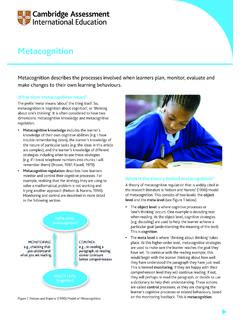
Transcription of METACOGNITION AND SELF-REGULATED LEARNING
1 Guidance ReportMETACOGNITION AND SELF-REGULATED LEARNING2 Education Endowment Foundation The authors would like to thank the many researchers and practitioners who provided support and feedback on drafts of this guidance. In particular we would like to thank the Advisory Panel and Review Team:Advisory Panel: Kate Atkins (Rosendale School), Professor Steve Higgins (Durham University), Dr David Whitebread (Cambridge University), Alex Quigley (Huntington School) and Professor Jonathan Sharples (EEF and UCL Institute of Education).Review team: Professor Daniel Muijs and Dr Christian Bokhove (University of Southampton).Written by: Alex Quigley (Huntington School), Professor Daniel Muijs (previously University of Southampton, now at Ofsted) and Eleanor Stringer (Education Endowment Foundation).33 METACOGNITION and SELF-REGULATED learningForeword 4 Introduction 5 Summary of recommendations 6 What are METACOGNITION and SELF-REGULATED LEARNING ?
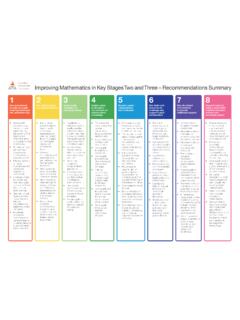
2 8 Recommendation 1 Teachers should acquire the professional understanding and skills to develop their pupils metacognitive knowledge10 Recommendation 2 Explicitly teach pupils metacognitive strategies, including how to plan, monitor, and evaluate their learning12 Recommendation 3 Model your own thinking to help pupils develop their metacognitive and cognitive skills16 Recommendation 4 Set an appropriate level of challenge to develop pupils self-regulation and metacognition18 Recommendation 5 Promote and develop metacognitive talk in the classroom20 Recommendation 6 Explicitly teach pupils how to organise, and effectively manage, their LEARNING independently22 Recommendation 7 Schools should support teachers to develop their knowledge of these approaches and expect them to be applied appropriately 26 References 28 How was this guidance compiled?
3 30 CONTENTS4 Education Endowment Foundation FOREWORD We hope this report brings some clarity and guidance to an area of teaching and LEARNING that holds so much promise but that can be difficult to implement. When we launched the Sutton Trust-EEF Teaching and LEARNING Toolkit in 2011, we designed it particularly with busy teachers and senior leaders in mind. Our aim was to bridge the gap between educational research and classroom practice, presenting our accumulated understanding of what works in a practical and accessible way. But there was one particular bit of education jargon we couldn t avoid: METACOGNITION and self-regulation . Rated by the Toolkit as high impact for very low cost, based on extensive evidence it can nonetheless seem an elusive topic. And with good reason. Beyond a simple definition of thinking about thinking or LEARNING to learn , it can be hard to describe what METACOGNITION means in the classroom.
4 On a very basic level, it s about pupils ability to monitor, direct, and review their LEARNING . Effective metacognitive strategies get learners to think about their own LEARNING more explicitly, usually by teaching them to set goals, and monitor and evaluate their own academic METACOGNITION is easier said than done; there s certainly no simple method or trick. We know that learners develop some metacognitive knowledge and skills naturally, and most teachers support METACOGNITION in their teaching without realising it. That said, it can be difficult to give concrete examples of what metacognitive knowledge and skills actually look like. But with a large body of international evidence telling us that when properly embedded these approaches are powerful levers for boosting LEARNING , it s clear that we need to spend time looking at how to do this well.
5 Teachers want to know more too. Since we launched the Teaching and LEARNING Toolkit, the strand on METACOGNITION and self-regulation has consistently ranked as one of our most popular and has been accessed over 120,000 times. This is why we ve produced this report. It offers seven practical, evidence-based recommendations to support teachers to develop metacognitive knowledge and skills in their pupils. The guidance is relevant to early years practitioners, teachers, and senior leaders in primary and secondary schools, as well as those in post-16 settings. To develop the recommendations, we reviewed the best available international research and consulted experts, teachers, and academics to arrive at key principles for effective teaching. Each recommendation is accompanied by specific examples designed to bring the work alive for teachers.
6 We hope this report brings some clarity and guidance to an area of teaching and LEARNING that holds so much promise but that can be difficult to implement. The EEF and its partners, particularly our network of Research Schools, will be producing a range of supporting resources, tools, and training to help you implement the recommendations in your classrooms. Sir Kevan Collins Chief Executive Education Endowment Foundation5 INTRODUCTION5 METACOGNITION and SELF-REGULATED learningreview our Early Years Toolkit, specifically the strand on self-regulation strategies, for further guidance).1 It is aimed primarily at senior leaders and teachers responsible for staff development. It may also be useful for class teachers with an interest in how research can improve their teaching. Further audiences who may find the guidance relevant include governors, parents, programme developers, and educational on the guidance Additional EEF resources to support the implementation of the recommendations made in this report are in the process of development.
7 As well as these resources, our other guidance reports can support the implementation of specific recommendations. The subject-specific reports, such as those on literacy, maths, and science, can be used in conjunction with this report to support pupils attainment in these subjects. The more general guidance, such as Putting Evidence to Work A School s Guide to Implementation, can also support teachers and senior staff to apply the recommendations in a may also want to seek support from our national network of Research Schools, a collaboration between the EEF and the Institute for Effective Education. Research Schools aim to lead the way in the use of evidence-based teaching, building affiliations with large numbers of schools in their region, and supporting the use of evidence at scale. Often the research evidence is generic and hard to interpret; by giving specific examples we have tried to bring the work alive for teachers.
8 What does this guidance cover?This guidance report is relevant to the teaching of all students, within any subject area. Most of the examples included are from Key Stages 1 to 4, where the research is strongest. It introduces a simplified framework for SELF-REGULATED LEARNING and due course, we will publish a more detailed research review exploring the subject in more depth; this is an area of academic discussion that may be of interest to some teachers. Here, however, we have simplified the frameworks to allow for ease of understanding and use in real-world settings we focus on what the evidence says about what teachers can do to develop these skills. Often the research evidence is generic and hard to interpret; by giving specific examples we have tried to bring the work alive for teachers (but this means they are less directly supported by strong evidence).
9 This guidance draws on a review of the evidence about SELF-REGULATED LEARNING and METACOGNITION led by Professor Daniel Muijs and Dr Christian Bokhove (University of Southampton). It is not a new study in itself, but rather is intended as an accessible overview of existing research with clear, actionable guidance. More information about the review and the process is at the end of the report. Some key references are included here; for those wishing to explore the subject in more depth, the forthcoming review will contain a more comprehensive reference section. Who is this guidance for?This guidance is applicable to both primary and secondary schools, and some recommendations may be relevant for early years education (you may want to 6 Education Endowment Foundation SUMMARY OF RECOMMENDATIONSM odel your own thinking to help pupils develop their metacognitive and cognitive skills Modelling by the teacher is a cornerstone of effective teaching; revealing the thought processes of an expert learner helps to develop pupils metacognitive skills.)
10 Teachers should verbalise their metacognitive thinking ( What do I know about problems like this? What ways of solving them have I used before? ) as they approach and work through a task. Scaffolded tasks, like worked examples, allow pupils to develop their metacognitive and cognitive skills without placing too many demands on their mental resources. 3 Page 18 SELF-REGULATED learners are aware of their strengths and weaknesses, and can motivate themselves to engage in, and improve, their LEARNING . Developing pupils metacognitive knowledge of how they learn their knowledge of themselves as a learner, of strategies, and of tasks is an effective way of improving pupil outcomes. Teachers should support pupils to plan, monitor, and evaluate their should acquire the professional understanding and skills to develop their pupils metacognitive knowledge Page 121 Sections are colour coded for ease of reference Find this info on: Explicit instruction in cognitive and metacognitive strategies can improve pupils LEARNING .