Transcription of METHOD 8260B VOLATILE ORGANIC COMPOUNDS BY …
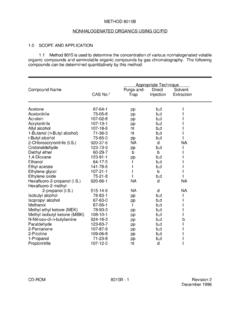
1 METHOD 8260B . VOLATILE ORGANIC COMPOUNDS BY GAS CHROMATOGRAPHY/. MASS SPECTROMETRY (GC/MS). SCOPE AND APPLICATION. METHOD 8260 is used to determine VOLATILE ORGANIC COMPOUNDS in a variety of solid waste matrices. This METHOD is applicable to nearly all types of samples, regardless of water content, including various air sampling trapping media, ground and surface water, aqueous sludges, caustic liquors, acid liquors, waste solvents, oily wastes, mousses, tars, fibrous wastes, polymeric emulsions, filter cakes, spent carbons, spent catalysts, soils, and sediments. The following COMPOUNDS can be determined by this METHOD : Appropriate Preparation Techniquea 5030/ Direct compound CAS 5035 5031 5032 5021 5041 Inject. Acetone 67-64-1 pp c c nd c c Acetonitrile 75-05-8 pp c nd nd nd c Acrolein (Propenal) 107-02-8 pp c c nd nd c Acrylonitrile 107-13-1 pp c c nd c c Allyl alcohol 107-18-6 ht c nd nd nd c Allyl chloride 107-05-1 c nd nd nd nd c Benzene 71-43-2 c nd c c c c Benzyl chloride 100-44-7 c nd nd nd nd c Bis(2-chloroethyl)sulfide 505-60-2 pp nd nd nd nd c Bromoacetone 598-31-2 pp nd nd nd nd c Bromochloromethane 74-97-5 c nd c c c c Bromodichloromethane 75-27-4 c nd c c c c 4-Bromofluorobenzene (surr) 460-00-4 c nd c c c c Bromoform 75-25-2 c nd c c c c Bromomethane 74-83-9 c nd c c c c n-Butanol 71-36-3 ht c nd nd nd c 2-Butanone (MEK) 78-93-3 pp c c nd nd c t-Butyl alcohol 75-65-0 pp c nd nd nd c Carbon disulfide 75-15-0 pp nd c nd c c Carbon tetrachloride 56-23-5 c nd c c c c Chloral hydrate 302-17-0 pp nd nd nd nd c Chlorobenzene 108-90-7 c nd c c c c Chlorobenzene-d5 (IS)
2 C nd c c c c Chlorodibromomethane 124-48-1 c nd c nd c c Chloroethane 75-00-3 c nd c c c c 2-Chloroethanol 107-07-3 pp nd nd nd nd c 2-Chloroethyl vinyl ether 110-75-8 c nd c nd nd c Chloroform 67-66-3 c nd c c c c Chloromethane 74-87-3 c nd c c c c Chloroprene 126-99-8 c nd nd nd nd c 3-Chloropropionitrile 542-76-7 I nd nd nd nd pc (continued). CD-ROM 8260B - 1 Revision 2. December 1996. Appropriate Preparation Techniquea 5030/ Direct compound CAS 5035 5031 5032 5021 5041 Inject. Crotonaldehyde 4170-30-3 pp c nd nd nd c 1,2-Dibromo-3-chloropropane 96-12-8 pp nd nd c nd c 1,2-Dibromoethane 106-93-4 c nd nd c nd c Dibromomethane 74-95-3 c nd c c c c 1,2-Dichlorobenzene 95-50-1 c nd nd c nd c 1,3-Dichlorobenzene 541-73-1 c nd nd c nd c 1,4-Dichlorobenzene 106-46-7 c nd nd c nd c 1,4-Dichlorobenzene-d4 (IS) c nd nd c nd c cis-1,4-Dichloro-2-butene 1476-11-5 c nd c nd nd c trans-1,4-Dichloro-2-butene 110-57-6 pp nd c nd nd c Dichlorodifluoromethane 75-71-8 c nd c c nd c 1,1-Dichloroethane 75-34-3 c nd c c c c 1,2-Dichloroethane 107-06-2 c nd c c c c 1,2-Dichloroethane-d4 (surr)
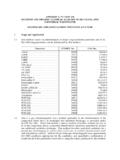
3 C nd c c c c 1,1-Dichloroethene 75-35-4 c nd c c c c trans-1,2-Dichloroethene 156-60-5 c nd c c c c 1,2-Dichloropropane 78-87-5 c nd c c c c 1,3-Dichloro-2-propanol 96-23-1 pp nd nd nd nd c cis-1,3-Dichloropropene 10061-01-5 c nd c nd c c trans-1,3-Dichloropropene 10061-02-6 c nd c nd c c 1,2,3,4-Diepoxybutane 1464-53-5 c nd nd nd nd c Diethyl ether 60-29-7 c nd nd nd nd c 1,4-Difluorobenzene (IS) 540-36-3 nd nd nd nd c nd 1,4-Dioxane 123-91-1 pp c c nd nd c Epichlorohydrin 106-89-8 I nd nd nd nd c Ethanol 64-17-5 I c c nd nd c Ethyl acetate 141-78-6 I c nd nd nd c Ethylbenzene 100-41-4 c nd c c c c Ethylene oxide 75-21-8 pp c nd nd nd c Ethyl methacrylate 97-63-2 c nd c nd nd c Fluorobenzene (IS) 462-06-6 c nd nd nd nd nd Hexachlorobutadiene 87-68-3 c nd nd c nd c Hexachloroethane 67-72-1 I nd nd nd nd c 2-Hexanone 591-78-6 pp nd c nd nd c 2-Hydroxypropionitrile 78-97-7 I nd nd nd nd pc Iodomethane 74-88-4 c nd c nd c c Isobutyl alcohol 78-83-1 pp c nd nd nd c Isopropylbenzene 98-82-8 c nd nd c nd c Malononitrile 109-77-3 pp nd nd nd nd c Methacrylonitrile 126-98-7 pp I nd nd nd c Methanol 67-56-1 I c nd nd nd c Methylene chloride 75-09-2 c nd c c c c Methyl methacrylate 80-62-6 c nd nd nd nd c 4-Methyl-2-pentanone (MIBK) 108-10-1 pp c c nd nd c Naphthalene 91-20-3 c nd nd c nd c (continued).
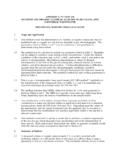
4 CD-ROM 8260B - 2 Revision 2. December 1996. Appropriate Preparation Techniquea 5030/ Direct compound CAS 5035 5031 5032 5021 5041 Inject. Nitrobenzene 98-95-3 c nd nd nd nd c 2-Nitropropane 79-46-9 c nd nd nd nd c N-Nitroso-di-n-butylamine 924-16-3 pp c nd nd nd c Paraldehyde 123-63-7 pp c nd nd nd c Pentachloroethane 76-01-7 I nd nd nd nd c 2-Pentanone 107-87-9 pp c nd nd nd c 2-Picoline 109-06-8 pp c nd nd nd c 1-Propanol 71-23-8 pp c nd nd nd c 2-Propanol 67-63-0 pp c nd nd nd c Propargyl alcohol 107-19-7 pp I nd nd nd c $-Propiolactone 57-57-8 pp nd nd nd nd c Propionitrile (ethyl cyanide) 107-12-0 ht c nd nd nd pc n-Propylamine 107-10-8 c nd nd nd nd c Pyridine 110-86-1 I c nd nd nd c Styrene 100-42-5 c nd c c c c 1,1,1,2-Tetrachloroethane 630-20-6 c nd nd c c c 1,1,2,2-Tetrachloroethane 79-34-5 c nd c c c c Tetrachloroethene 127-18-4 c nd c c c c Toluene 108-88-3 c nd c c c c Toluene-d8 (surr) 2037-26-5 c nd c c c c o-Toluidine 95-53-4 pp c nd nd nd c 1,2,4-Trichlorobenzene 120-82-1 c nd nd c nd c 1,1,1-Trichloroethane 71-55-6 c nd c c c c 1,1,2-Trichloroethane 79-00-5 c nd c c c c Trichloroethene 79-01-6 c nd c c c c Trichlorofluoromethane 75-69-4 c nd c c c c 1,2,3-Trichloropropane 96-18-4 c nd c c c c Vinyl acetate 108-05-4 c nd c nd nd c Vinyl chloride 75-01-4 c nd c c c c o-Xylene 95-47-6 c nd c c c c m-Xylene 108-38-3 c nd c c c c p-Xylene 106-42-3 c nd c c c c a See Sec.
5 For other appropriate sample preparation techniques b Chemical Abstract Service Registry Number c = Adequate response by this technique ht = METHOD analyte only when purged at 80EC. nd = Not determined I = Inappropriate technique for this analyte pc = Poor chromatographic behavior pp = Poor purging efficiency resulting in high Estimated Quantitation Limits surr = Surrogate IS = Internal Standard CD-ROM 8260B - 3 Revision 2. December 1996. There are various techniques by which these COMPOUNDS may be introduced into the GC/MS system. The more common techniques are listed in the table above. Purge-and-trap, by methods 5030 (aqueous samples) and 5035 (solid and waste oil samples), is the most commonly used technique for VOLATILE ORGANIC analytes. However, other techniques are also appropriate and necessary for some analytes. These include direct injection following dilution with hexadecane ( METHOD 3585) for waste oil samples; automated static headspace by METHOD 5021 for solid samples; direct injection of an aqueous sample (concentration permitting) or injection of a sample concentrated by azeotropic distillation ( METHOD 5031); and closed system vacuum distillation ( METHOD 5032) for aqueous, solid, oil and tissue samples.
6 For air samples, METHOD 5041 provides methodology for desorbing VOLATILE organics from trapping media ( methods 0010, 0030, and 0031). In addition, direct analysis utilizing a sample loop is used for sub-sampling from Tedlar bags ( METHOD 0040). METHOD 5000 provides more general information on the selection of the appropriate introduction METHOD . METHOD 8260 can be used to quantitate most VOLATILE ORGANIC COMPOUNDS that have boiling points below 200EC. VOLATILE , water soluble COMPOUNDS can be included in this analytical technique by the use of azeotropic distillation or closed-system vacuum distillation. Such COMPOUNDS include low molecular weight halogenated hydrocarbons, aromatics, ketones, nitriles, acetates, acrylates, ethers, and sulfides. See Tables 1 and 2 for analytes and retention times that have been evaluated on a purge-and-trap GC/MS system. Also, the METHOD detection limits for 25- mL sample volumes are presented. The following COMPOUNDS are also amenable to analysis by METHOD 8260: Bromobenzene 1,3-Dichloropropane n-Butylbenzene 2,2-Dichloropropane sec-Butylbenzene 1,1-Dichloropropene tert-Butylbenzene p-Isopropyltoluene Chloroacetonitrile Methyl acrylate 1-Chlorobutane Methyl-t-butyl ether 1-Chlorohexane Pentafluorobenzene 2-Chlorotoluene n-Propylbenzene 4-Chlorotoluene 1,2,3-Trichlorobenzene Dibromofluoromethane 1,2,4-Trimethylbenzene cis-1,2-Dichloroethene 1,3,5-Trimethylbenzene The estimated quantitation limit (EQL) of METHOD 8260 for an individual compound is somewhat instrument dependent and also dependent on the choice of sample preparation/introduction METHOD .
7 Using standard quadrapole instrumentation and the purge-and-trap technique, limits should be approximately 5 g/kg (wet weight) for soil/sediment samples, mg/kg (wet weight) for wastes, and 5 g/L for ground water (see Table 3). Somewhat lower limits may be achieved using an ion trap mass spectrometer or other instrumentation of improved design. No matter which instrument is used, EQLs will be proportionately higher for sample extracts and samples that require dilution or when a reduced sample size is used to avoid saturation of the detector. This METHOD is restricted to use by, or under the supervision of, analysts experienced in the use of gas chromatograph/mass spectrometers, and skilled in the interpretation of mass spectra and their use as a quantitative tool. CD-ROM 8260B - 4 Revision 2. December 1996. SUMMARY OF METHOD . The VOLATILE COMPOUNDS are introduced into the gas chromatograph by the purge-and-trap METHOD or by other methods (see Sec. ). The analytes are introduced directly to a wide-bore capillary column or cryofocussed on a capillary pre-column before being flash evaporated to a narrow-bore capillary for analysis.
8 The column is temperature-programmed to separate the analytes, which are then detected with a mass spectrometer (MS) interfaced to the gas chromatograph (GC). Analytes eluted from the capillary column are introduced into the mass spectrometer via a jet separator or a direct connection. (Wide-bore capillary columns normally require a jet separator, whereas narrow-bore capillary columns may be directly interfaced to the ion source). Identification of target analytes is accomplished by comparing their mass spectra with the electron impact (or electron impact-like) spectra of authentic standards. Quantitation is accomplished by comparing the response of a major (quantitation) ion relative to an internal standard using a five-point calibration curve. The METHOD includes specific calibration and quality control steps that supersede the general requirements provided in METHOD 8000. INTERFERENCES. Major contaminant sources are VOLATILE materials in the laboratory and impurities in the inert purging gas and in the sorbent trap.
9 The use of non-polytetrafluoroethylene (PTFE) thread sealants, plastic tubing, or flow controllers with rubber components should be avoided, since such materials out-gas ORGANIC COMPOUNDS which will be concentrated in the trap during the purge operation. Analyses of calibration and reagent blanks provide information about the presence of contaminants. When potential interfering peaks are noted in blanks, the analyst should change the purge gas source and regenerate the molecular sieve purge gas filter. Subtracting blank values from sample results is not permitted. If reporting values without correcting for the blank results in what the laboratory feels is a false positive result for a sample, the laboratory should fully explained this in text accompanying the uncorrected data. Contamination may occur when a sample containing low concentrations of VOLATILE ORGANIC COMPOUNDS is analyzed immediately after a sample containing high concentrations of VOLATILE ORGANIC COMPOUNDS . A technique to prevent this problem is to rinse the purging apparatus and sample syringes with two portions of ORGANIC -free reagent water between samples.
10 After the analysis of a sample containing high concentrations of VOLATILE ORGANIC COMPOUNDS , one or more blanks should be analyzed to check for cross-contamination. Alternatively, if the sample immediately following the high concentration sample does not contain the VOLATILE ORGANIC COMPOUNDS present in the high level sample, freedom from contamination has been established. For samples containing large amounts of water-soluble materials, suspended solids, high boiling COMPOUNDS , or high concentrations of COMPOUNDS being determined, it may be necessary to wash the purging device with a soap solution, rinse it with ORGANIC -free reagent water, and then dry the purging device in an oven at 105EC. In extreme situations, the entire purge-and-trap device may require dismantling and cleaning. Screening of the samples prior to purge-and-trap GC/MS analysis is highly recommended to prevent contamination of the system. This is especially true for soil and waste samples. Screening may be accomplished with an automated headspace technique ( METHOD 5021) or by METHOD 3820 (Hexadecane Extraction and Screening of Purgeable Organics).