Example: bankruptcy
Methodological Briefs Impact Evaluation No. 7
A randomized controlled trial (RCT) is a way of doing impact evaluation in which the population receiving the programme or policy intervention is chosen at random from the eligible population, and a control group is also chosen at random from the same eligible population. It tests the extent to which specific, planned
Tags:
Information
Domain:
Source:
Link to this page:
Documents from same domain

Prevalence and Correlates of Food Insecurity among ...
www.unicef-irc.org1 Prevalence and Correlates of Food Insecurity among Children across the Globe Audrey L. Pereira, Sudhanshu Handa, and Goran Holmqvist Office of Research - …
The Adolescent Brain: A second window of …
www.unicef-irc.orgThe Adolescent Brain: A second window of opportunity THE ADOLESCENT BRAIN: A SECOND WINDOW OF OPPORTUNITY A Compendium FOREWORD UNICEF Executive Director, Anthony Lake

Towards Inclusive Education - UNICEF-IRC
www.unicef-irc.orgTowards Inclusive Education The impact of disability on school attendance in developing countries Suguru Mizunoya, Sophie Mitra and Izumi Yamasaki

DOMESTIC VIOLENCE - UNICEF-IRC
www.unicef-irc.orgdomestic violence against women and girls overview scope of the problem magnitude of the problem causes of domestic violence consequences calculating the socio-economic costs of violence strategies and interventions: an integrated approach combating domestic violence: obligations of the state innocenti digest

Methodological Briefs Impact Evaluation No. 9 - …
www.unicef-irc.orgUNICEF OFFICE OF RESEARCH The Office of Research is UNICEF’s dedicated research arm. Its prime objectives are to improve international understanding of issues relating to children’s rights and to help facilitate full implementation of
Chapter 6 Globalisation and Child Labour - UNICEF …
www.unicef-irc.orgCHAPTER 6: GLOBALISATION AND CHILD LABOUR 2 1. Introduction Economists have long been aware that international trade is beneficial on efficiency
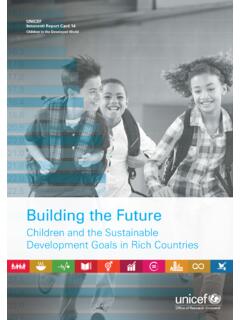
Children and the Sustainable - UNICEF-IRC
www.unicef-irc.orgBuilding the Future Children and the Sustainable Development Goals in Rich Countries UNICEF Innocenti Report Card 14 Children in the Developed World. Innocenti Report Card 14 was written by Chris Brazier. ... Report Card 14 BUILDING THE FUTURE.
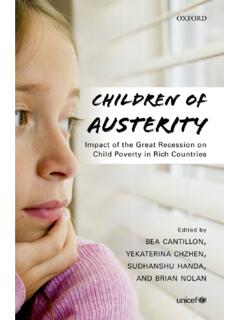
CHILDREN OF AUSTERITY - UNICEF-IRC
www.unicef-irc.orgChildren of Austerity Impact of the Great Recession on Child Poverty in Rich Countries Edited by BEA CANTILLON, YEKATERINA CHZHEN, SUDHANSHU HANDA, AND BRIAN NOLAN Published by The United Nations Children’s Fund and Oxford University Press …
Overview: Data Collection and Analysis Methods in Impact ...
www.unicef-irc.orgData collection and analysis methods should be chosen to match the particular evaluation in terms of its key evaluation questions (KEQs) and the resources available. Impact evaluations should make maximum use of existing data and then fill gaps with new

Quasi-Experimental Design and Methods - UNICEF-IRC
www.unicef-irc.orgex-post impact evaluation designs. It may also be necessary to use quasi-experimental designs for ex-ante impact evaluations, for example, where ethical, political or logistical constraints, like the need for a …
Related documents

Page 1 / 2 Safety of Ivermectin
covid19criticalcare.com2) Randomized controlled trial, with 3 arms; one arm treated with 1.2 mg/kg for 5 days, and another treated with 0.6mg/kg for 5 days with no differences in side effects 3) A report by the State Health Minister on 3,000 patients in La Pampa, Argentina who were
Randomized Trial of Molnupiravir or Placebo in Patients ...
evidence.nejm.orgDec 16, 2021 · MOVe-IN (protocol MK-4482-001) was a randomized, placebo-controlled, double-blind phase 2/3 trial evaluating safety and efficacy of molnupiravir in hospitalized adults with Covid-19 (ClinicalTrials.gov NCT04575584). The phase 2 component of MOVe-IN (initiated October 21, 2020) was conducted at 65 hospitals/treatment centers in
Efficacy & Safety of BNT162b2 booster - C4591031 2 month ...
www.cdc.govNov 19, 2021 · • Randomized at a 1:1 ratio into Study C4591031 to receive either • a booster dose of BNT162b2 30 µg or a placebo dose at least 6 months after the second dose. • Randomization was stratified by age, such that approximately 60% of participants enrolled would be ≥16 to 55 years of age and approximately 40% of participants >55 years of age.
Randomized Block Analysis of Variance - NCSS
ncss-wpengine.netdna-ssl.comThe randomized block design is often confused with a single-factor repeated measures design because the analysis of each is similar. However, the randomization pattern is different. In a randomized block design, the treatments are applied in random order within each block. In a repeated measures design, however, the treatments are usually