Transcription of Microsoft Outlook 2007 - CustomGuide
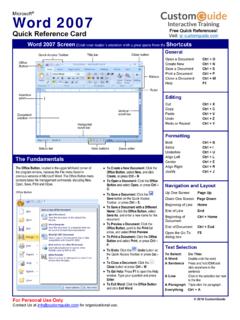
1 Microsoft Outlook 2007 Quick Reference Card Outlook 2007 Screen Navigation Pane Menu Bar Title Bar Messages Navigation Pane buttons Standard Toolbar Status Bar Reading Pane To-Do Bar Navigation Pane Shortcuts Add shortcuts to folders and locations in Outlook for quick to organize to-do lists, track task progress, and delegate tasks. Contains mail-related folders like your Inbox, Sent Items and Search Folders. Use the Favorite Folders at the top of the pane for easy access to frequently-used mail folders. Enables you to view and schedule appointments, events, and meetings.
2 View shared calendars and compare calendars by viewing them side by side. Use to store and keep track of addresses, numbers, and e-mail addresses. Notes Use like electronic Post-It Notes to write down information. Folder List Displays a list of all your Outlook folders in the Navigation pane. Messages: Basic Tasks New Print Delete Move to Folder Reply to the Sender Reply to All RecipientsForward Message Send & Receive Messages Address Book Find a Contact Help Create Rule Categorize Mark for Follow Up Toolbar Options The Standard ToolbarSave Ctrl + S Print Ctrl + P Undo Ctrl + Z Cut Ctrl + X Copy Ctrl + C Paste Ctrl + V Check Spelling F7 Check for Mail F9 Save, Close.
3 Alt + S and Send Reply Ctrl + R Reply to All Alt + L Address Book Ctrl + Shift + B Help F1 Switch Between Alt + Tab Applications New Item Ctrl + N Keyboard Shortcuts To Access the Inbox: Click the Mail button in theNavigation Pane. To Check for New Messages: Click the Send/Receive button on the Standard toolbar, or press F9. Message Indicators: Message has not been read. Message has been read. File is attached to the message. Message has high or low importance. To Open a Message: Open the Inbox. Click amessage to preview or double-click to open it.
4 To Reply to the Message Sender: Click themessage, click the Reply button, type your reply, and click the Send button. To Reply to All Message Recipients: Click themessage, click the Reply to All button, type your reply, and click the Send button. To Forward a Message: Click the message, clickthe Forward button, enter e-mailaddresses in the To box, enter comments in the textbox, and click the Send button. To Delete a Message: Select the message andpress the Delete key. To Create a New the New button or press Ctrl + N. the e-mail addresses in the To box, or clickthe To button to use the address book.
5 The Cc button and select the e-mail addresses for recipients to whom you want to send a copy of the message. the subject of the message in the the text of your message in the text the Send button. To Attach a File: Create a new message, click the Attach File button in the Include group on the Ribbon in the Message window, select the file you want to send, and click Insert. To Send a Blind Carbon Copy (Bcc): In themessage window, click the Options tab on theRibbon and select Show Bcc in the Fields the Bcc: button and select the e-mail addresses for recipients to whom you want to senda blind copy of the message.
6 To Open an Attachment: Double-click theattachment at the top of the message Quick References!Visit: 2016 CustomGuide For Personal Use Only Contact Us at for organizational use. Message Window Features In item windows like the message window, the Office Button and the Ribbon replace the File menu found in previous versions of Outlook . Ribbon Office Button Quick Access Toolbar Calendar Contacts To Flag a Message as a To-Do Item: Right-click the message, select Follow Up from the contextual menu, and select a flag. Or, click the flag icon on the message.
7 Or, select the message, click the Follow Up button on the Standard toolbar and select a flag. To Clear a Flagged Message: Right-click the message, select Follow Up from the contextual menu, and select Clear Flag. To Categorize a Message by Color: Click the Quick Click icon on the message. Or, right-click the message, select Categorize from the contextual menu, and select a color category. Or, select the message, click the Categorize button on the Standard toolbar, and select a flag. To Recall a Message: Open the Sent Items folder. Double-click the message, click the Other Actions button in the Actions group on the Ribbon, and select Recall This Message.
8 Choose to delete the message or replace the message with a new one in the dialog box and click OK. You can only recall a message if you are using MS Exchange Server and the recipient has not opened it. To Resend a Message: Open the Sent Items folder. Double-click the message, click the Other Actions button in the Actions group on the Ribbon, and select Resend This Message. Enter new recipients in the message window and click Send. To Save a Message as a Draft: Click the Save button on the Quick Access Toolbar in the message window. The message appears in the Drafts folder.
9 To View Your Contacts: Click the Contacts button in the Navigation Pane. To Create a New Contact: Click the New button on the Standard toolbar. To Edit a Contact: Double-click the contact. To Find a Contact: Type words to search for in the Search Contacts box. To Delete a Contact: Select the contact and press the Delete key. To Change Views: Select the desired view in the Current View section of the Contacts Navigation pane. To View the Calendar: Click the Calendar button in the Navigation Pane. To Change Views: Click View on the menu bar and select the desired view.
10 Or, click one of the Day, Week, or Month view buttons. To Schedule an Appointment: Click the New button or press Ctrl + N. To Schedule a Recurring Appointment: Click Actions on the menu bar and select New Recurring Appointment from the menu. To Schedule a Meeting Request: Click the New button arrow on the Standard toolbar and select Meeting Request. To Schedule an All Day Event: Click Actions on the menu bar and select New All Day Event from the menu. To Plan a Tentative Meeting: Click Actions on the menu bar and select Plan a Meeting from the menu.