Transcription of MISSION 3
1 PAGE9 MISSION nutrition * resources for Kindergarten to Grade 8 are available in English and French at or by calling 1-888-876-3750. Adventures in learning, created by Canadian dietitiansMISSION nutrition * is brought to you by the Registered Dietitians at Kellogg Canada Inc. MISSION nutrition * materials may be duplicated in whole without permission for educational purposes only.* 2007, Trademark of Kellogg Company used under licence by Kellogg Canada Inc.* MISSION PLANS FOR GRADES 4-5 MISSION 3 EXPLORING FOOD LABELS Students explore and interpret the ingredient and nutrition information featured on the food labels of a variety of food Expectations:1. Identify critical content information on food labels ( , ingredients, calories, fat, protein, carbohydrate, fibre, vitamin and mineral content).
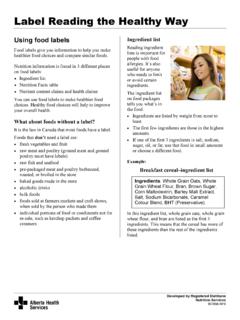
2 2. Read and interpret basic information of food labels. Subject Links: Health, Information Technology, LanguageMaterials & Resources:Food packaging with nutrition labels (provided bystudents or teacher)Look for more information on Canada s nutrition labelling system at: (visit the virtual grocery store) Construction paperSee the Teacher Notes at the back of this resource (on pages 23-26) for more information on this Discussion:Have students complete the Home Connection activity before this class discussion. Ask each student to bring the empty food packages they collect at home to examine in class for this discussion. The following questions will help students identify and interpret the basic information found on food labels:Find the ingredient list on your package.
3 Why must all food packaging include this list? In what order do the ingredients appear on this list?Does your package have a nutrition Facts table? What does it list? Are there any claims about the nutritional content, such as low fat or high fibre or health benefits of the product on your package? If so, what are they?How can people with a food allergy use food labels to avoid ingredients they may react to? Teaching Tip:In Canada, nutrition labelling is mandatory on mostpackaged foods. Healthy Eating Is In Store for You( ) is a joint initiative ofDietitians of Canada and the Canadian Diabetes Association to educate Canadians about using the nutrition label to make healthy food Awareness: To ensure safety, always check with students and their parents for any food allergies before activities that involve bringing foods or food packaging into the classroom.
4 The ingredient list found on food labels is especially useful for identifying ingredients that may cause an allergic and Anaphylaxis Resources:Calgary Allergy Network - School Related #schoolAllergy and Asthma Information Association: Anaphylaxis Canada: or ph: 1-866-785-5660 * MISSION nutrition * resources for Kindergarten to Grade 8 are available in English and French at or by calling 1-888-876-3750. Adventures in learning, created by Canadian dietitiansPAGE10* MISSION nutrition * is brought to you by the Registered Dietitians at Kellogg Canada Inc. MISSION nutrition * materials may be duplicated in whole without permission for educational purposes only.* 2007, Trademark of Kellogg Company used under licence by Kellogg Canada the Teacher Notes for further information on the ingredient list, nutrition information panel, nutrient content claims and health claims students may find on their packages.
5 These notes also include Information on how people with allergies can use food labels. Activities:1. Allow time in class or in the computer lab for students to explore information on Canada s nutrition labelling system available on the web sites suggested under Materials & Resources. The Healthy Eating is in Store for You web site will have a presentation for educators, educational fact sheets and a virtual grocery store tour. If time permits you may wish to have a class discussion on new information they learned on the Internet. Although these resources are intended for adults, they should help students develop label reading Divide the class into groups of four or five students. Using the packaging they have collected ask each group to observe and discuss in more detail the nutrition information found on the different labels and record their observations.
6 Using the nutrition labels students can then complete the Take a Closer Look activity sheet (see Student MISSION 3).3. As a class, work together to create a Take a Closer Look nutrition label display using the food packaging brought to class. Cut out six large magnifying glasses using construction paper and place them on a wall in the classroom or cafeteria. Then label the magnifying glasses: One for each of the four food groupsOne for combination foods (with more than one food group)One for less healthy food choices (see Teacher Notes for a list)Students can then classify the food labels and glue them in the appropriate magnifying glass. Since many food packages contain ingredients from a combination of food groups these may be placed in the food group that best represents the major ingredient, or placed in the combination foods MISSION 3: Take a Closer LookHave students complete the Take a Closer Look activity sheet to record the nutrition information they find on the labels of packaged food products.
7 Note that the nutrition Facts can be used to compare and choose between similar foods. Emphasize that each food group supplies a set of key nutrients, and all four food groups are important for health. Remind students that Canada s Food Guide recommends limiting less healthy food choices that are higher in calories, fat, sugar and salt (sodium). Home Connection: Examining a variety of food packages they find at home will provide students with a hands-on opportunity to identify the information on food Home: Have students collect several empty food packages with the assistance of a family member. They should examine the packages together and discuss the kind of information they find on the label in preparation for the class discussion.
8 Reinforce that these must be cleaned thoroughly before bringing them to completing the class discussion and activities in this unit, students can share what they learned about the information on food labels with their family. They can use this information to assist with making food PLANS FOR GRADES 4-5 MISSION 3 EXPLORING FOOD LABELS Continued*