Transcription of Mobility Management - vtpi.org
1 Sustainable Transport:A Sourcebook for Policy-makers in Developing CitiesModule 2b: Mobility ManagementDeutsche Gesellschaft f rTechnische Zusammenarbeit (GTZ) GmbHDivision 44 Environment and InfrastructureSector project: Transport Policy Advice iOVERVIEW OF THE SOURCEBOOKS ustainable Transport: A Sourcebook for Policy-Makers in Developing CitiesWhat is the Sourcebook?This Sourcebook on Sustainable Urban Transport addresses the key areas of a sustainable transport policy framework for a developing city. The Sourcebook consists of 20 is it for?The Sourcebook is intended for policy-makers in developing cities, and their advisors. This target audience is reflected in the content, which provides policy tools appropriate for application in a range of developing is it supposed to be used?The Sourcebook can be used in a number of ways.
2 It should be kept in one location, and the different modules provided to officials involved in urban transport. The Sourcebook can be easily adapted to fit a formal short course training event, or can serve as a guide for developing a curriculum or other training program in the area of urban transport; avenues GTZ is are some of the key features?The key features of the Sourcebook include:< A practical orientation, focusing on best practices in planning and regulation and, where possible, successful experience in developing cities.< Contributors are leading experts in their fields.< An attractive and easy-to-read, colour layout.< Non-technical language (to the extent possible), with technical terms explained.< Updates via the do I get a copy?Please visit or for details on how to order a copy.
3 The Sourcebook is not sold for profit. Any charges imposed are only to cover the cost of printing and or feedback?We would welcome any of your comments or suggestions, on any aspect of the Sourcebook, by email to or by surface mail to:Manfred BreithauptGTZ, Division 44 Postfach 518065726 EschbornGermanyModules and contributorsSourcebook Overview, and Cross-cutting Issues of Urban Transport (GTZ)Institutional and policy orientation1a. The Role of Transport in Urban Development Policy (Enrique Pe alosa)1b. Urban Transport Institutions (Richard Meakin)1c. Private Sector Participation in Transport Infra-structure Provision (Christopher Zegras, MIT)1d. Economic Instruments (Manfred Breithaupt, GTZ)1e. Raising Public Awareness about Sustainable Urban Transport (Karl Fjellstrom, GTZ)Land use planning and demand management2a.
4 Land Use Planning and Urban Transport (Rudolf Petersen, Wuppertal Institute)2b. Mobility Management (Todd Litman, VTPI)Transit, walking and cycling3a. Mass Transit Options (Lloyd Wright, ITDP; GTZ)3b. Bus Rapid Transit (Lloyd Wright, ITDP)3c. Bus Regulation & Planning (Richard Meakin)3d. Preserving and Expanding the Role of Non-motorised Transport (Walter Hook, ITDP)Vehicles and fuels4a. Cleaner Fuels and Vehicle Technologies (Michael Walsh; Reinhard Kolke, Umweltbundesamt UBA)4b. Inspection & Maintenance and Roadworthiness (Reinhard Kolke, UBA)4c. Two- and Three-Wheelers (Jitendra Shah, World Bank; Iyer, Bajaj Auto)4d. Natural Gas Vehicles (MVV InnoTec)Environmental and health impacts5a. Air Quality Management (Dietrich Schwela, World Health Organisation)5b. Urban Road Safety (Jacqueline Lacroix, DVR; David Silcock, GRSP)5c.
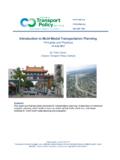
5 Noise and its Abatement (Civic Exchange Hong Kong; GTZ; UBA)Resources6. Resources for Policy-makers (GTZ)Further modules and resourcesFurther modules are anticipated in the areas of Driver Training; Financing Urban Transport; Benchmarking; and Participatory Planning. Additional resources are being developed, and an Urban Transport Photo CD (GTZ 2002) is now 2b: Mobility ManagementBy Todd Litman(Victoria Transport Policy Institute)Editor: Karl FjellstromManager: Manfred BreithauptGTZ Transport and Mobility Group, 2003 Findings, interpretations and conclusions expressed in this document are based on information gathered by GTZ and its consultants, partners, and contributors from reliable sources. GTZ does not, however, guarantee the accuracy or completeness of information in this document, and cannot be held responsible for any errors, omissions or losses which emerge from its photo: Suzhou, China, Jan.
6 2002. Photo by Karl FjellstromAbout the authorTodd Litman is founder and executive director of the Victoria Transport Policy Institute, an independent research organization dedicated to developing innovative solutions to transportation problems. He developed the Online TDM Encyclopedia and many other resources . His research is used worldwide in transportation planning and policy analysis. Todd lives with his family in Victoria, British Columbia, a city that demonstrates the value of a balanced transportation system: tourists come from all over the world to walk around the city s harbour, ride in a horse-drawn wagon, and travel by double-decker 2b: Mobility Management 1. Introduction 12. Basic concepts Rationale for Mobility Management 63. Mobility Management planning and evaluation Introduction Best practices 84.
7 Mobility Management policy and institutional reforms 10 Introduction 10 Best practices 11 Institutional reform information resources 125. Examples of Mobility Management strategies Smart growth land use Management strategies 12 Smart growth practices 12 How it is implemented 14 Smart growth resources non-motorised transport planning 15 How it is implemented 15 Travel impacts 16 Non-motorised transport resources Transportation market and pricing reforms 17 Vehicle tariffs and industrial development 17 Commuter financial incentives 17 Road pricing 18 Revenue-neutral tax shifts 18 Improved transportation pricing methods 18 Neutral planning and investment policies 18 How it is implemented 19 Travel impacts 19 Best practices 19 Transportation market reform resources Public transport improvements Commute trip reduction programs 21 How it is implemented 21 Travel impacts 21 Best practices 22 Commute trip reduction
8 Program resources Freight transport Management 24 Freight transport Management resources Tourist transport Management 26 How it is implemented 26 Travel Impacts 27 Best practices 27 Tourist transport Management resources Parking Management 27 Parking Management strategies 27 How it is implemented 30 Travel impacts 32 Best practices 32 Information resources for parking Management Vehicle fees, restrictions and car-free planning 33 Cordon / area pricing 33 Odd / even schemes and their variations 35 Mobility Management resources 36ii1 Module 2b: Mobility Management 1. IntroductionMobility Management (also called Transportation Demand Management or TDM) is a general term for strategies that result in more efficient use of transportation resources, as opposed to increasing transportation system supply by expanding roads, parking facilities, air-ports and other motor vehicle facilities.
9 Mobility Management emphasises the movement of people and goods, not just motor vehicles, and so gives priority to public transit, ridesharing and non-motorised modes, particularly under congested urban are many potential Mobility Management strategies with a variety of impacts. Some im-prove transportation diversity (the travel options available to users). Others provide incentives for users to change the frequency, mode, des-tination, route or timing of their travel. Some reduce the need for physical travel through Mobility substitutes or more efficient land use. Some involve policy reforms to correct current distortions in transportation planning Management is an increasingly com-mon response to transport problems. Mobility Management is particularly appropriate in de-veloping country cities, because of its low costs and multiple benefits.
10 Table 1 lists some of the reasons to implement Mobility Management in developing countries. Developing countries have limited resources to devote to transportation infrastructure. Developing country cities often have narrow and crowded streets, limited space for parking and a diverse mix of road users, lead-ing to conflicts over space and risk of crashes. Few developing countries can afford to build the highways and parking facilities that would be needed if automobile ownership becomes common. A major portion of the population cannot afford to own private motor vehicles, so investments and policies that favour automobiles over other travel modes may be inequitable and unsatisfactory for solving most residents travel needs. When all factors are considered, Mobility Management is often the best solution to trans-portation planning practices tend to create a self-fulfilling prophecy: by favouring automobile travel and giving little support to other modes such as walking, cycling and public transit, the quality of these other modes declines.