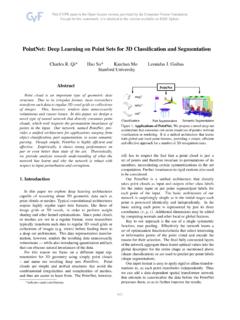
Transcription of Momentum Contrast for Unsupervised Visual Representation ...
1 Momentum Contrast for Unsupervised Visual Representation learning Kaiming He Haoqi Fan Yuxin Wu Saining Xie Ross Girshick Facebook AI Research (FAIR). Code: Abstract contrastive loss We present Momentum Contrast (MoCo) for unsuper- similarity vised Visual Representation learning . From a perspective on contrastive learning [29] as dictionary look-up, we build q k0 k1 k2 .. a dynamic dictionary with a queue and a moving-averaged queue encoder. This enables building a large and consistent dic- tionary on-the-fly that facilitates contrastive Unsupervised encoder Momentum encoder learning .
2 MoCo provides competitive results under the common linear protocol on ImageNet classification. More importantly, the representations learned by MoCo transfer xquery xkey 0 xkey 1 xkey 2 .. well to downstream tasks. MoCo can outperform its super- vised pre-training counterpart in 7 detection/segmentation Figure 1. Momentum Contrast (MoCo) trains a Visual represen- tasks on PASCAL VOC, COCO, and other datasets, some- tation encoder by matching an encoded query q to a dictionary of encoded keys using a contrastive loss. The dictionary keys times surpassing it by large margins.
3 This suggests that {k0 , k1 , k2 , ..} are defined on-the-fly by a set of data samples. the gap between Unsupervised and supervised representa- The dictionary is built as a queue, with the current mini-batch en- tion learning has been largely closed in many vision tasks. queued and the oldest mini-batch dequeued, decoupling it from the mini-batch size. The keys are encoded by a slowly progressing 1. Introduction encoder, driven by a Momentum update with the query encoder. This method enables a large and consistent dictionary for learning Unsupervised Representation learning is highly success- Visual representations.
4 Ful in natural language processing, , as shown by GPT. [50, 51] and BERT [12]. But supervised pre-training is still dominant in computer vision, where Unsupervised meth- From this perspective, we hypothesize that it is desirable ods generally lag behind. The reason may stem from dif- to build dictionaries that are: (i) large and (ii) consistent ferences in their respective signal spaces. Language tasks as they evolve during training. Intuitively, a larger dictio- have discrete signal spaces (words, sub-word units, etc.) nary may better sample the underlying continuous, high- for building tokenized dictionaries, on which Unsupervised dimensional Visual space, while the keys in the dictionary learning can be based.
5 Computer vision, in Contrast , further should be represented by the same or similar encoder so that concerns dictionary building [54, 9, 5], as the raw signal is their comparisons to the query are consistent. However, ex- in a continuous, high-dimensional space and is not struc- isting methods that use contrastive losses can be limited in tured for human communication ( , unlike words). one of these two aspects (discussed later in context). Several recent studies [61, 46, 36, 66, 35, 56, 2] present We present Momentum Contrast (MoCo) as a way of promising results on Unsupervised Visual Representation building large and consistent dictionaries for Unsupervised learning using approaches related to the contrastive loss learning with a contrastive loss (Figure 1).
6 We maintain the [29]. Though driven by various motivations, these methods dictionary as a queue of data samples: the encoded repre- can be thought of as building dynamic dictionaries. The sentations of the current mini-batch are enqueued, and the keys (tokens) in the dictionary are sampled from data oldest are dequeued. The queue decouples the dictionary ( , images or patches) and are represented by an encoder size from the mini-batch size, allowing it to be large. More- network. Unsupervised learning trains encoders to perform over, as the dictionary keys come from the preceding sev- dictionary look-up: an encoded query should be similar eral mini-batches, a slowly progressing key encoder, imple- to its matching key and dissimilar to others.
7 learning is mented as a Momentum -based moving average of the query formulated as minimizing a contrastive loss [29]. encoder, is proposed to maintain consistency. 19729. MoCo is a mechanism for building dynamic dictionar- for Unsupervised data generation. Adversarial methods for ies for contrastive learning , and can be used with various Representation learning are explored in [15, 16]. There are pretext tasks. In this paper, we follow a simple instance relations (see [24]) between generative adversarial networks discrimination task [61, 63, 2]: a query matches a key if and noise-contrastive estimation (NCE) [28].
8 They are encoded views ( , different crops) of the same Pretext tasks. A wide range of pretext tasks have been pro- image. Using this pretext task, MoCo shows competitive posed. Examples include recovering the input under some results under the common protocol of linear classification corruption, , denoising auto-encoders [58], context auto- in the ImageNet dataset [11]. encoders [48], or cross-channel auto-encoders (coloriza- A main purpose of Unsupervised learning is to pre-train tion) [64, 65]. Some pretext tasks form pseudo-labels by, representations ( , features) that can be transferred to , transformations of a single ( exemplar ) image [17], downstream tasks by fine-tuning.
9 We show that in 7 down- patch orderings [13, 45], tracking [59] or segmenting ob- stream tasks related to detection or segmentation, MoCo jects [47] in videos, or clustering features [3, 4]. Unsupervised pre-training can surpass its ImageNet super- vised counterpart, in some cases by nontrivial margins. In Contrastive learning vs. pretext tasks. Various pretext these experiments, we explore MoCo pre-trained on Ima- tasks can be based on some form of contrastive loss func- geNet or on a one-billion Instagram image set, demonstrat- tions. The instance discrimination method [61] is related ing that MoCo can work well in a more real-world, billion- to the exemplar-based task [17] and NCE [28].
10 The pretext image scale, and relatively uncurated scenario. These re- task in contrastive predictive coding (CPC) [46] is a form sults show that MoCo largely closes the gap between un- of context auto-encoding [48], and in contrastive multiview supervised and supervised Representation learning in many coding (CMC) [56] it is related to colorization [64]. computer vision tasks, and can serve as an alternative to Im- ageNet supervised pre-training in several applications. 3. Method Contrastive learning as Dictionary Look-up 2. Related Work Contrastive learning [29], and its recent developments, Unsupervised /self-supervised1 learning methods gener- can be thought of as training an encoder for a dictionary ally involve two aspects: pretext tasks and loss functions.