Transcription of MOTION IN A S L
1 CHAPTER THREE. MOTION IN A STRAIGHT LINE. INTRODUCTION. MOTION is common to everything in the universe. We walk, run and ride a bicycle. Even when we are sleeping, air moves Introduction into and out of our lungs and blood flows in arteries and Position, path length and veins. We see leaves falling from trees and water flowing displacement down a dam. Automobiles and planes carry people from one average velocity and average place to the other. The earth rotates once every twenty-four speed hours and revolves round the sun once in a year. The sun instantaneous velocity and itself is in MOTION in the Milky Way, which is again moving speed within its local group of galaxies. Acceleration MOTION is change in position of an object with time.
2 How Kinematic equations for does the position change with time ? In this chapter, we shall uniformly accelerated MOTION learn how to describe MOTION . For this, we develop the Relative velocity concepts of velocity and acceleration. We shall confine Summary ourselves to the study of MOTION of objects along a straight Points to ponder line, also known as rectilinear MOTION . For the case of Exercises rectilinear MOTION with uniform acceleration, a set of simple Additional exercises equations can be obtained. Finally, to understand the relative Appendix nature of MOTION , we introduce the concept of relative velocity . In our discussions, we shall treat the objects in MOTION as point objects.
3 This approximation is valid so far as the size of the object is much smaller than the distance it moves in a reasonable duration of time. In a good number of situations in real-life, the size of objects can be neglected and they can be considered as point-like objects without much error. In Kinematics, we study ways to describe MOTION without going into the causes of MOTION . What causes MOTION described in this chapter and the next chapter forms the subject matter of Chapter 5. POSITION, PATH LENGTH AND DISPLACEMENT. Earlier you learnt that MOTION is change in position of an object with time. In order to specify position, we need to use a reference point and a set of axes. It is convenient to choose 2021-22.
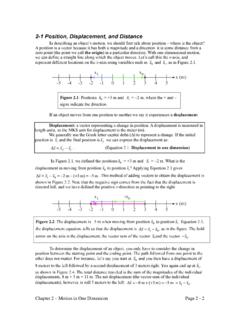
4 40 PHYSICS. a rectangular coordinate system consisting of with the path of the car's MOTION and origin of three mutually perpenducular axes, labelled X-, the axis as the point from where the car started Y-, and Z- axes. The point of intersection of these moving, the car was at x = 0 at t = 0 (Fig. ). three axes is called origin (O) and serves as the Let P, Q and R represent the positions of the car reference point. The coordinates (x, y. z) of an at different instants of time. Consider two cases object describe the position of the object with of MOTION . In the first case, the car moves from O to P. Then the distance moved by the car is respect to this coordinate system. To measure OP = +360 m.
5 This distance is called the path time, we position a clock in this system. This length traversed by the car. In the second coordinate system along with a clock constitutes case, the car moves from O to P and then moves a frame of reference. back from P to Q. During this course of MOTION , If one or more coordinates of an object change the path length traversed is OP + PQ = + 360 m with time, we say that the object is in MOTION . + (+120 m) = + 480 m. Path length is a scalar Otherwise, the object is said to be at rest with quantity a quantity that has a magnitude respect to this frame of reference. only and no direction (see Chapter 4). The choice of a set of axes in a frame of reference depends upon the situation.
6 For Displacement example, for describing MOTION in one dimension, It is useful to define another quantity we need only one axis. To describe MOTION in displacement as the change in position. Let two/three dimensions, we need a set of two/ x1 and x2 be the positions of an object at time t1. three axes. and t2. Then its displacement, denoted by x, in Description of an event depends on the frame time t = (t2 - t1), is given by the difference of reference chosen for the description. For between the final and initial positions : example, when you say that a car is moving on x = x2 x1. a road, you are describing the car with respect (We use the Greek letter delta ( ) to denote a to a frame of reference attached to you or to the change in a quantity.)
7 Ground. But with respect to a frame of reference If x2 > x1, x is positive; and if x2 < x1, x is attached with a person sitting in the car, the negative. car is at rest. Displacement has both magnitude and direction. Such quantities are represented by To describe MOTION along a straight line, we vectors. You will read about vectors in the next can choose an axis, say X-axis, so that it chapter. Presently, we are dealing with MOTION coincides with the path of the object. We then along a straight line (also called rectilinear measure the position of the object with reference MOTION ) only. In one-dimensional MOTION , there to a conveniently chosen origin, say O, as shown are only two directions (backward and forward, in Fig.)
8 Positions to the right of O are taken upward and downward) in which an object can as positive and to the left of O, as negative. move, and these two directions can easily be Following this convention, the position specified by + and signs. For example, coordinates of point P and Q in Fig. are +360 displacement of the car in moving from O to P is : m and +240 m. Similarly, the position coordinate x = x2 x1 = (+360 m) 0 m = +360 m of point R is 120 m. The displacement has a magnitude of 360 m and Path length is directed in the positive x direction as indicated Consider the MOTION of a car along a straight by the + sign. Similarly, the displacement of the line. We choose the x-axis such that it coincides car from P to Q is 240 m 360 m = 120 m.
9 The Fig. x-axis, origin and positions of a car at different times. 2021-22. MOTION IN A STRAIGHT LINE 41. negative sign indicates the direction of then returns to O, the final position coincides displacement. Thus, it is not necessary to use with the initial position and the displacement vector notation for discussing MOTION of objects is zero. However, the path length of this journey in one-dimension. is OP + PO = 360 m + 360 m = 720 m. The magnitude of displacement may or may MOTION of an object can be represented by a not be equal to the path length traversed by position-time graph as you have already learnt an object. For example, for MOTION of the car about it. Such a graph is a powerful tool to from O to P, the path length is +360 m and the represent and analyse different aspects of displacement is +360 m.
10 In this case, the MOTION of an object. For MOTION along a straight magnitude of displacement (360 m) is equal to line, say X-axis, only x-coordinate varies with the path length (360 m). But consider the MOTION of the car from O to P and back to Q. In this time and we have an x-t graph. Let us first case, the path length = (+360 m) + (+120 m) = + consider the simple case in which an object is 480 m. However, the displacement = (+240 m) stationary, a car standing still at x = 40 m. (0 m) = + 240 m. Thus, the magnitude of The position-time graph is a straight line parallel displacement (240 m) is not equal to the path to the time axis, as shown in Fig. (a). length (480 m). If an object moving along the straight line The magnitude of the displacement for a covers equal distances in equal intervals of course of MOTION may be zero but the time, it is said to be in uniform MOTION along a corresponding path length is not zero.