Transcription of Motor Speech Disorders Evaluation
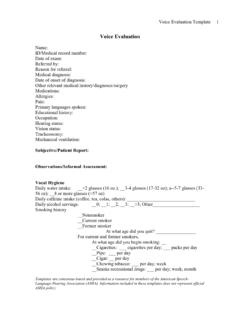
1 Motor Speech Evaluation Template 1 Templates are consensus-based and provided as a resource for members of the American Speech -Language-Hearing Association (ASHA). Information included in these templates does not represent official ASHA policy. Motor Speech Disorders Evaluation Name: ID/Medical record number: Date of exam: Referred by: Reason for referral: Medical diagnosis: Date of onset of diagnosis: Other relevant medical history/diagnoses/surgery Medications: Allergies: Pain: Primary languages spoken: Educational history: Occupation: Hearing status: Vision status: Tracheostomy: Mechanical ventilation: Subjective/Patient Report: Observations/Informal Assessment: Mental Status (check all that apply).
2 __ alert __ responsive __ cooperative __ confused __ lethargic __ impulsive __ uncooperative __ combative __ unresponsive Motor Speech Evaluation Template 2 Templates are consensus-based and provided as a resource for members of the American Speech -Language-Hearing Association (ASHA).
3 Information included in these templates does not represent official ASHA policy. Oral Motor , Respiration, and Phonation Lips WNL, mild, mod, severe impairment Observation at rest (WNL, Edema, Erythema, Lesion): _____ Symmetry, range, speed, strength, tone: Pucker _____ Retraction _____ Alternating pucker/retraction _____ Involuntary movement ( , chorea, dystonia, fasciculations, myoclonus, spasms, tremor): _____ Tongue WNL, mild, mod, severe impairment Observation at rest (WNL, Edema, Erythema, Lesion).
4 Symmetry, range, speed, strength, tone: Protrusion _____ Retraction _____ Lateralization _____ Involuntary movement: _____ Jaw WNL, mild, mod, severe impairment Observation at rest: _____ Symmetry, range, strength, tone: Opening _____ Closing _____ Lateralization _____ Protrusion _____ Retraction _____ Involuntary movement: _____ Soft palate WNL, mild, mod, severe impairment Observation at rest (WNL, Edema, Erythema, Lesion): _____ Symmetry, range, strength, tone: _____ Elevation _____ Sustained elevation _____ Alternating elevation/relaxation _____ Involuntary movement.
5 Motor Speech Evaluation Template 3 Templates are consensus-based and provided as a resource for members of the American Speech -Language-Hearing Association (ASHA). Information included in these templates does not represent official ASHA policy. Respiration/Phonation Observations/formal measures administered: _____ Activity Stimulus Quality Duration Loudness Steadiness Phonation WNL Breathy Hoarse Harsh Strained-strangled ___ secs WNL Mildly impaired Moderately impaired Severely impaired WNL Monoloudness Excessive loudness Variable loudness Oral reading WNL Breathy Hoarse Harsh Strained-strangled WNL Mildly impaired Moderately impaired Severely impaired WNL Monoloudness Excessive loudness Variable loudness Conversation WNL Breathy Hoarse Harsh Strained-strangled WNL Mildly impaired Moderately impaired Severely impaired WNL Monoloudness Excessive loudness Variable loudness Oral Agility.
6 Diadochokinetic Rates Duration Quality Comments P^ __/Per 3 sec. WNL/mild/mod/sev T^ __/ Per 3 sec. WNL/mild/mod/sev K^ __/Per 3 sec. WNL/mild/mod/sev P^T^K^ __/Per 3 sec. WNL/mild/mod/sev Other oral agility: _____ Speech Intelligibility Standardized dysarthria/apraxia tests: _____ Non-Standardized Tasks: _____ Stimulus Severity Comments Phoneme WNL/mild/mod/sev Word WNL/mild/mod/sev Sentence WNL/mild/mod/sev Conversation WNL/mild/mod/sev Motor Speech Evaluation Template 4 Templates are consensus-based and provided as a resource for members of the American Speech -Language-Hearing Association (ASHA).
7 Information included in these templates does not represent official ASHA policy. Awareness/strategy use __Limited to no awareness of Motor Speech impairment __Aware of Motor Speech impairment; unable to use strategies to improve intelligibility __Uses strategies intermittently to improve intelligibility or listener s understanding of message __Uses strategies effectively and consistently to improve intelligibility or listener s understanding of message Findings __Motor Speech within normal limits __ (mild, mild-moderate, moderate, moderate-severe, severe) apraxia characterized by _____ __ (mild, mild-moderate, moderate, moderate-severe, severe) dysarthria characterized by _____ Dysarthria type.
8 __ataxic __hypokinetic __hyperkinetic __spastic __flaccid __mixed __unilateral upper Motor neuron NOMS Motor Speech Score (1-7): _____ Impact of Motor Speech Impairment on Functioning: Activity Limitations and Participation Restrictions (check all that apply): Mild Moderate Severe General tasks and demands _____ _____ _____ Household tasks _____ _____ _____ Interpersonal interactions _____ _____ _____ Education _____ _____ _____ Employment
9 _____ _____ _____ Community _____ _____ _____ Other_____ _____ _____ _____ Motor Speech Evaluation Template 5 Templates are consensus-based and provided as a resource for members of the American Speech -Language-Hearing Association (ASHA). Information included in these templates does not represent official ASHA policy. Safety Risks Mild Moderate Severe Being left alone at home _____ _____ _____ Traveling alone in community _____ _____ _____ Other _____ _____ _____ _____ Prognosis: __Good __Fair __Poor Based on _____ Recommendations: (check all that apply) __ Speech -language pathology treatment Frequency: Duration: __ Augmentative-Alternative Communication or Speech Generating Device Evaluation __Other suggested referrals.
10 __Neurology __Otolaryngology __Pulmonology __Other Patient/Family Education __Described results of Evaluation __Patient expressed understanding of Evaluation and agreement with goals and treatment plan __Patient expressed understanding of Evaluation but refused treatment __Family/caregivers expressed understanding of Evaluation and agreement with goals and treatment plan. __Patient demonstrated recommended strategies __Family/caregivers demonstrated recommended strategies __Patient requires further education on strategies __Family/caregivers require further education on strategies __Other _____ Treatment Plan Long Term Goals Short Term Goals