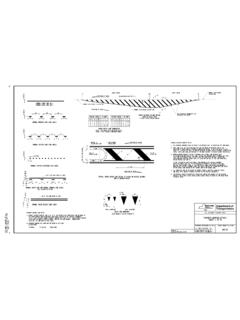
Transcription of MOTSAM Part II: Section 03 Intersection pavement markings
1 INTERSECTIONPAVEMENT markings Section 3 March 2011 Part 2: MarkingsCONTENTSM arch 2011%CONTENTSR eference Page Page Number 1: August Intersection pavement pavement markings ..1-1 pavement markings ..1-1 and Hazard markings ..1-2 pavement markings ..1-2 Section 2: pavement ..2-1 August Lines ..2-5 Lines ..2-9 July Shoulder August Overtaking Lines.
2 2-14 Feb Overtaking Advance Warning Lines ..2-16 August Feb Ahead of Raised Islands and Medians ..2-22 August 2007 Cycle ..2-30 August 2010 ..2-34 July Vehicle Parking Areas ..2-38 July Vehicle Bays ..2-42 Feb 2010 Section 3: Intersection pavement - at Intersections ..3-2 June 2009 lines at Intersections ..3-4 Lines at Intersections ..3-8 Arrows ..3-11 Feb Lines.
3 3-14 June 2009 Lines ..3-16 Uncontrolled Give Way Controlled Intersections ..3-21 Controlled Signal Controlled Intersections ..3-30 to March 2011 CONTENTSPart 2: MarkingsAugust 2010%CONTENTSR eference Page Page Number Traffic Islands at June Turn Turn Lanes In Raised Turn Flush Medians at Cycle Lanes at August 2010 Section 4: MISCELLANEOUS pavement Messages and Symbols ..4-1 Level ( Section deleted June 2009).
4 4-14 Red (and Temporary) Lane Bridges ..(Figure corrected June 2009) .. 4-34 pavement July Line Feb 2010 Section 5: DELINEATION AND HAZARD and Hazard Markers - Adjacent to The Roadway; including Safety Barriers.. 5-2 June 2009 Within The Aug To Hazards Within The Nov 2004% Marker Posts ..5-13 Feb Linear Delineation Panels.
5 5-18 April 2005 Note: For chevron sight boards refer to MOTSAM Part 1 Section 6: PW-66, PW-67, PW-68 & PW-69. For motorway markings refer to MOTSAM part related Technical Documents may be found at: and Part 2: MarkingsINTERSECTIONS - GENERALJune 19943 - INTERSECTIONS - GENERALOn approaches to intersections the standard centreline,edge line, no-ov ertaking a nd lane line markings w illrequire s pecial treatment depending on thecharacteristics of the Intersection . Some additionalmarkings are often necessary, these include:!
6 Limit lines,!continuity lines,!crosswalk lines,!lane arrows, and! pavement messages and symbols. Intersections with high approach speeds may requiredifferent treatment from those with low approach , roads with higher traffic volumes or status in theroading hierarchy will be treated differently from thosewith lower traffic volumes or status in the ROAD HIERARCHYR efer to MOT/TNZ RTS 1: Guidelines for theImplementation of Traffic Control At refle ct the importance of a roading hierarchy anddriver expectation of route priority, all cross roads shallbe controlled by a Give Way sign ( Section ) or a Stopsign ( Section ), unless some other form of prioritycontrol is , it is recommended that all 'T'-intersections onstate highw ays, and arterial or principa l roads, arecontrolled by a Give Way sign ( Section ) or a Stopsign ( Section )
7 , unless some other form of prioritycontrol is - CENTRELINES Part 2: MarkingsJune 20093 - CENTRELINES AT GENERALG enerally, centrelines on the approaches to intersectionsshould be marked as described in paragraphs of typical centreline markings for various trafficcontrol and i ntersection configurations are show n inSections to to Section for non Intersection centrelinemarking details , including the marking of centrelines onsharp bends and to Section for t he marking of centrelines inadvance of traffic islands and RURAL ROADSC entrelines on the approaches to rural road intersectionsshall be marked as follows:Refer to Figure : Reflectorised white Width : 100 mmLength : 50 mStripe.
8 On side roads should terminate m clear ofthe nearest lane or at the limit on main roads should have at least a 12 mgap at URBAN ROADSC entrelines on the approaches to urban roadintersections shall be marked as follows:Refer to Figure : Reflectorised white Width : 100 mmLength : 30 mStripe : road centrelines should terminate m clear of thenearest traffic lane, at the prolongation of the kerb line, orat the limit should not normally be marke d , where one is necessary to showthe normal path of vehicles, thus defining turning andnon-turning movements (Ref Land Transport (Road UserRule) Interpretation)
9 , then it should b e m arked as d escribed in Section on main roads should have at least a 12 mgap at solid white centreline may be marked on tight curveswhere it is impractical to mark a normal broken to Section (b) for details of centrelinemarking on sharp curves. MULTI LANE ROADSC entrelines on the approaches t o multi lane roadintersections should be marked as follows:Colour : Reflectorised yellowWidth : Double 100 mm lines 100 mm apartLength : 50 m minimum - rural *30 m minimum - urban *Stripe : Continuous* A double yellow line may also be used as acontinuous centerline over an entire.
10 In urban areas a single 150 mmwide reflectorised white line may be used forthe centreline of a multi lane road as analternative to a double yellow on side roads should terminate m clear ofthe nearest lane or at the limit on main roads should have at least a 12 mgap at the CENTRELINES TO ESTABLISHPRIORITY AT INTERSECTIONSC entrelines to establish route priority , should only beused when the main road through the intersectiondoes not follow a straight :Where the main road route throughan Intersection is on a curve with a radius of100 m, or more, it should be treated as astraight centreline to establish priority at intersectionsshould be marked as follows:Refer to Figure : Reflectorised whiteWidth : 100 mmStripe : 1 mGap.