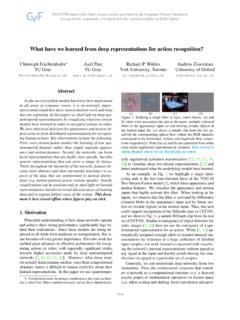
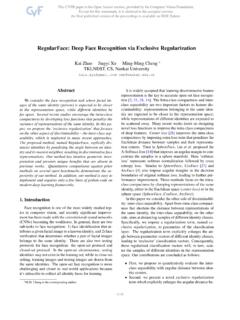
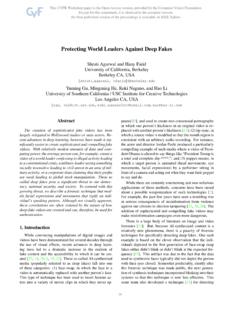
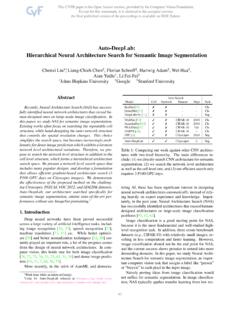
Transcription of Multi-Stage Progressive Image Restoration
1 Multi-Stage Progressive Image RestorationSyed Waqas Zamir*1 Aditya Arora*1 Salman Khan2 Munawar Hayat3 Fahad Shahbaz Khan2 Ming-Hsuan Yang4,5,6 Ling Shao1,21 Inception Institute of AI2 Mohamed bin Zayed University of AI3 Monash University4 University of California, Merced5 Yonsei University6 Google ResearchAbstractImage Restoration tasks demand a complex balance be-tween spatial details and high-level contextualized informa-tion while recovering images. In this paper, we propose anovel synergistic design that can optimally balance thesecompeting goals. Our main proposal is a Multi-Stage ar-chitecture, that progressively learns Restoration functionsfor the degraded inputs, thereby breaking down the over-all recovery process into more manageable steps.
2 Specifi-cally, our model first learns the contextualized features us-ing encoder-decoder architectures and later combines themwith a high-resolution branch that retains local informa-tion. At each stage, we introduce a novel per-pixel adap-tive design that leverages in-situ supervised attention toreweight the local features. A key ingredient in such amulti-stage architecture is the information exchange be-tween different stages. To this end, we propose a two-faceted approach where the information is not only ex-changed sequentially from early to late stages, but lateralconnections between feature processing blocks also exist toavoid any loss of information. The resulting tightly inter-linked Multi-Stage architecture, named as MPRNet, deliversstrong performance gains on ten datasets across a rangeof tasks including Image deraining, deblurring, and denois-ing.
3 The source code and pre-trained models are IntroductionImage Restoration is the task of recovering a clean imagefrom its degraded version. Typical examples of degradationinclude noise, blur, rain, haze, etc. It is a highly ill-posedproblem as there exist infinite feasible solutions. In order torestrict the solution space to valid/natural images, existingrestoration techniques [19,29,39,59,66,67,100] explic-itly use Image priors that are handcrafted with empirical ob-servations. However, designing such priors is a challengingtask and often not generalizable. To ameliorate this issue,recent state-of-the-art approaches [17,44,57,86,87,93,94,97] employ convolutional neural networks (CNNs) that im-*Equal contribution46810121416182022 Number of parameters (Millions) (dB)BaselineMPRNet (ours)NahCVPR17 SRNCVPR18 DMPHNCVPR19 SuinCVPR20 DBGANCVPR20 ZhangCVPR18[70][53][92][88][91][71]Figur e 1: Image deblurring on the GoPro dataset [53].
4 Underdifferent parameter capacities (x-axis), our Multi-Stage approachperforms better than the single-stage baseline [65] (with channelattention [95]), as well as the state-of-the-art (PSNR on y-axis).plicitly learn more general priors by capturing natural imagestatistics from large- scale performance gain of CNN-based methods over theothers is primarily attributed to its model design. Nu-merous network modules and functional units for imagerestoration have been developed including recursive resid-ual learning [4,95], dilated convolutions [4,81], attentionmechanisms [17,86,96], dense connections [73,75,97],encoder-decoders [7,13,43,65], and generative mod-els [44,62,90,92]. Nevertheless, nearly all of these mod-els for low-level vision problems are based onsingle-stagedesign.
5 In contrast, multi -stagenetworks are shown to bemore effective than their single-stage counterparts in high-level vision problems such as pose-estimation [14,46,54],scene parsing [15] and action segmentation [20,26,45].Recently, few efforts have been made to bring the Multi-Stage design to Image deblurring [70,71,88], and imagederaining [47,63]. We analyze these approaches to iden-tify the architectural bottlenecks that hamper their perfor-mance. First, existing Multi-Stage techniques either employtheencoder-decoderarchitecture [71,88] which is effec-tive in encoding broad contextual information but unreliablein preserving spatial Image details, or use asingle-scalepipeline[63] that provides spatially accurate but semanti-14821cally less reliable outputs.
6 However, we show that the com-bination of both design choices in a Multi-Stage architectureis needed for effective Image Restoration . Second, we showthat naively passing the output of one stage to the next stageyields suboptimal results [53]. Third, unlike in [88], it is im-portant to provide ground-truth supervision at each stage forprogressive Restoration . Finally, during Multi-Stage process-ing, a mechanism to propagate intermediate features fromearlier to later stages is required to preserve contextualizedfeatures from the encoder-decoder propose a Multi-Stage Progressive Image restorationarchitecture, called MPRNet, with several key ). The earlier stages employ an encoder-decoder for learn-ing multi - scale contextual information, while the last stageoperates on the original Image resolution to preserve finespatial details.
7 2). A supervised attention module (SAM)is plugged between every two stages to enable progressivelearning. With the guidance of ground-truth Image , thismodule exploits the previous stage prediction to computeattention maps that are in turn used to refine the previousstage features before being passed to the next stage. 3). Amechanism of cross-stage feature fusion (CSFF) is addedthat helps propagating multi - scale contextualized featuresfrom the earlier to later stages. Furthermore, this methodeases the information flow among stages, which is effectivein stabilizing the Multi-Stage network main contributions of this work are: A novel Multi-Stage approach capable of generatingcontextually-enriched and spatially accurate outputs.
8 Dueto its Multi-Stage nature, our framework breaks down thechallenging Image Restoration task into sub-tasks to pro-gressively restore a degraded Image . An effective supervised attention module that takes fulladvantage of the restored Image at every stage in refiningincoming features before propagating them further. A strategy to aggregate multi - scale features across stages. We demonstrate the effectiveness of our MPRNet by set-ting new state-of-the-art ontensynthetic and real-worlddatasets for various Restoration tasks including Image de-raining, deblurring, and denoising while maintaining alow complexity (see ). Further, we provide detailedablations, qualitative results, and generalization Related WorkRecent years have witnessed a paradigm shift from high-end DSLR cameras to smartphone cameras.
9 However,capturing high-quality images with smartphone cameras ischallenging. Image degradations are often present in im-ages either due to the limitations of cameras and/or adverseambient conditions. Early Restoration approaches are basedon total variation [10,67], sparse coding [3,51,52], self-similarity [8,16], gradient prior [68,80],etc. Recently,CNN-based Restoration methods have achieved state-of-the-art results [57,70,86,93,97]. In terms of architecturaldesign, these methods can be broadly categorized as single-stage and , the majority of im-age Restoration methods are based on a single-stage de-sign, and the architectural components are usually based onthose developed for high-level vision tasks.
10 For example,residual learning [30] has been used to perform Image de-noising [2,72,93], Image deblurring [42,43] and imagederaining [37]. Similarly, to extract multi - scale informa-tion, the encoder-decoder [65] and dilated convolution [83]models are often used [4,28,43]. Other single-stage ap-proaches [5,89,97] incorporate dense connections [34]. Multi-Stage methods [24,47,53,63,70,71,88,99] aim to recover clean Image in a progressivemanner by employing a light-weight subnetwork at eachstage. Such a design is effective since it decomposes thechallenging Image Restoration task into smaller easier sub-tasks. However, a common practice is to use the identicalsubnetwork for each stage which may yield suboptimal re-sults, as shown in our experiments (Section4).