Transcription of My Nutrition
1 This is a consensus document from Dietitian/ Nutritionists from the Nutrition Education Materials Online, "NEMO", team. Disclaimer: Reviewed: February 2019 Copyright: Due for review: February 2021 carbohydrate counting carbohydrate When carbohydrate containing foods (sugars & starches) are digested, they break down to form glucose in the blood stream. This causes blood glucose levels to rise. The amount of carbohydrate you eat needs to be considered when deciding your quick acting insulin dose, so it is important to accurately estimate your carbohydrate intake. Incorrectly estimating your carbohydrate intake can result in an incorrect insulin dose leading to hyperglycaemia (high blood sugar levels) or hypoglycaemia (low blood sugar levels).
2 carbohydrate counting Estimating or counting carbohydrate involves 3 steps: Step 1. Measure or weigh the amount of food or drink you will consume. Use standard household measures such as measuring cups, spoons and scales. Step 2. Check the Nutrition information panel or carbohydrate counter reference guide for the carbohydrate content of the food. Step 3. Calculate the amount of carbohydrate based on the amount of food or drink you will consume. carbohydrate counting tips Round carbohydrate grams to the nearest whole number. If unsure of carbohydrate content, always be cautious and aim to under-estimate the amount to reduce the risk of hypoglycaemia. Once you are confident with common measures, it is important to check your portions regularly to ensure accuracy.
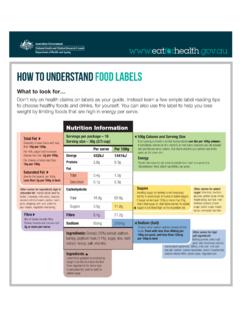
3 Please note the values used in this worksheet are examples only and are not to be used for personal carbohydrate referencing. My Nutrition This is a consensus document from Dietitian/ Nutritionists from the Nutrition Education Materials Online, "NEMO", team. Disclaimer: Reviewed: February 2019 Copyright: Due for review: February 2021 carbohydrate counting using the Nutrition information panel . Nutrition Information Muesli bar Servings per package: 1 Serving size: 35g Per Serve Per 100g Energy 501kJ 1430kJ Protein 10g Fat 1g Saturated fat carbohydrate (total) Sugar Fibre Sodium 185mg 535mg Total carbohydrate Always look at the total carbohydrate , not just the sugar content.
4 It is the total amount of carbohydrate that affects blood glucose levels. Serving size The package serving size may be different from the amount you eat. Always measure the amount that you will eat. See example 1. Per 100g The per 100g column can be used if you know the weight of your food. Be sure to accurately weigh the amount of food you will eat. Digital kitchen scales are quick and easy to use. Work out the carbohydrate based on the weight of the food you will eat. See examples 2 and 3. This is a consensus document from Dietitian/ Nutritionists from the Nutrition Education Materials Online, "NEMO", team. Disclaimer: Reviewed: February 2019 Copyright: Due for review: February 2021 Example 1. Calculating carbohydrate using the per serve size.
5 If you eat two of the biscuits below, calculate the carbohydrate content. Cream biscuit Working using per serve column: Step 1. Measure how much you will eat: 2 biscuits. Step 2. Check the carbohydrate content. 1 biscuit contains of carbohydrate . Step 3. Calculate the amount of carbohydrate in the 2 biscuits you will eat. The serving size is different to the amount you will eat; therefore, you need to calculate the total carbohydrate amount. ( carbohydrate per biscuit) x 2 = ( carbohydrate in 2 biscuits) 2 biscuits contain carbohydrate , we can round this up to 30g. If you work in 15g carbohydrate exchanges: 30 15 = 2x 15g exchanges If you work in 10g carbohydrate portions (CPs): 30 10= 3x 10g CPs Nutrition Information Servings per package: 10 Serving Size: 1 biscuit, Per serve Per 100g Energy 428kJ 2060kJ Protein Fat Saturated fat carbohydrate Sugar Sodium 59mg 285mg This is a consensus document from Dietitian/ Nutritionists from the Nutrition Education Materials Online, "NEMO", team.
6 Disclaimer: Reviewed: February 2019 Copyright: Due for review: February 2021 Example 2. Calculating carbohydrate using the per 100g column. If you eat 50g or of a 200g packet of the potato crisps, calculate the carbohydrate content. Potato crisps Working using per 100g column: Step 1. Measure how much you will eat: In this example you will eat 50g of crisps. Step 2. Check the carbohydrate content: 100g of these crisps contains 44g of carbohydrate . Step 3. Calculate carbohydrate based on the 50g of these crisps that you will consume. 50g (amount you will consume) x 44 (amount of carbohydrate /100g) = 22g 100g 50g of these crisps contains 22g of carbohydrate . We can round this down to 20g.
7 If you work in 15g carbohydrate exchanges: 20 15 = 1 x 15g exchanges If you work in 10g carbohydrate portions (CPs): 20 10 = 2 x 10g CPs Nutrition Information Servings per package: Serving Size: 30g Per serve Per 100g Energy 654kJ 2180kJ Protein Fat Saturated fat carbohydrate 44g Sugar Sodium 596mg This is a consensus document from Dietitian/ Nutritionists from the Nutrition Education Materials Online, "NEMO", team. Disclaimer: Reviewed: February 2019 Copyright: Due for review: February 2021 Example 3. Calculating carbohydrate using per 100ml column. If you consume 1 cup of the skim milk below, calculate the carbohydrate content. Skim milk Working using per 100ml column: Step 1.
8 Measure how much you will drink: Use a standard measuring cup to measure the amount of milk you will consume. In this example we will use 250mls. Step 2. Check the carbohydrate content: 100mls of the milk contains of carbohydrate . Step 3. Calculate carbohydrate based on the 250mls you will consume as follows: 250ml (amount you will consume) x (amount of carbohydrate /100ml) = 100ml 250ml of this skim milk contains of carbohydrate , we can round this up to 15g. If you work in 15g carbohydrate exchanges: 15 15 = 1 x 15g exchanges If you work in 10g carbohydrate portions (CPs): 15 10= x 10g CPs TIP: Milk has approximately 5g of carbohydrate per 100mls Nutrition Information Servings per package: 3 Serving Size: 200ml Per serve Per 100ml Energy 300kJ 150kJ Protein Fat Saturated fat carbohydrate Sugar Sodium 126mg 63mg Calcium 276mg 138mg This is a consensus document from Dietitian/ Nutritionists from the Nutrition Education Materials Online, "NEMO", team.
9 Disclaimer: Reviewed: February 2019 Copyright: Due for review: February 2021 carbohydrate reference guides carbohydrate reference guides provide detailed carbohydrate information on foods and drinks and are useful for products which may not have a Nutrition information panel. Use Australian databases, because carbohydrate data is different across countries. There are a variety of carbohydrate reference guides including books, websites and phone applications. Some useful reference guides include: Website Calorie King: Books Alan Borushek s Pocket Calorie, Fat and carbohydrate Counter The Traffic Light Guide to Food- Pocket Size carbohydrate Counter Phone applications Easy Diet Diary: Australian Calorie & Nutrient Tracker Calorie King Australia (Apple) Australian Carb Counter: The Traffic Light Guide to Food Check with your dietitian about other suitable reference guides.
10 Tips for using carbohydrate reference guides Be sure to choose the correct carbohydrate reference value for the food you will eat. Pay attention to the brand, cooking method, if the food is with or without skin and if it contains a dressing or sauce. For example, if you are eating baked potato, ensure you select the baked potato option rather than fresh potato, as this will affect the carbohydrate content of the food. Once you are confident you have selected the appropriate food option, calculate carbohydrate using the 3-step process you would use for Nutrition information panels. This is a consensus document from Dietitian/ Nutritionists from the Nutrition Education Materials Online, "NEMO", team. Disclaimer: Reviewed: February 2019 Copyright: Due for review: February 2021 Now your turn, see how you go counting carbohydrate .