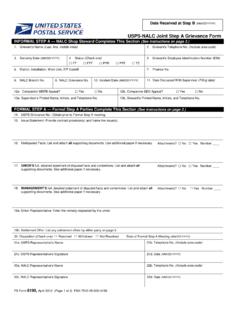
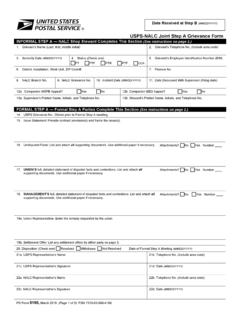
Transcription of NALC POSITION PAPERS - BRANCH 38
1 nalc POSITION PAPERS P-00001: Double Jeopardy P-00002: Mitigating Circumstances P-00003: POSITION On Casuals P-00004: Technical Defenses Unrelated to Merit P-00005: Discipline Was Not Timely Issued P-00006: Discipline was ordered by higher management P-00007: Management's Representative Lacked Authority To Settle P-00008: Higher Management Failed To Review And Concur P-00009: Insufficient Or Defective Charge P-00010: Failure To Render A Proper Decision P-00011: Failure To Properly Investigate P-00012: Improper Citation Of "PAST ELEMENTS" P-00013: No Proper Basis P-00014: Correctness or Completeness of the Facts P-00015: Lack Of, Or, Improper Training P-00016: Long Prior Service, Good Prior Record P-00017: Grievant s Misconduct Was Not Intentional P-00018: Grievant Was Emotionally Impaired P-00019: Grievant Impaired By Drugs Or Alcohol P-00020: Grievant Was Dispartately Treated P-00021: Rule Grievant Broke Was Otherwise Unenforced P-00022: Not Progressive Discipline P-00023: Driving Privileges - Revocation/Suspension P-00024: Employee Claims P-00025: Holiday Scheduling - Change to Tuesday P-00026: Leave: Family And Medical P-00027: Administrative Leave for "Acts of God" P-00028: Marriage Mail.
2 Third Bundles P-00029: Medical Certification P-00030: Opting / Bid Holddown P-00031: Out-Of-Schedule Pay P-00032: Work Assignment Overtime & T-6 Carriers P-00033: Employee Claims - Bicycles P-00034: Employee Claimes Eyeglasses P-00035: Employee Claims: The Automobile Exclusion P-00036: Time Off As A Remedy nalc POSITION PAPERS P-00001: Double Jeopardy P-00002: Mitigating Circumstances P-00003: POSITION On Casuals P-00004: Technical Defenses Unrelated to Merit P-00005: Discipline Was Not Timely Issued P-00006: Discipline was ordered by higher management P-00007: Management's Representative Lacked Authority To Settle P-00008: Higher Management Failed To Review And Concur P-00009: Insufficient Or Defective Charge P-00010: Failure To Render A Proper Decision P-00011: Failure To Properly Investigate P-00012: Improper Citation Of "PAST ELEMENTS" P-00013: No Proper Basis P-00014: Correctness or Completeness of the Facts P-00015: Lack Of, Or, Improper Training P-00016: Long Prior Service, Good Prior Record P-00017: Grievant s Misconduct Was Not Intentional P-00018: Grievant Was Emotionally Impaired P-00019: Grievant Impaired By Drugs Or Alcohol P-00020: Grievant Was Dispartately Treated P-00021: Rule Grievant Broke Was Otherwise Unenforced P-00022: Not Progressive Discipline P-00023: Driving Privileges - Revocation/Suspension P-00024: Employee Claims P-00025: Holiday Scheduling - Change to Tuesday P-00026: Leave: Family And Medical P-00027: Administrative Leave for "Acts of God" P-00028: Marriage Mail.
3 Third Bundles P-00029: Medical Certification P-00030: Opting / Bid Holddown P-00031: Out-Of-Schedule Pay P-00032: Work Assignment Overtime & T-6 Carriers P-00033: Employee Claims - Bicycles P-00034: Employee Claimes Eyeglasses P-00035: Employee Claims: The Automobile Exclusion P-00036: Time Off As A Remedy nalc POSITION DOUBLE JEOPARDY (P-00001) Double Jeopardy Management may not twice impose discipline for a single act of misconduct. Thus, to issue both a letter of warning and seven-day suspension for the same roll-away accident would be improper. It is not improperly subjecting a letter carrier to double jeopardy, however, when a removal is issued for the same misconduct for which an emergency suspension or an indefinite suspension has been issued (unless the employee was returned to work after the suspension). nalc POSITION Mitigating Circumstances (P-00002) Allegations that, Because of Mitigating Circumstances, the Discipline Imposed is too Harsh, or No Discipline is Warranted.
4 The final group of defenses may be called the "mitigation" defenses. With them, the nalc in effect says "even assuming that the grievant's behavior constitutes misconduct, when all relevant factors are considered the amount of discipline imposed is excessive." "Mitigation" should not be confused with "leniency". The mitigation defenses present a variety of factors which management should have considered when imposing discipline, and which an arbitrator will consider even if management didn't. Leniency--simply asking for another change--is within the exclusive province of management, and will not be considered by any arbitrator. Grievant may have acted improperly, but did so as a result of lack of, or improper, training (including claims that the grievant "didn't know it was wrong"). A letter carrier should not be disciplined for violating a rule of which he or she was not aware.
5 It should be noted, however, that employees are presumed to know the major rules of the shop. This defense, therefore, will not be useful where the grievant has assaulted a customer, or has intentionally discarded deliverable mail. nalc POSITION CAU POSITION ON CASUALS (P-00003) Over the course of the past 15 years, nalc and APWU have taken at least six grievances concerning one aspect or another of casual employment to national level arbitration (see, , C-00114, C-00403, C-00449, C-00675, C-00895, C-03246). All were denied. Grievances appealed to Step 4 may be divided into two basic categories: first, claims that PTFS carriers must be worked across craft lines to perform straight time work before such work is given to casuals and, second, claims that PTFS carriers have an absolute right to perform carrier work at the straight time rate before any such work is given to casuals.
6 The Contract Administration Unit is in complete agreement with the POSITION taken in the first category of cases, and there is, in addition, substantial external support for that POSITION . Arbitrator Elliot Goldstein, in a regional level case (C-01215) sustained nalc 's grievance where casuals were worked in the clerk craft while PTFS carriers were idle. Further, a 1976 Senior Assistant Postmaster General memorandum (M-00312) and the prearbitration decision M-00964 support our POSITION on this issue. The second category--claims that PTFS carriers must be given absolute priority in scheduling--is murkier. The same Senior Assistant Postmaster General memorandum that supports our POSITION in the first category of cases contradicts our POSITION on this issue. It states that priority need not be given to PTFS employees "where it is projected that the part-time flexible will otherwise be scheduled for 40 hours during the service week.
7 " That interpretation was not challenged by nalc when it was issued. A second strike against our POSITION is found in the national level decision of Arbitrator Howard Gamser (C-00403). In that case, management worked PTFS clerks at the beginning of the service week, used casuals in the middle of the week, and returned to the PTFS clerks at the end of the week. APWU grieved, asserting that the PTFS clerks were entitled to work a full 40 hour week before any work was assigned to casuals. Denying APWU's grievance, Gamser ruled: Nor does the language of Article 7, Section 1-B-2, which provides, in part "during the course of the service week, the Employer will make every effort to insure that qualified and available part-time flexible employees are utilized at the straight time rate prior to assigning such work to casuals" prevent the Service from making rational decisions regarding the scheduling of the casual work force to handle certain work for which its limited qualifications make its use more appropriate.
8 It does not prevent consideration of the work load and composition of that work load during the entire service week rather than on a day by day basis. Given this background, we have reluctantly concluded that a national level arbitrator would rule against us if we were to proceed to arbitration with the abstract issue whether in all circumstances a PTFS must be given absolute priority in scheduling on a daily basis. However, the line between what management may do and what management may not do in this area has not been so clearly drawn that nalc should permit management complete freedom to do as it wishes. If, for example, PTFS carriers were consistently worked on a six-day per week basis while casuals were making 40 hours in just five days, and if the work being performed by the PTFS carriers and by the casuals were substantially identical, and if this situation persisted over a considerable period, there might be a meritorious grievance.
9 nalc POSITION Technical Defenses Unrelated to Merit (P-00004) Technical Defenses Unrelated to the Merits of the Discipline. Many arbitrators have found principles of procedural due process to be implied by the just cause standard. The examples of technical defenses in this section illustrate ways in which arbitrators have applied these principles in USPS cases. When technical defenses are used, nalc turns the tables and takes the initiative. Management, who started the whole business by making an accusation of misconduct, finds the finger pointed back at it. Because technical defenses are exhilarating, there is an unfortunate temptation to try to use them in every case, even where not quite justified. This temptation should be resisted, because overuse blunts their sharp effect, and erodes credibility. And in any event, other legitimate defenses may be found in almost every case. nalc POSITION DISCIPLINE WAS NOT TIMELY ISSUED.
10 (P-00005) DISCIPLINE WAS NOT TIMELY ISSUED. When management discovers a letter carrier's misconduct, it must initiate discipline in a timely manner. If management does not do so, it waivers whatever rights it may have to impose discipline. It is not clear exactly where the line is drawn between timely and untimely discipline. A letter of warning for a one-minute extension of a break issued thirty years after the event would obviously be untimely. However, a removal two weeks after mail was discarded might be found timely, particularly where management spent the two-week period investigating to make certain that it had all the facts before it acted to impose discipline. nalc POSITION Discipline was ordered by higher management (P-00006) Discipline was ordered by higher management, rather than by the grievant's immediate supervisor. The decision whether to impose discipline, and the decision as to the degree of discipline to be imposed, should be made by the letter carrier's immediate supervisor.