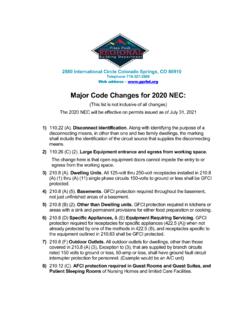
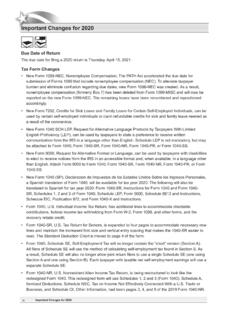
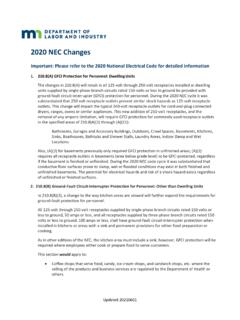
Transcription of National Electrical 2020 Code Changes: 210.8(A) Dwelling ...
1 National Electrical 2020 Code Changes: (A) Dwelling Units. All 125-volt through 250-volt receptacles installed in the locations specified in (A)(1) through (A) (11) and supplied by single-phase branch circuits rated 150 volts or less to ground shall have ground-fault circuit-interrupter protection for personnel. (1) Bathrooms (2) Garages and also accessory buildings that have a floor located at or below grade level not intended as habitable rooms and limited to storage areas, work areas, and areas of similar use (3) Outdoors (4) Crawl spaces at or below grade level (5) Basements (6) Kitchens where the receptacles are installed to serve the countertop surfaces (7) Sinks where receptacles are installed within m (6 ft) from the top inside edge of the bowl of the sink (8) Boathouses (9) Bathtubs or shower stalls where receptacles are installed within m (6 ft) of the outside edge of the bathtub or shower stall (10) Laundry areas (11) Indoor damp and wet locations (B) Other Than Dwelling Units.
2 All 125-volt through 250-volt receptacles supplied by single-phase branch circuits rated 150 volts or less to ground, 50 amperes or less, and all receptacles supplied by three-phase branch circuits rated 150 volts or less to ground, 100 amperes or less, installed in the locations specified in (B)(1) through (B)(12) shall have ground-fault circuit-interrupter protection for personnel. (1) Bathrooms (2) Kitchens or areas with a sink and permanent provisions for either food preparation or cooking (3) Rooftops (4) Outdoors (5) Sinks where receptacles are installed within m (6 ft) from the top inside edge of the bowl of the sink (6) Indoor damp and wet locations (7) Locker rooms with associated showering facilities (8) Garages, accessory buildings, service bays, and similar areas other than vehicle exhibition halls and showrooms (9) Crawl spaces at or below grade level (10) Unfinished areas of basements (11) Laundry areas (12) Bathtubs and shower stalls where receptacles are installed within m (6 ft) of the outside edge of the bathtub or shower stall N (D) Specific Appliances.
3 Unless GFCI protection is provided in accordance with (B)(3) through (B)(5), the outlets supplying the appliances specified in (A) shall have GFCI protection in accordance with (B)(1) or (B)(2). ** In the 2020 NEC, the GFCI requirements for dishwasher outlets previously located in (D) have been relocated to Article 422 (Appliances) and new language was added to point the code reader to Article 422 to find additional GFCI requirements and which appliances require it. (A) requires the following appliances to have Class A GFCI protection if they are rated 150 volts or less to ground and 60 amperes or less, single- or 3-phase: (1) Automotive vacuum machines (2) Drinking water coolers and bottle fill stations (3) Cord-and-plug-connected high-pressure spray washing machines (4) Tire inflation machines (5) Vending machines (6) Sump pumps (7) Dishwashers (B) details the type and location of the device that provides the GFCI protection as follows: The GFCI shall be readily accessible, listed, and located in one or more of the following locations: (1) Within the branch-circuit overcurrent device (2) A device or outlet within the supply circuit (3) An integral part of the attachment plug (4) Within the supply cord not more than 300 mm (12 in.)
4 From the attachment plug (5) Factory installed within the appliance In a nutshell, the first paragraph in new Section (D) can be summed up as follows: If any of the seven types of appliances from (A) do not have GFCI protection as an integral part of the attachment plug, or within the supply cord not more than 12 inches from the attachment plug, or factory installed within the appliance, then either the overcurrent device supplying the appliance must be of the GFCI type or a GFCI device such as a receptacle needs to be installed in the supply circuit. N (E) Equipment Requiring Servicing. GFCI protection shall be provided for the receptacles required by N (F) Outdoor Outlets. All outdoor outlets for dwellings, other than those covered in (A)(3), Exception to (3), that are supplied by single-phase branch circuits rated 150 volts to ground or less, 50 amperes or less, shall have ground-fault circuit-interrupter protection for personnel.
5 Exception: Ground-fault circuit-interrupter protection shall not be required on lighting outlets other than those covered in (C). ** An Outlet , according to the NEC Article 100 definition, is a point on the wiring system at which current is taken to supply utilization equipment. Many people make the mistake of thinking that only receptacles can be outlets . A receptacle is one kind of outlet, but so is a hard-wired connection such as a smoke detector, or a surface mounted luminaire, or even the point on an outdoor air conditioner system where the circuit connects to the disconnecting means supplying the AC unit. In the 2020 NEC, all outdoor outlets for dwellings, other than lighting, electric snow-melting, deicing, or pipeline heating, that are supplied by single-phase branch circuits rated 150 volts to ground or less, 50 amperes or less, shall have ground-fault circuit-interrupter protection for personnel.
6 This is a big change ! Example: A 240V, single phase, outdoor, Dwelling unit air conditioner has two ungrounded conductors that are each 120V to ground and 240V phase to phase. If this air conditioner is rated 50 amps or less, then GFCI protection is now required for the outlet . This code change came as a result of a child s death. On August 3, 2007, a 12-year-old child jumped over a chain link fence and landed on the adjacent AC condenser unit. The condenser had an Electrical ground fault which caused the unit's metal housing to become electrified. The child was fatally electrocuted when he made contact simultaneously with both the condenser and the metal fence. Arc-Fault Interrupter Protection (A) Dwelling Units. All 120-volt, single-phase, 15- and 20-ampere branch circuits supplying outlets or devices installed in Dwelling unit kitchens, family rooms, dining rooms, living rooms, parlors, libraries, dens, bedrooms, sunrooms, recreation rooms, closets, hallways, laundry areas, or similar rooms or areas shall be protected by any of the means described in (A)(1) through (6).
7 Note: Currently AFCI s are required in bedrooms only but would recommend the use of AFCI s in wooden structures. Tamper-Resistant Receptacles. All 15- and 20-ampere, 125- and 250-volt nonlocking-type receptacles in the areas specified in (1) through (7) shall be listed tamper-resistant receptacles. Note: Tamper-Resistant Receptacles are required in Bedrooms.