Transcription of National Qualifications Framework United Arab Emirates ...
1 National Qualifications Framework United Arab Emirates QFEmirates (QFE) Guide to Writing Learning Outcomes at Program and Course Level that Align with QFEmirates Commission for Academic Accreditation United Arab Emirates 2 Contents 1. Introduction .. 3 Part 1 Writing Learning Outcomes at Program Level .. 4 2. The QFE and its relationship with program outcomes .. 4 3. Writing Program Outcomes .. 6 4. Alignment of program outcomes to QFEmirates .. 6 5. Judging the level of learning outcomes .. 8 6. Example of program outcomes.
2 11 Part 2 Writing Learning Outcomes at Course Level .. 13 7. Differences between program and course learning outcomes .. 13 8. Writing course learning outcomes .. 14 9. How course learning outcomes contribute to the achievement of program outcomes.. 16 10. Critique Exercise .. 19 Appendix 20 Appendix 22 Appendix 26 3 1. Introduction This booklet is intended to provide guidance to staff in universities in the United Arab Emirates (UAE) who are working to either develop new or align existing program and course learning outcomes (LO s) to the Qualifications Framework Emirates (QFE).
3 This guidance sets out ways of approaching this task but is not the only or definitive way. It draws on experience from other countries, particularly the UK, which has already introduced such a Framework . It is important that institutions and their staff develop and embed a learning outcomes based approach not only in the writing of program documentation but as importantly to the development of curricula and within the teaching, learning and assessment activity used on these programs if QFE is to have maximum impact in improving student outcomes.
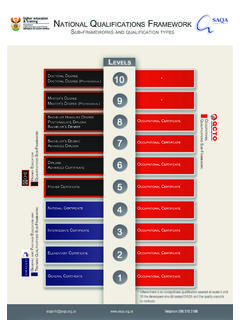
4 4 Part 1 Writing Learning Outcomes at Program Level 2. The QFE and its relationship with program outcomes The National Qualifications Authority (NQA) has established a National Framework of Qualifications in order to bring coherence to the award system and relate all education and training awards to each other. It has established clearly defined standards about the quality of Qualifications and about what a learner can be expected to achieve for each award. The Framework introduces a new approach to the meaning of a qualification in that it recognises learning outcomes what a person with an award knows, can do and understands rather than content or time spent on a The Framework has a structure of ten levels with each level based on specified standards of knowledge, skills and competence.
5 These standards define the outcomes to be achieved by learners seeking to gain awards at each level. Levels 5 to 10 are relevant to higher education in UAE. Each of these levels is defined by a set of learning outcomes which are categorised into three strands, knowledge & skill, and competence. QFE further divides competence into three sub-strands, autonomy and responsibility, self-development and role in context which make up the Framework which program learning outcomes need to address. It is also useful to think of knowledge and skills using some substrands as this helps focus our efforts in aligning program learning outcomes to QFE.
6 The table below sets out a suggested way of looking at the strands to develop program level learning outcomes. 5 Strand Sub-strand Description Knowledge Breadth How broad is the learner's knowledge? Type What characteristics and quality of knowing has the learner engaged in? Skill Range What is the breadth of the physical, intellectual, social and other skills acquired by the learner? Selectivity How does the learner select the skills learned to address a range of problems? What is the nature of the complexity of the problems and how does the learner engage with them?
7 Competence Autonomy and responsibility How does the learner demonstrate the taking of responsibility personally and in groups? How does the learner deploy skills acquired in managing interactions with others and working on their own? Self- development To what extent can the learner operate in new environments, acquire new knowledge and skills; and assimilate these to their existing body of knowledge and skills? Role in Context Can the learner apply/deploy their knowledge and skills in a range of relevant contexts? When designing or reviewing a program, it should be evident from the program learning outcomes in the program document that a successful graduate would achieve the required QFEmirates learning outcomes, therefore, when writing learning outcomes for a program it is advisable to organise them into these strands and where possible into the sub-strands.
8 In the future there is an expectation that all programs delivered in the UAE will be designed and delivered in a way that ensures that all strands in the QFE will be addressed. The balance of emphasis between the strands will vary between individual programs. For example, some will place a stronger emphasis on knowledge and skills and less on competencies while others will have a greater focus on competencies and a narrower knowledge base. It will be important to demonstrate how significant each strand is to your program and be able to reflect 6 on why some strands have much less significance.
9 It is recognised that few programs currently emphasise outcomes related to competencies . 3. Writing Program Outcomes Program outcomes set out the outcomes expected across the entire program leading to the award. Thus a program outcome is a statement of what a learner is expected to know, the skills they will have and be able to use to underpin the competencies in the QFE. Writing Guidance: Start program learning outcomes with the phrase: On successful completion of this program the graduate This phrase can be followed with the program learning outcomes grouped under the strands of QFE.
10 Program outcomes are inherently broad as they recognise the learning outcomes of an entire program. They differ from course learning outcomes in that course learning outcomes are written to clearly indicate how the students will demonstrate their knowledge, skill or competence. Program learning outcomes are attained through the achievement of course learning outcomes across the program. It is at course level that the main assessment of learning outcomes takes place. Program outcomes can be assessed by different measures and instruments, such as capstone course assessments, and integrative exit examinations.