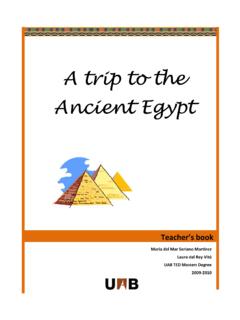
Transcription of Natural disasters - XTEC
1 Natural disasters TEACHER'S. TEACHER S BOOK. M. Morales, 2010. Marta Aulinas & Francisca Galm s (2010). UAB TED Masters Degree ACKNOWLEDGMENTS. This unit would not have been possible without the unconditional support of Oriol Pallar s and N ria Ramos, whose involvement and support have been crucial for its design and implementation. Natural disasters INTRODUCTION. The materials of this unit have been designed to be used with the Educat1x1. project. However, this unit was implemented in a class where the students did not have their netbooks yet. Therefore, the materials are adapted so that teachers can use the whole unit in a regular classroom.
2 The unit has four different parts: Introduction, Volcanoes, Earthquakes and Tsunamis. Except for the Introduction section, teachers can change the order of the topics according to his or her preferences. Students will have five different worksheets bound in a book format in order to complement the digital media used in class. The eduCAT1x1 project: The eduCAT1x1 project offers new classroom resources, such as wider wifi connectivity and Interactive Whiteboards in the classrooms. Students use their own Netbook when they work in class. The main feature of this project is the use of digital books instead of printed ones.
3 Its main goal is to develop the key competences in the society of knowledge. Natural disasters TABLE OF CONTENTS. CLIL TEMPLATE 6. SYMBOL CODE 13. INTRODUCTION 14. Task 1. What is the name of the topic? 14. Task 2. What is the name of this Natural disaster ? 15. Our objectives 15. Task 3. Which Natural disaster is it? 16. Task 4. What do you know about Natural disasters ? 16. Task 5. Write a short composition about your Natural disaster 17. INTRODUCTION II 18. Task 6. Guess the name of my Natural disaster 18. Task 7. How to use the Moodle and how to create an e-book 19. Task 8.
4 Match the name with the definition (I) 20. Task 9. Match the name with the definition (II) 20. VOLCANOES 23. Task 10. Warming up activity 23. Task 11. Review 24. Task 12. Watch the video and order the following photos 25. Task 13. Watch the video again and order the following sentences. 25. Task 14. Preparing a fill-in-the-gaps activity. 26. Task 15. Match the draw with the definition 27. DOING EXPERIMENTS 30. Reminding 30. Task 16. Write the names of the definitions or pictures using the words from the left 30. Task 17. What do I think will happen while doing this experiment?
5 30. Task 18. Let's do the experiment 31. Task 19. Add a tick next to the materials your teacher is using 32. Task 20. Order the following steps writing a number before the sentence 32. Task 21. Chemical reaction 32. EARTHQUAKES I 36. Task 22. Working with words 36. Task 23. Jigsaw reading 36. Task 24. Moodle fill-in-the-gaps activity 37. EARTHQUAKES II 40. Task 25. We are the world 25 for Haiti (I) 40. Task 26. We are the world 25 for Haiti (II) 41. Task 27. Let's sing!! 41. TSUNAMIS 44. Task 28. Review 44. Task 29. The Deadliest Tsunami in History 45. Task 30. Watch the video carefully 45.
6 Natural disasters Task 31. Watch the video and order the following sentences 46. Task 32. Are the following sentences true or false? 46. Task 33. Playing with words 46. Task 34. Let's create a fantastic story 47. ANNEX 1 49. ANNEX 2 57. ANNEX 3 58. ANNEX 4 59. ANNEX 5 62. ANNEX 6 63. ANNEX 7 67. ANNEX 8 69. ANNEX 9 70. EBOOK CHECKLIST 71. INTRODUCTION PRESENTATION RUBRIC 72. INTRODUCTION ESSAY RUBRIC 73. EARTHQUAKE JIGSAW PRESENTATION RUBRIC 74. TSUNAMI ESSAY RUBRIC 75. FEEDBACK CHECKLIST 76. HOTPOTATOES GRADER REPORT 78. FINAL GRADE 79. MOODLE ORGANISATION 80. CD CONTENT 81.
7 CREATIVE COMMONS 83. Natural disasters CLIL TEMPLATE. UNIT TITLE: Natural disasters . CLASS/ AGE: 1st ESO / 11. SUBJECTS, LANGUAGES and/or TEACHERS INVOLVED: Geology, Science, and forces of nature of Natural disasters ; English /Aulinas and Galm s APPROXIMATE NUMBER OF OF LESSONS: 8 COE LEVEL: Recommended for A1. INTRODUCTION TO THE UNIT. You and your group will be able to identify different Natural disasters and define them. You will also know what people should do if a hazard takes place. In addition, you will learn how to build a mock volcano and say why a volcano erupts. MAIN GOALS AND COMPETENCES.
8 COMPETENCES. By the end of the unit, the students will be competent to . 1. participate in short guided conversations in small groups related to Natural disasters . 2. produce short coherent texts focusing on Natural disasters . 3. comprehend oral, audiovisual and written messages related to Natural disasters . 4. produce a guided oral presentation about a personal opinion on a particular Natural disaster with the appropriate pronunciation. 5. identify keywords for Natural disasters . 6. use new ICT technologies and apply them to present their works in class 7. recognize familiar words and very basic phrases concerning Natural disasters .
9 8. read and comprehend literary texts a. Analyse the situation that Haiti is living. 6 M. Aulinas & F. Galm s, 2010. Natural disasters This unit contributes to the achievement of the following key competences (according to the current nomenclature and grouping in Catalonia). Linguistic and audiovisual communicative competence - communicating orally (speaking and listening). giving their opinion and arguments - doing oral presentations - producing coherent writings Data processing and digital competence - using ICT to get information, learn and communicate effectively Social and civic competence - analysing and interpreting events and social phenomen Learning to learn competence - learning together with the others SUBJECT MATTER CONTENT SUBJECT MATTER CONTENT.
10 MAIN TARGET KNOWLEDGE MAIN TARGET SKILLS. 1. Definition of the most common kind of 1. Formulating questions on a Natural disasters . specific hazard. 2. Different kinds of volcanoes. 2. Classifying information from audiovisual media. 3. How to construct a mock volcano and understand the explosion in chemical terms 3. Summarizing the different types of Natural disasters . 4. The causes of volcanoes, earthquakes and tsunamis. 4. Identifying the keywords in a text. 5. Consequences of Natural disasters . 5. Using ICT and learning how to manage new software. 6. What to do in case of any Natural disaster .