Transcription of .NET Format Strings - cheat sheets
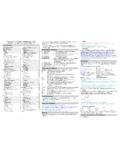
1 NET Standard DateTime Format Strings Specifier Name Description d Short date pattern Represents a custom DateTime Format string defined by the current ShortDatePattern property. D Long date pattern Represents a custom DateTime Format string defined by the current LongDatePattern property. f Full date/time pattern Represents a combination of the long date (D) and short time (t) patterns, separated by a space. (short time). F Full date/time pattern Represents a custom DateTime Format string defined by the current FullDateTimePattern property. (long time). g General date/time Represents a combination of the short date (d) and short time (t) patterns, separated by a space. pattern (short time). G General date/time Represents a combination of the short date (d) and long time (T) patterns, separated by a space. pattern (long time).
2 M or m Month day pattern Represents a custom DateTime Format string defined by the current MonthDayPattern property. o Round-trip date/time Represents a custom DateTime Format string using a pattern that preserves time zone information. The pattern is designed to round-trip DateTime pattern formats, including the Kind property, in text. Then the formatted string can be parsed back using Parse or ParseExact with the correct Kind property value. Equivalent custom Format string is "yyyy'-'MM'-'dd'T'HH':'mm':' ". R or r RFC1123 pattern Represents a custom DateTime Format string defined by the current RFC1123 Pattern property. The pattern is a defined standard and the property is read- only. Equivalent custom Format string is "ddd, dd MMM yyyy HH':'mm':'ss 'GMT'". Does not convert DateTimes to UTC. s Sortable date/time Represents a custom DateTime Format string defined by the current SortableDateTimePattern property.
3 Pattern; ISO 8601 This pattern is a defined standard and the property is read-only. Equivalent custom Format string is "yyyy'-'MM'-'dd'T'HH':'mm':'ss". t Short time pattern Represents a custom DateTime Format string defined by the current ShortTimePattern property. For example, the custom Format string for the invariant culture is "HH:mm". T Long time pattern Represents a custom DateTime Format string defined by the current LongTimePattern property. For example, the custom Format string for the invariant culture is "HH:mm:ss". u Universal sortable Represents a custom DateTime Format string defined by the current UniversalSortableDateTimePattern property. date/time pattern Equivalent custom Format string is "yyyy'-'MM'-'dd HH':'mm':'ss'Z'". Does not convert DateTimes to UTC. U Universal sortable Represents a custom DateTime Format string defined by the current FullDateTimePattern property.
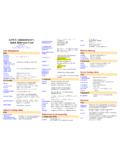
4 This pattern is the same as the full date/long time (F). date/time pattern pattern. However, formatting operates on the Coordinated Universal Time (UTC) that is equivalent to the DateTime object being formatted. Y or y Year month pattern Represents a custom DateTime Format string defined by the current YearMonthPattern property. For example, the custom Format string for the invariant culture is "yyyy MMMM". Any other single (Unknown specifier) An unknown specifier throws a runtime Format exception. character More .NET cheat sheets available at .NET Custom DateTime Format Strings Specifier Description d Represents the day of the month as a number from 1 through 31. A single-digit day is formatted without a leading zero. dd Represents the day of the month as a number from 01 through 31. A single-digit day is formatted with a leading zero.
5 Ddd Represents the abbreviated name of the day of the week as defined in the current property. dddd Represents the full name of the day of the week as defined in the current property. f Represents the most significant digit of the seconds fraction. Note that if the "f" Format specifier is used alone, without other Format specifiers, it is interpreted as the "f" standard DateTime Format specifier (full date/time pattern). When you use this Format specifier with the ParseExact or TryParseExact method, the number of "f" Format specifiers that you use indicates the number of most significant digits of the seconds fraction to parse. ff Number of repeated specifiers represents most significant digits of the seconds fraction. F Represents the most significant digit of the seconds fraction. Nothing is displayed if the digit is zero.
6 When you use this Format specifier with the ParseExact or TryParseExact method, the number of "F" Format specifiers that you use indicates the maximum number of most significant digits of the seconds fraction to parse. FF Number of repeated specifiers represents most significant digits of the seconds fraction. Trailing zeros, or two zero digits, are not displayed. g or gg Represents the period or era ( for example). This specifier is ignored if the date to be formatted does not have an associated period or era string. h Represents the hour as a number from 1 through 12, that is, the hour as represented by a 12-hour clock that counts the whole hours since midnight or noon. A single-digit hour is formatted without a leading zero. hh Represents the hour as a number from 01 through 12, that is, the hour as represented by a 12-hour clock that counts the whole hours since midnight or noon.
7 A single-digit hour is formatted with a leading zero. H Represents the hour as a number from 0 through 23, that is, the hour as represented by a zero-based 24-hour clock that counts the hours since midnight. A single-digit hour is formatted without a leading zero. HH Represents the hour as a number from 00 through 23, that is, the hour as represented by a zero-based 24-hour clock that counts the hours since midnight. A single-digit hour is formatted with a leading zero. K Represents different values of the property, that is, Local, Utc, or Unspecified. This specifier round-trips the kind value in text and preserves the time zone. For the Local kind value, this specifier is equivalent to the "zzz" specifier and displays the local offset, for example, "-07:00". For the Utc kind value, the specifier displays a "Z" character to represent a UTC date.
8 For the Unspecified kind value, the specifier is equivalent to "" (nothing). m Represents the minute as a number from 0 through 59. The minute represents whole minutes passed since the last hour. A single-digit minute is formatted without a leading zero. mm Represents the minute as a number from 00 through 59. The minute represents whole minutes passed since the last hour. A single-digit minute is formatted with a leading zero. M Represents the month as a number from 1 through 12. A single-digit month is formatted without a leading zero. MM Represents the month as a number from 01 through 12. A single-digit month is formatted with a leading zero. MMM Represents the abbreviated name of the month as defined in the current property. MMMM Represents the full name of the month as defined in the current property. More.
9 NET cheat sheets available at s Represents the seconds as a number from 0 through 59. The second represents whole seconds passed since the last minute. A single-digit second is formatted without a leading zero. ss Represents the seconds as a number from 00 through 59. The second represents whole seconds passed since the last minute. A single-digit second is formatted with a leading zero. t Represents the first character of the designator defined in the current or property. tt Represents the designator as defined in the current or property. y Represents the year as at most a two-digit number. If the year has more than two digits, only the two low-order digits appear in the result. If the year has fewer than two digits, the number is formatted without a leading zero. yy Represents the year as a two-digit number. If the year has more than two digits, only the two low-order digits appear in the result.
10 If the year has fewer than two digits, the number is padded with leading zeroes to achieve two digits. yyy Represents the year as a three-digit number. If the year has more than three digits, only the three low-order digits appear in the result. If the year has fewer than three digits, the number is padded with leading zeroes to achieve three digits. Note that for the Thai Buddhist calendar, which can have five-digit years, this Format specifier displays all five digits. yyyy Represents the year as a four-digit number. If the year has more than four digits, only the four low-order digits appear in the result. If the year has fewer than four digits, the number is padded with leading zeroes to achieve four digits. Note that for the Thai Buddhist calendar, which can have five-digit years, this Format specifier renders all five digits.