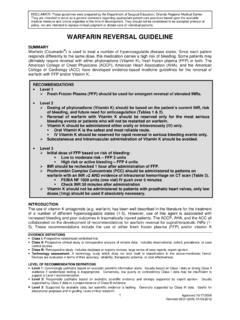
Transcription of NEUROMUSCULAR BLOCKING AGENTS (NMBAs) …
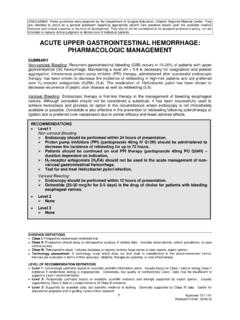
1 DISCLAIMER: These guidelines were prepared by the Department of Surgical Education, Orlando Regional Medical Center. They are intended to serve as a general statement regarding appropriate patient care practices based upon the available medical literature and clinical expertise at the time of development. They should not be considered to be accepted protocol or policy, nor are intended to replace clinical judgment or dictate care of individual patients. EVIDENCE DEFINITIONS Class I: Prospective randomized controlled trial. Class II: Prospective clinical study or retrospective analysis of reliable data. Includes observational, cohort, prevalence, or case control studies.
2 Class III: Retrospective study. Includes database or registry reviews, large series of case reports, expert opinion. Technology assessment: A technology study which does not lend itself to classification in the above-mentioned format. Devices are evaluated in terms of their accuracy, reliability, therapeutic potential, or cost effectiveness. LEVEL OF RECOMMENDATION DEFINITIONS Level 1: Convincingly justifiable based on available scientific information alone. Usually based on Class I data or strong Class II evidence if randomized testing is inappropriate. Conversely, low quality or contradictory Class I data may be insufficient to support a Level I recommendation.
3 Level 2: Reasonably justifiable based on available scientific evidence and strongly supported by expert opinion. Usually supported by Class II data or a preponderance of Class III evidence. Level 3: Supported by available data, but scientific evidence is lacking. Generally supported by Class III data. Useful for educational purposes and in guiding future clinical research. 1 Revised 10/2/07, 09/01/12 Approved 11/18/03 NEUROMUSCULAR BLOCKING AGENTS (NMBAs) IN ADULT INTENSIVE CARE UNITS SUMMARY Although NMBAs may be used to facilitate mechanical ventilation and treat muscle contractures associated with tetanus, the scientific support is limited to case studies and small trials.
4 NMBAs do appear to be beneficial in post-cardiac arrest therapeutic hypothermia and medical management of intra-abdominal hypertension after other methods have failed. Due to the lack of data supporting improved outcomes for other indications, as well as the potential for serious adverse effects, the use of these AGENTS should be reserved for select clinical situations. In fact, recent Surviving Sepsis Campaign Guideline have advocated for the avoidance of NMBAs if at all possible. Given that concomitant medications and comorbidities commonly preclude the use of aminosteroidal AGENTS in the surgical critical care population, cisatracurium is considered our NMBA of choice despite its higher cost.
5 A number of adjunctive therapies are necessary in the paralyzed patient and must not be overlooked. RECOMMENDATIONS PPaattiieennttss MMUUSSTT bbee mmeecchhaanniiccaallllyy vveennttiillaatteedd pprriioorr ttoo aaddmmiinniissttrraattiioonn ooff AAddeeqquuaattee sseeddaattiivvee aanndd aannaallggeessiicc tthheerraappyy MMUUSSTT bbee pprroovviiddeedd pprriioorr ttoo aanndd ffoorr tthhee dduurraattiioonn ooff nneeuurroommuussccuullaarr PPrroopphhyyllaaccttiicc eeyyee ccaarree sshhoouulldd bbee aaddmmiinniisstteerreedd ttoo aallll ppaattiieennttss ffoorr tthhee dduurraattiioonn ooff nneeuurroommuussccuullaarr Level 1 None Level 2 NMBA therapy should be
6 Monitored using either clinical assessment of respiratory function or presence of shivering OR peripheral nerve stimulation [Train of Four (TOF) monitoring]. Level 3 There is inadequate data to support the routine use of NMBAs. NMBAs should be reserved for the following situations: Medical management of refractory intra-abdominal hypertension or elevated intracranial pressures Facilitation of mechanical ventilation with refractory hypoxemia / hypercarbia Treatment of muscle contractures associated with tetanus Treatment of shivering during therapeutic hypothermia Cisatracurium is our NMBA of choice.
7 In patients able to tolerate interruption of NEUROMUSCULAR blockade, the NMBA infusion should be interrupted daily to assess motor function and level of sedation. Physical therapy should be provided to patients on NMBAs. 2 Revised 10/2/07, 09/01/12 Approved 11/18/03 INTRODUCTION NEUROMUSCULAR BLOCKING AGENTS (NMBAs) should be considered an intervention of last resort due to the multiple complications associated with their use. These AGENTS are classified based upon their structure, mechanism of action, and pharmacokinetic properties. Structurally, NMBAs have either an aminosteroidal or benzylisoquinolinium nucleus.
8 Mechanistically, they are classified as either depolarizing or non-depolarizing. Depolarizing AGENTS bind to and activate nicotinic acetylcholine receptors resulting in depolarization of the postsynaptic membrane of striated muscle. Succinylcholine is the only depolarizing agent . Outside of rapid sequence intubation (RSI), it has limited application in the ICU setting due to its short half-life. Non-depolarizing AGENTS also bind to acetylcholine receptors, but instead of activating them they act as competitive antagonists. Pharmacokinetically, NMBAs differ in their duration of action and route of elimination.
9 Additionally, differences exist in the degree of histamine release, vagal block, risk of prolonged blockade, and cost. AMINOSTEROIDAL AGENTS BENZYLISOQUINOLINIUM agent NMBA Pancuronium (Pavulon ) Vecuronium (Norcuron ) Cisatracurium (Nimbex ) Initial dose (mg/kg) Duration (min) 90-100 35-45 45-60 Infusion dose ( g/kg/min) 1-2 Recovery (min) 120-180 45-60 90 % Renal excretion 45-70 50 Hoffman elimination Renal failure Increased effect Increased effect No change % Biliary excretion 10-15 35-50 Hoffman elimination Hepatic failure Mild increased effect Variable, mild increased effect Minimal to no change Active metabolites Yes Yes No Histamine release (hypotension) No No No Vagal block (tachycardia)
10 Modest to marked No No Prolonged ICU block Yes Yes Rare Relative Cost $ $$ $$$ Adapted from Murray et al. Crit Care Med 2002; 30:142-56 LITERATURE REVIEW The clinical practice guidelines developed by the American College of Critical Care Medicine of the Society of Critical Care Medicine provide a detailed review of issues related to the sustained use of NMBAs in critically ill patients (1). The physiology of the NEUROMUSCULAR receptor and pharmacology of NMBAs used in the ICU setting are reviewed. Additionally, methods of monitoring and complications are discussed and recommendations are provided.