Transcription of New York State Next Generation Mathematics Learning ...
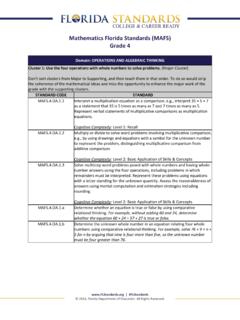
1 New York State Next Generation Mathematics Learning Standards Grade 4 Crosswalk Operations and Algebraic Thinking Cluster NYS P-12 CCLS NYS Next Generation Learning Standard Use the four Interpret a multiplication equation as a comparison, Interpret a multiplication equation as a comparison. operations with whole , interpret 35 = 5 7 as a statement that 35 is 5 times as Represent verbal statements of multiplicative comparisons as numbers to solve many as 7 and 7 times as many as 5. Represent verbal multiplication equations. problems. statements of multiplicative comparisons as multiplication , equations. Interpret 35 = 5 x 7 as a statement that 35 is 5 times as many as 7 or 7 times as many as 5. Represent Four times as many as eight is thirty-two as an equation, 4 x 8 = 32.
2 Multiply or divide to solve word problems involving Multiply or divide to solve word problems involving multiplicative comparison, , by using drawings and multiplicative comparison, distinguishing multiplicative comparison equations with a symbol for the unknown number to from additive comparison. Use drawings and equations with a symbol represent the problem, distinguishing multiplicative for the unknown number to represent the problem. comparison from additive comparison. Solve multistep word problems posed with whole Solve multistep word problems posed with whole numbers numbers and having whole- number answers using the four and having whole- number answers using the four operations, including operations, including problems in which remainders must be problems in which remainders must be interpreted.
3 Interpreted. Represent these problems using equations with a letter standing for the unknown quantity. Assess the Represent these problems using equations or reasonableness of answers using mental computation and expressions with a letter standing for the unknown quantity. estimation strategies including rounding. Assess the reasonableness of answers using mental computation and estimation strategies including rounding. Note: Multistep problems need not be represented by a single expression or equation. NYSED Grade 4 Draft New York State Next Generation Mathematics Learning Standards Grade 4 Crosswalk Operations and Algebraic Thinking Cluster NYS P-12 CCLS NYS Next Generation Learning Standard Gain familiarity with Find all factor pairs for a whole number in the range 1 100.
4 Find all factor pairs for a whole number in the factors and multiples. Recognize that a whole number is a multiple of each of its factors. range 1-100. Recognize that a whole number is a multiple of Determine whether a given whole number in the range 1 100 is a each of its factors. Determine whether a given whole number multiple of a given one-digit number . Determine whether a given in the range 1-100 is a multiple of a given one-digit number . whole number in the range 1 100 is prime or composite. Determine whether a given whole number in the range 1-100. is prime or composite. Generate and analyze Generate a number or shape pattern that follows a given rule. Generate a number or shape pattern that follows a patterns . Identify apparent features of the pattern that were not explicit in the given rule.
5 Identify and informally explain apparent rule itself. For example, given the rule Add 3 and the starting features of the pattern that were not explicit in the rule itself. number 1, generate terms in the resulting sequence and observe that the terms appear to alternate between odd and even numbers. Explain , Given the rule Add 3 and the starting number 1, informally why the numbers will continue to alternate in this way. generate terms in the resulting sequence and observe that the terms appear to alternate between odd and even numbers. Explain informally why the numbers will continue to alternate in this way. NYSED Grade 4 Draft New York State Next Generation Mathematics Learning Standards Grade 4 Crosswalk number and Operations in Base Ten Cluster NYS P-12 CCLS NYS Next Generation Learning Standard Generalize place value Recognize that in a multi-digit whole number , a Recognize that in a multi-digit whole number , a digit in understanding for multi- digit in one place represents ten times what it represents one place represents ten times what it represents in the place to its digit whole numbers.
6 In the place to its right. For example, recognize that 700 right. 70 = 10 by applying concepts of place value and division. , Recognize that 70 10 = 700 (and, therefore, 700 10 = 70) by applying concepts of place value, multiplication, Note: Grade 4 expectations in this domain are limited to whole and division. numbers less than or equal to 1,000,000. Note: Grade 4 expectations are limited to whole numbers less than or equal to 1,000,000. Read and write multi-digit whole numbers Read and write multi-digit whole numbers using base- using base-ten numerals, number names, and expanded ten numerals, number names, and expanded form. form. Compare two multi-digit numbers based on meanings of the digits in each place, using >, =, and < , 50,327 = 50,000 + 300 + 20 + 7.
7 Symbols to record the results of comparisons. Note: Grade 4 expectations in this domain are limited to whole Compare two multi-digit numbers based on meanings numbers less than or equal to 1,000,000. of the digits in each place, using >, =, and < symbols to record the results of comparisons. Note: Grade 4 expectations are limited to whole numbers less than or equal to 1,000,000. Use place value understanding to round multi- Use place value understanding to round multi-digit whole digit whole numbers to any place. numbers to any place. Note: Grade 4 expectations in this domain are limited to whole Note: Grade 4 expectations are limited to whole numbers less than or numbers less than or equal to 1,000,000. equal to 1,000,000.
8 NYSED Grade 4 Draft New York State Next Generation Mathematics Learning Standards Grade 4 Crosswalk number and Operations in Base Ten Cluster NYS P-12 CCLS NYS Next Generation Learning Standard Use place value Fluently add and subtract multi-digit whole Fluently add and subtract multi-digit whole numbers understanding and numbers using the standard algorithm. using a standard algorithm. properties of operations to perform multi-digit Note: Grade 4 expectations in this domain are limited to whole Note: Grade 4 expectations are limited to whole numbers less than or equal to numbers less than or equal to 1,000,000. 1,000,000. arithmetic. Multiply a whole number of up to four digits Multiply a whole number of up to four digits by a by a one-digit whole number , and multiply two two-digit one-digit whole number , and multiply two two-digit numbers, using numbers, using strategies based on place value and the strategies based on place value and the properties of operations.
9 Properties of operations. Illustrate and explain the Illustrate and explain the calculation by using equations, rectangular calculation by using equations, rectangular arrays, and/or arrays, and/or area models. area models. Note on and/or: Students should be taught to use equations, Note: Grade 4 expectations in this domain are limited to whole rectangular arrays, and area models; however, when illustrating numbers less than or equal to 1,000,000. and explaining any calculation, students can choose any strategy. Note: Grade 4 expectations are limited to whole numbers less than or equal to 1,000,000. Find whole- number quotients and remainders Find whole- number quotients and remainders with up to with up to four-digit dividends and one-digit divisors, four-digit dividends and one-digit divisors, using strategies based on using strategies based on place value, the properties of place value, the properties of operations, and/or the relationship operations, and/or the relationship between between multiplication and division.
10 Illustrate and explain the multiplication and division. Illustrate and explain the calculation by using equations, rectangular arrays, and/or area models. calculation by using equations, rectangular arrays, and/or area models. Notes on and/or: Students should be taught to use strategies based on place value, the properties of operations, and the relationship between Note: Grade 4 expectations in this domain are limited to whole multiplication and division; however, when solving any problem, students numbers less than or equal to 1,000,000. can choose any strategy. Students should be taught to use equations, rectangular arrays, and area models; however, when illustrating and explaining any calculation, students can choose any strategy.