Example: bankruptcy
Newton’s First Law
A body continues at rest or in motion in a straight line with a constant speed until acted on by an unbalanced force. The tendency of a body to resist change is called inertia. Newton’s First Law is often referred to as the Law of Inertia. Newton’s Laws apply to macroscopic systems – things you can feel and see. There are environments for ...
Tags:
Information
Domain:
Source:
Link to this page:
Documents from same domain
La Ley de Gravedad de Newton - NASA
imagine.gsfc.nasa.govLa Ley de Gravedad de Newton Duración: 1-2 periodos Preguntas esenciales: • ¿Cómo es que la aceleración ... Sir Isaac Newton (1642-1727) estableció las leyes cientíicas que rigen el 99% o más de nuestras experiencias cotidianas. El explicó también nuestra relación con el universo a través de sus leyes del movimiento y su

La tercera ley Newton: acciones y reacciones
imagine.gsfc.nasa.govLa Primera Ley de Newton explica la Ley de Inercia, que predice la conducta de los objetos cuando todas las fuerzas que actúan sobre ellos son equilibradas. La Segunda Ley de Newton describe cuantitativamente cómo es que las fuerzas desequilibradas afectan movimiento, y explica las fuerzas de la naturaleza que experimenta dos objetos que

La Segunda ley de Newton: principio fundamental de la …
imagine.gsfc.nasa.govLa segunda ley de Newton empieza donde terminó la primera ley. La primera ley describe la inercia: un cuerpo no cambiará su movimiento hasta que una fuerza desbalanceada actúe en el cuerpo. En otras palabras, sin no se aplica una fuerza desbalanceada, el cuerpo permanecerá sin moverse, o, si se encuentra en movimiento, continuará con la misma

La primera ley de Newton: ley de la inercia - NASA
imagine.gsfc.nasa.govque emiten las energías más intensas y breves llamadas brotes de rayos gamma ... El material que se encuentra en este set de pósters ... El estaba de acuerdo en que los objetos continuaran en movi miento aunque no haya una fuerza aplicada. De la misma manera, sabía que existía más de una fuerza actuando
Newton’s Law of Gravitation - Imagine the Universe!
imagine.gsfc.nasa.govthe highest energy explosions in the Universe: gamma-ray bursts (GRBs). Launched in November, 2004, Swift is detecting and observing hundreds of these explosions, vastly increasing scientists’ knowledge of these enigmatic events. Education and public outreach (E/PO) is also one of the goals of the mission.
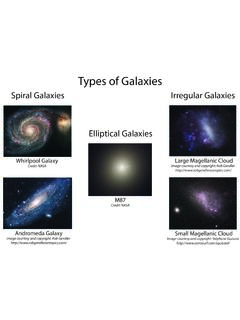
Types of Galaxies
imagine.gsfc.nasa.govTitle: Types of Galaxies Author: Sarah Eyermann Subject: Illustrations of different types of galaxies; used in Session 9 of Afterschool Universe. Created Date

Melting Ice: Designing an Experiment - NASA
imagine.gsfc.nasa.govGraduated cylinders at least 100 ml ! Clock ! Thermometer . Preparation . The day before the experiment prepare one large bucket of plain tap water and another bucket of warm tap water with . as much salt dissolved in it as possible. Lab grade salt is nice, but expensive and not really necessary. Un-iodized salt from the grocery is fine, but
Related documents
Galileo and the physics of motion
www.nicadd.niu.eduKepler’s Laws • Kepler’s Laws can all be derived from Newton’s laws of motion and force of gravity • gravity causes elliptical orbits where planet moves faster when closer to the Sun as force of gravity is larger there • Third Law actually D3 = (Mass(sun) and Mass(earth) ) x P2 D=distance from Sun and P=period

Newton’s laws of motion and gravity
www.as.utexas.eduNewton’s laws of motion and gravity. Newton’s laws of motion 1. Every body continues in a state of rest or uniform motion (constant velocity) in a straight line unless acted on by a force. (A deeper statement of this law is that momentum (mass x velocity) is a

SCIENCE (Code No. 086) Classes: IX and X (2020-21)
cbseacademic.nic.inline; acceleration, distance-time and velocity-time graphs for uniform motion and uniformly accelerated motion, derivation of equations of motion by graphical method; elementary idea of uniform circular motion. Force and Newton’s laws : Force and Motion, Newton’s Laws of Motion, Action and Reaction
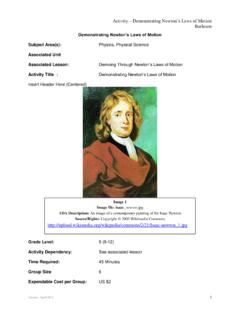
Activity Demonstrating Newton’s Laws of Motion Burleson
gk12.egr.uh.eduNewton’s First Law of Motion An object at rest stays at rest and an object moving at a constant velocity, continues at that velocity unless acted upon by a net force. Newton’s Second Law of Motion Force equals mass times acceleration Newton’s Third Law of Motion For every action there is an equal and opposite reaction. Brake Pads
Newton's Laws of Motion Newton's First Law of Motion ...
w3.ric.eduNewton’s Notes 2 Gravity has an effect on an object in the vertical direction only. If I drop an object, its path follows directly toward the center of the earth. For an object standing still, the acceleration due to gravity is still 9.80 m/s2. On earth, normally we do not distinguish between mass and weight. Notice they have different units!

*ANSWER KEY * ANSWER KEY* ANSWER KEY* Newton's …
olivas8science.weebly.comNewton's First Law of Motion. The penny is not moving. When you quickly remove the index card, the penny will fall down into the cup because of the unbalanced force of Earth's gravity. 6. In your own words, paraphrase the second part of Newton's First Law of Motion. (An object in motion continues to move with the same velocity unless acted on by an
6. The Momentum Equation - Loughborough University
learn.lboro.ac.ukIn fluid mechanics the analysis of motion is performed in the same way as in solid mechanics - by use of Newton’s laws of motion. Account is also taken for the special properties of fluids when in motion. The momentum equation is a statement of …
Physics Lab: Measuring the acceleration due to gravity ...
www.rvrhs.comFeb 12, 2014 · The acceleration due to gravity (g) can be most easily measured by the use the of the basic motion equations. An object is dropped from a known height, the time is measured, and the equation d = v i t + ½ a t 2 is used to calculate the acceleration due to gravity g. Procedure: 1) Place the small diameter ball in the apparatus at a height

Physics 121C Mechanics - University of Hawaiʻi
www.phys.hawaii.eduNewton’s 2nd Law: An object of a given mass m subjected to forces F 1, F 2, F 3, … will undergo an acceleration a given by: a = F net /m where F net = F 1 + F 2 + F 3 + … The mass m is positive, force and acceleration are in the same direction. NewtonÕs Second Law of Motion