Example: tourism industry
NHPCO Facts and Figures
Considered the model for quality compassionate care for people facing a life-limiting illness, hospice provides expert medical care, pain management, and emotional and spiritual support expressly tailored to the patient’s needs and wishes. Support is provided to the patient’s family as well. Hospice focuses on caring, not curing.
Tags:
Information
Domain:
Source:
Link to this page:
Documents from same domain

STANDARDS OF PRACTICE FOR PEDIATRIC PALLIATIVE CARE
www.nhpco.orgPalliative Care and Hospice All children with life-threatening conditions deserve excellent pediatric palliative care either as the primary treatment, or concurrent with disease-modifying or curative therapies. Delays in the provision of pediatric palliative care strategies and services are associated with increased physical, emotional, and

Table of Contents - National Hospice and Palliative Care ...
www.nhpco.orgPROGRAM RESOURCE MANUAL PROFESSIONAL DEVELOPMENT AND RESOURCE SERIES Table of Contents ... Volunteer 2 2015 Standards of Practice for Hospice Programs: Volunteers 8 Volunteer Cost Savings Information Sheet A Resource for Volunteer Managers 12 Cost Savings Dollar Value for Volunteer Hours 13 ... Sample Volunteer Recruitment Plan 172 Recruitment ...

Continuous Home Care in the Medicare Hospice Benefit
www.nhpco.orgContinuous home care may be provided only during a period of crisis. A period of crisis is defined by the Centers for Medicare and Medicaid Services (CMS) as a period in which a patient requires continuous ... impact location of care codes on the hospice claim form. For example, all nursing facilities ... CMS Medicare Benefit Policy Manual ...
Medicare Hospice Conditions of Participation (CoPs)
www.nhpco.orgMedicare Hospice Conditions of Participation (CoPs) Compliance Guide for Hospice Providers January 2015 . Sec. 418.108 Condition of Participation: Short Term Inpatient Care . Short-term inpatient care may be provided in a participating hospital, hospice inpatient unit, or a

“COPS – PLANNING FOR SUCCESS” Medicare Hospice …
www.nhpco.org(CoPs), and to add several new CoPs to address aspects of hospice care that we believe need attention. This section will briefly describe the content of each CoP in the proposed rule. We proposed no changes to Subparts B (Eligibility, Election and Duration of Benefits), G

Medicare Hospice Regulations - National Hospice and ...
www.nhpco.orgface-to-face encounter occurred and by statute only a physician may certify the terminal illness, at §418.22(b)(4) we proposed that the f ace-to-face attestation and signature be either a separate and distinct area on the recertification form, or a

JUNE 2018 - NHPCO
www.nhpco.org• The patient/representative signs a form indicating that patient rights notice was received and understood • A registered nurse (RN) completes an initial assessment of the patient/family within 48 hours of effective date of the election to hospice care Note: In a nurse case manager model, the nurse may complete the

CHAPTER 2: ITEM-SPECIFIC INSTRUCTIONS
www.nhpco.orgThe beginning of each section contains an overview of all HIS items in the section, as well as a section rationale, which explains the purpose of items in each section. For each HIS item, the general order of information presented in Chapter 2 is as

StandardS of Practice for HoSPice ProgramS
www.nhpco.orgStandardS of Practice for HoSPice ProgramS 2 Compliance with Laws and Regulations: Ensuring compliance with applicable laws, regulations, and professional standards of practice, implementing systems and processes that prevent fraud and abuse.
STANDARDS OF PRACTICE FOR HOSPICE PROGRAMS
www.nhpco.orgProfeSSional deVeloPment and reSoUrce SerieS 79 WE 4.5 Educational programs are developed in accordance with the hospice’s policies and individual competency development needs. WE 4.6 Educational programs are evaluated by the participants, and the results are used to inform the development of future programs. Practice Examples: • The hospice has a written policy …
Related documents

A Guide to Symptom Management in Palliative Care
www.hey.nhs.ukSECTION A: PRINCIPLES OF PAIN MANAGEMENT 1. Pain is common in advanced cancer and non-malignant conditions, and its management can be difficult. 2. Pain is a total, personal experience with physical, psychological, social and spiritual dimensions. Optimal pain management will be compromised if any of these aspects are neglected. Management
Guidelines for Syringe Driver Management in Palliative Care
www.health.qld.gov.auGuidelines for Syringe Driver Management in Palliative Care Developed by: Victoria J. Kain Project Officer, Centre for Palliative Care Research and Education ... A total of 43 published ... of drugs to treat unrelieved pain and other distressing symptoms
Pain Management for the Geriatric Patient
www.med.upenn.edu•Total pain. Pain caused by disease states ... • Pain Geriatric Palliative Care 2014. Red flags •Constitutional symptoms •Pain that wakes patient up ... Task Force on Chronic Pain Management and the American Society of Regional Anesthesia and Pain Medicine.

Principles Of Opioid Management - Fraser Health
www.fraserhealth.caSee Fraser Health Hospice Palliative Care Symptom ‘Pain Guideline’ for the assessment and management of pain. Assess patient and family fears and barriers around the use of opioids.(7, 16, 23) Recommendation 4 Diagnosis Management should include treating reversible causes where possible and desirable according to the goals of care.

Guidelines for the use of Methadone in Palliative Care
www.palliativedrugs.comTitration requires skilled monitoring to avoid poor pain control or accidental overdose and should be done under close supervision, ideally in a specialist inpatient palliative care unit. After initial titration and during long term use the drug may be prescribed by the non-specialist but there should be ongoing regular specialist review.
![[P] Fentanyl Subcutaneous & Nasal - Palliative Care (Adults)](/cache/preview/3/6/0/0/a/b/5/9/thumb-3600ab597c837bd6f4f240fa5200c14c.jpg)
[P] Fentanyl Subcutaneous & Nasal - Palliative Care (Adults)
www.waitematadhb.govt.nzMedicines & Infusion Protocols (Adults)/ 1d Palliative Care Fentanyl Subcutaneous and Nasal - Palliative Care (Adult) Issued by Pharmacy & Hospital Palliative Care Team Issued Date February 2017 Classification 014-001-01-079 Authorised by P&T Committee Review Period 36 mths Page 1 of 6 This information is correct at date of issue.
Palliative Care Case Study and Discussion
wordpress.uchospitals.eduPalliative Care “Palliative care is an approach that improves the quality of life of patients and their families facing the problem associated with life-threatening illness, through the prevention and relief of suffering by means of early identification and impeccable assessment and treatment of pain and other problems, physical, psychosocial and
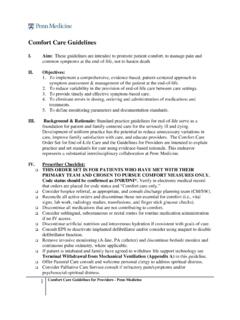
Comfort Care Guidelines - Perelman School of Medicine at ...
www.med.upenn.edu3 Comfort Care Guidelines for Providers - Penn Medicine b) Dyspnea Management For all assessments, document dyspnea using the one or more of the following. o Patient/clinician-reported dyspnea using 0-10 scale o Use of accessory muscles o RR>35/min. If patient is comfortable, assess dyspnea at least hourly and as needed. If patient is uncomfortable, bolus …
Related search queries
Management in Palliative Care, Pain Management, Pain, Management, Total, Palliative care, Pain Management for the Geriatric Patient, Total pain, Principles Of Opioid Management, Care, In Palliative Care, Fentanyl Subcutaneous, Nasal - Palliative Care, Palliative Care Fentanyl Subcutaneous, Palliative Care Case Study and Discussion, Comfort Care Guidelines