Transcription of Nick HO Oxide - LagunaClay.com
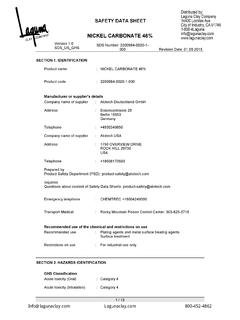
1 SafetyDataSheetGHS Version 06/15 June 1, 2015 nickel Oxide Page 1 of 11 AND COMPANY Product identifiers Material Type: Synonyms: Product Names: CAS-No.: nickel Oxide nickel monoxide, Nickelous OxideCalcined Black nickel Oxide (Calcined A Grade, Calcined F Grade) Green nickel Oxide (Regular Grade, A Grade, F Grade, Coarse Grade) (Brown nickel Oxide ) 1313-99-1 Relevant identified uses of the substance or mixture and uses advised against Identified uses: Catalysts, Fuel cells, Frit Glass, nickel based powders from nickel Oxide , nickel -containing electronics and thermally functioning ceramics, nickel -containing pigments, nickel -containing glass, Stainless, special steels and special alloys manufacturing Details of the supplier of the safety data sheet Company: Telephone: Fax.
2 Laguna Clay Company14400 Lomitas of Industry, CA Emergency telephone number Emergency Contact: Chemtrec Telephone: (703) 527-3887 Contract No.: Classification of the substance or mixture Skin Sensitization - Category 1; Respiratory Sensitization - Category 1; Carcinogenicity- Category 1 A; Specific Target Organ Toxicity, Repeated exposure - Category 1 Aquatic Chronic - Category 4 Clay Company800-452-4862 nickel OxideSafetyDataSheetGHS Version 06/15 June 1, 2015 nickel Oxide Page 2 of 11 GHS Label elements, including precautionary statements Product Identifier: nickel Oxide CAS No.: 1313-99-1 Pictogram GHS07 GHS08 Signal word Danger Hazard statement(s) H317 May cause an allergic skin reaction.
3 H334 May cause allergy or asthma symptoms or breathing difficulties if inhaled. H350 May cause cancer. H372 Causes damage to organs through prolonged or repeated exposure. H413 May cause long lasting harmful effects to aquatic life. Precautionary statement(s) P202 Do not handle until all safety precautions have been read and understood. P261 Avoid breathing dust/fumes/gas/mist/vapors/spray. P273 Avoid release to the environment. P281 Use personal protective equipment as required. P302 + P352 IF ON SKIN: Wash with plenty of soap and water. P501 Dispose of contents/ container to an approved waste disposal plant. (NOTE: number of P-statements has been reduced, as per CLP regulation, the full list can be found in Section 15).
4 Hazards not otherwise classified (HNOC) or not covered by GHS none May cause long lasting harmful effects to aquatic life ON SubstancesHazardous Ingredients Typical Composition NumberEINECS/EC Label No. nickel Oxide >98%1313-99-1 215-215-7 nickel Hydroxide 12054-48-7 Clay Company800-452-4862 nickel OxideSafetyDataSheetGHS Version 06/15 June 1, 2015 nickel Oxide Page 3 of 11 AID Description of first aid measures Ingestion: No specific first aid required. Inhalation: No specific first aid required. Skin: Remove contaminated clothing, and wash affected areas thoroughly with soap and water. If skin irritation or rash occurs: Get medical advice/attention.
5 Show label if possible. Eyes: Irrigate eyeball thoroughly with water for at least 10 minutes. If discomfort persists seek medical attention. Most important symptoms and effects, both acute and delayed Skin contact: Rash Eye contact: Redness Indication of any immediate medical attention and special treatment needed No special requirements Suitable Extinguishing Media Any, type to be selected according to materials in the immediate neighborhood. Special Risks Non-Flammable. Extinguish surrounding fires with appropriate methods Special Protective equipment for fire fighting None needed. Wear protective equipment if required for other materials within immediate vicinity.
6 NFPA Rating Health hazard: 2 Fire Hazard: 0 Reactivity Hazard: 0 RELEASE Personal precautions, protective equipment and emergency procedures Avoid generation of dusty atmospheres. Do not inhale dusts. Contaminated work clothing should not be allowed out of the workplace. Use personal protective equipment as required. Wash hands, and face thoroughly after handling. Environmental precautions Spillages and uncontrolled discharges must be prevented from entering waterways. Methods and materials for containment and cleaning up Pick up and replace in original container. nickel -containing material is normally collected to recover nickel values. Reference to other sections For disposal see section 13.
7 Clay Company800-452-4862 nickel OxideSafetyDataSheetGHS Version 06/15 June 1, 2015 nickel Oxide Page 4 of 11 AND Precautions for safe handling Prevent the generation of inhalable dusts by the use of suitable ventilation. Do not inhale dust. Wear appropriate nationally approved respirators if handling is likely to cause the concentration limits of airborne nickel to exceed the locally prescribed exposure limits. Wear suitable protective clothing and gloves. Contaminated work clothing should not be allowed out of the workplace. Conditions for safe storage, including any incompatibilities Keep in the container supplied, and keep container closed when not in use.
8 Local regulations should be followed regarding the storage of this product. EXPOSURE CONTROLS / PERSONAL PROTECTION Exposure Limits nickel Oxide (NiO) CAS 1313-99-1 Exposure Limit (mg/m3) Year ACGIH TLV-TWA 1 *+ as Ni 2012 UK WEL 2 as Ni 2011 Japan 1 as Ni 2012 Korea as Ni 2006 China 1 as Ni 2007 * Inhalable fraction+ Insoluble inorganic Environmental Limits PNEC s Compartment Unit PNEC Freshwater g Ni/L (bioavailable) Marine g Ni/L Terrestrial mg Ni/kg DNEL s Unit DNEL Dermal Acute systemic mg Ni/kg/day - Acute local mgNi/cm2/day - Long-term systemic mg Ni/kg/day - Long-term local mgNi/cm2/day Inhalation Acute systemic mgNi/m3 520 Acute local mgNi/m3 1 Long-term systemic mgNi/m3 2 3 Long-term local mgNi/m3 2 31 Based on MMAD of m, increases with increasing MMAD (estimated as mg Ni/m3 for exposures to particles with a MMAD of 30 m.)
9 2 When handling powders of particle aerodynamic equivalent diameter (AED) below 10 m, exposures (8h TWA) to these powders should be kept under mg Ni/m3 Clay Company800-452-4862 nickel OxideSafetyDataSheetGHS Version 06/15 June 1, 2015 nickel Oxide Page 5 of 11 3 When exposure are solely to metallic and nickel oxides (without exposure to any other nickel compounds) and the mean particle size of the aerosol is greater than 10 m AED ( 10% of aerosol mass in respirable fraction), inhalable exposure levels up to mg Ni/m3 could be reasonably assumed to be safe. Exposure controls Do not inhale dust. Mechanical extraction ventilation may be required if user operations change it to other physical or chemical forms, whether as end products, intermediates or fugitive emissions, which are inhalable.
10 Maintain airborne nickel levels as low as possible. Avoid repeated skin contact. PPE Respiratory protection: If required, use an approved respirator with particulate filters. Eye protection: If required. Hand & Skin Protection: Wear suitable protective clothing and gloves, which should be selected specifically for the working place, depending on concentration and quantity of the hazardous material (overalls and leather/rubber gloves). Wash skin thoroughly after handling and before eating, drinking or smoking. Change contaminated clothing frequently. Launder clothing and gloves as needed. Use of skin-protective barrier cream advised. AND CHEMICAL PROPERTIESS olid granular dark gray materialPhysical state at 200C and kPa Solid Melting / freezing point >19000 CBoiling point Not applicable Relative Density g/cm3 at 250C Vapor Pressure Not applicable Surface Tension Not applicable Water Solubility g/I at 20 C (green nickel Oxide ) g/I at 20 C (black nickel Oxide ) Partition Coefficient n-octanol/water (log value)Not applicable Flash Point Not applicable Flammability Non-flammable Explosive Properties Non-explosive Self-ignition temperature >4000 COxidizing Properties Non-oxidizing Granulometry Particle Size.