Transcription of Nomenclature for ionic compounds - Easy Hard Science
1 Nomenclatureis a system of naming. This worksheet presents a widely used system of Nomenclature for ionic are two types of metal cations with different naming conventions discussed separately. Part A:Fixed charge (single charge) cations Part B:Variable charge (multiple charge) cationsCations with a single, fixed charge Cationshave a positive charge. They are formed from metals, which lie on the left side of the periodic table. The main group (Groups 1-8) metals form cations with a single, fixed charge. The charge is the same as the Group (column) number on the periodic table. The cation name is formed by adding the word ion after the element name. For example, the element sodium (Na) is found in Group 1.
2 It ionizes to form the sodium ion represented as Na+. The charge is +1 because it is in Group for ionic compoundsWorksheetDr. Scott BeaverNameDatePage 1 of 5 NeverThe big picture: How this worksheet is organized:AlwaysUse a Roman numeralAnionshave a negative charge. They are formed from nonmetals, which lie on the right side of the periodic table. The negative charge is found using the Octet Ruleas eight (8) minus the Group number. Anions always have a single, fixed charge. The anion name is formed by changing the element name suffix to -ide and adding the word ion after the element name. For example, the element chlorine (Cl) is found in Group 7. It ionizes to form the chloride ion represented as Cl.
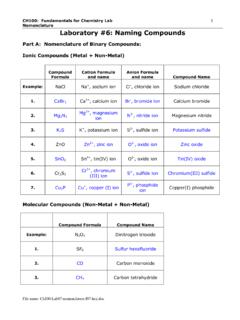
3 The charge is -1 because it is in Group 7, and 8 -7 = compoundsare formed by cation-anion pairs in electrically neutral ratios. They are named using the cation name first, followed by the anion name, excluding the word ion. For example, sodium ion (Na+) and chloride ion (Cl-) form the compound sodium chloride. Its formula is NaCl, which is electrically neutral because sodium ion is +1 and chloride ion is -1. As a second example, magnesium chloride has the formula MgCl2. The subscript indicates 2 chloride ions (Cl-) per 1 magnesium ion (Mg2+). The subscript 1 is always implied and never : There is neverany charge indicated in the name of a compound having a cation with a single, fixed charge.
4 The single, fixed charge is obvious to a for ionic compoundsWorksheetDr. Scott BeaverPage 2 of 5 Exercise 1. Provide the name or formula for each ion:_____chloride ion_____ Li+_____bromide ion_____Na+_____F-_____K+_____S2-_____Mg 2+_____O2-_____Ca2+_____N3-_____Al3+____ _P3-_____bariumion_____I-_____boron ion_____Nomenclature for ionic compoundsWorksheetDr. Scott BeaverPage 3 of 5Cl-I-S2-O2-Br-N3-Na+K+Mg2+Al3+Exercise the table of neutral ionic compounds with the formulasand namesfor each cation-anion with a variable/multiple chargesSome transition metals have multiple possible cation charges. A roman numeral (I, II, III, IV, V, ..) must be used in the cation and ionic compound naming system to distinguish between the charges.
5 For example, iron (Fe) can form the iron (II) ion and also the iron (III) ion, denoted Fe2+and Fe3+, respectively. Iron (II) oxide and iron (III) oxide are distinct compounds , with electrically neutral formulas FeOand Fe2O3, for ionic compoundsWorksheetDr. Scott BeaverPage 4 of 5 Exercise the formula for each (II) oxide_____ iron (III) oxide_____lead (II) chloride_____lead (IV) iodide_____cobalt (II) chloride_____cobalt (III) chloride_____Mixed cation typesThe first step in naming an ionic compound is to determine whether or not the cation can exhibit multiple charges. This requires memorization. Learn the following main group (Groups 1-8) elements always have a single charge, determined by the column on the periodic and zinc are the only transition metals with a single charge.
6 Memorize the ionic charges for Ag+and Zn2+. other transition metals have multiple charges. Use a roman numeralto indicate the cation charge, which can be figured out from the given for ionic compoundsWorksheetDr. Scott BeaverPage 5 of 5 FeO_____NaCl _____ CuBr2_____ ZnO_____ K3P_____ CaS_____ Ag2S _____ CoI3_____ Be3N2 _____ NaCl _____Exercise 4. Provide the name for each compound .