Example: tourism industry
NON-TRADITIONAL MACHINING
always in physical contact with the tool and work piece, In some non relative motion with each other, traditional process tool wear exists. which results in friction and tool wear. 2. Material removal rate is limited by NTM can machine difficult to cut and mechanical properties of work hard to cut materials like material.
Tags:
Information
Domain:
Source:
Link to this page:
Related documents

CERAMICS: Properties 1 (Physical, Chemical, Mechanical) - …
www-personal.umich.edu1 CERAMICS: Properties 1 (Physical, Chemical, Mechanical) S.C. BAYNE,1 J.Y. Thompson2 1University of Michigan School of Dentistry, Ann Arbor, MI 48109-1078 sbayne@umich.edu 2Nova Southeastern College of Dental Medicine, Ft. Lauderdale, FL 33328-2018 jeffthom@nova.edu

Properties of nanomaterials - 123seminarsonly.com
www.123seminarsonly.comNanoparticles were used as dye materials in ceramics by ancient people [1]; Colloidal gold was ... the mechanical properties of nanomaterials will be better than the bulk materials. The superior ... borides and carbides by plasma-induced chemical and physical vapor deposition [26]. In
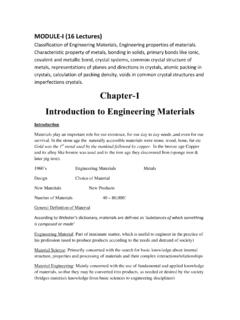
Chapter-1 Introduction to Engineering Materials
www.bput.ac.in• Mechanical engineers search for high temp material so that gas turbines, jet engines ... • Chemical engineers search for highly corrosion-resistant materials ... 1. Material Properties • Physical: e.g. appearance, shape, weight, boiling point, ...
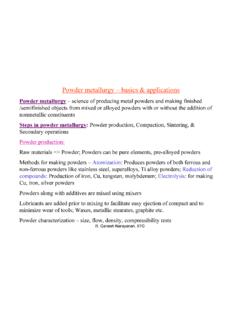
Powder metallurgy – basics & applications
www.iitg.ac.in• Metal powders => Main constituent of a P/M product; final properties of the finished P/M part depends on size, shape, and surface area of powder particles • Single powder production method is not sufficient for all applications Powder production methods: 1. Mechanical methods, 2. Physical methods, 3. Chemical methods 1.

MATERIAL SELECTION FOR MECHANICAL SEALS
www.911metallurgist.comMechanical carbons aremanufactured by blending together types of amorphous carbon (i.e., lampblack, charcoal, or coke) and carbon graphite with a carbonaceous binder (i.e., pitch or resins). The source of the raw materials not only helps determine the physical properties of the carbon but also the type and amount of impurities.
PHYSICAL PROPERTIES OF MATERIALS
www.me.nchu.edu.twPhysical Properties Defined Properties that define the behavior of materials in response to physical forces other than mechanical •Components in a product must do more than simply withstand mechanical stresses •They must conduct electricity (or prevent conduction), allow heat to transfer (or allow its escape), transmit
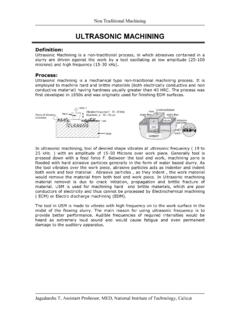
Ultrasonic Machining - National Institute of Technology ...
www.nitc.ac.inb. Liquid – Chemical property, viscosity, flow rate c. Pressure d. Density Process capability 1. Can Machine work piece harder than 40 HRC to 60 HRC like carbides, ceramics, tungsten glass that cannot be machined by conventional methods 2. Tolerance range 7 micron to 25 microns 3.
Section 4 Chapter 1 Fundamentals - Sahand University of …
staff.sut.ac.irNote that since the physical structure of the drying solid is subject to change during drying the mechanisms of moisture transfer may also change with elapsed time of drying. 2.1 Thermodynamic Properties of Air-Water Mixtures and Moist Solids 2.1.1 Psychrometry As noted earlier, a majority of dryers are of direct (or convective) type. In other
MATERIAL SCIENCE Module 2 Properties of Metals
sites.ntc.doe.gov1.18 STATE how heat treatment effects the properties of heat-treated steel and carbon steel. 1.19 DESCRIBE the adverse effects of welding on metal including types of stress and method(s) for minimizing stress. 1.20 STATE the reason that galvanic corrosion is a concern in design and material selection.

CK-12 Chemistry
d3r1z7wkgqhj9d.cloudfront.netwww.ck12.orgChapter 1. Introduction to Chemistry Assessments c.lowered carbon dioxide due to increased use by plants d.forest fires 8.Improved rubber compounds for tires might be developed by