Transcription of Northern Harrier - Pennsylvania
1 CURRENT STATUS: In Pennsylvania , Northern Harrier (Circus cyaneus) is categorized by the Pennsyl-vania Game Commission as a threatened species because of its risk of becoming endangered if losses continue. It also is listed in the State Wildlife Plan as a high level of concern species, because of its small, localized and vulnerable populations that are scattered in pockets of open wetland, grassland or farmland habitat. They are protected under the Game and Wildlife Code. Nationally, harriers are pro-tected under the Migratory Bird Treaty Act of 1918. POPULATION TREND: Northern harriers (Circus cyaneus) were uncommon, but regular breeders in the state through the mid 1900s, primarily near rivers and lakes in the Northern and northwestern counties.
2 Some observers described them as common or abundant, especially in the Pymatuning and Lake Erie re-gion. A few nests were found at the Philadelphia Airport until the 1980s and as many as eight pairs nested at nearby Tinicum Marsh (now John Heinz National Wildlife Refuge). Declines in the North Ameri-can population of Northern harriers, attributed to habitat loss, were noted in the 1960s through the 1980s, as wetlands were drained for agriculture and suburban development, and as old fields reforested or were converted for other uses. Changes in agricultural practices also decreased Harrier nesting habitat. Since then, widely but thinly distributed populations have sta-bilized or declined at slower rates.
3 Results from the Second Pennsylvania Breeding Bird At-las (2004-2009) indicate Northern harriers are still rare breeders in the state and with an even more restricted nesting range than in the recent past. Significantly fewer birds were observed during this recent atlas effort than during the First Pennsylvania Breeding Bird Atlas, conducted from 1983 to 1989, and in fewer counties, especially in the southeast. In most counties where they do nest, they may only nest in one or two locations and not always every year. So, the distribution map may over-represent the nesting population in any given year. Declines in the migrating population have been noticed at Hawk Mountain Sanctuary in recent decades, but other hawk watch sites have not seen those declines.
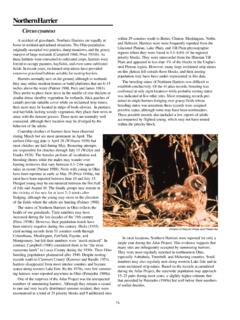
4 Migration seems tied to fluctuations in its small-rodent prey base. Because it had experienced a marked decline in Pennsylvania over the several decades, the Northern Harrier was listed as a state threatened species in 2012. IDENTIFYING CHARACTERISTICS: Harriers are of-ten observed in flight, hunting low over open fields of Northern Harrier Circus cyaneus Dan Pancamo Photo Vic Berardi Photo tall grasses, or perched on fence posts. They re not as easy to spot on the ground, especially while feeding, given the way their plumage blends with winter landscapes. They can be dis-tinguished from other open country raptors, such as rough-legged (Buteo lagopus) and red-tailed hawks (Buteo jamaicensis), by their nar-row wings forming a V-shape in flight, long tail, dark wing tips, and white rump patch.
5 Rough-legged hawks, arctic breeders and winter visi-tors to the state, and Northern harriers both hover briefly over prey items. Observing the white rump patch of Northern harriers will lead to a positive identification. Rough-legged hawks are generally larger birds with broader wings, dark wrists, and a white band at the base of the tail. Short-eared owls (Asio flammeus) hunt the same fields, but in the evening and at night, rather than in the day. Northern harriers are unique among our birds of prey, because sexes can be distinguished by plumage differences. Males are gray above and light below, while the larger females are brown above with buff and streaks of brown on her chest.
6 The face of Northern harriers bears more resemblance to that of an owl than a hawk. Most hawks are visual predators, however facial disks around the Harrier s eyes direct sound to their ears, allowing them to hunt by sound as well as sight. BIOLOGY-NATURAL HISTORY: Formerly known as the marsh hawk, Northern harriers are found in open wetlands, meadows, grasslands, farmland, thickets, and riparian woodlands. Since we have lost so much of these habitats, the Harrier serves well as a symbol of our diminishing open wild spaces. They also are unusual by occurring in our state during all seasons. Rare as a nesting bird and declining as a migrant and wintering resident, the Harrier is worth watching.
7 It is surely the hawk that is ruled by a mouse as it has been called by its admirers. Harriers spend the winter across the middle to southern United States into Central and South America and the Caribbean Islands. Some birds travel more than 900 miles to their wintering grounds. Northern harriers are uncommon but regular winter residents in Pennsylvania and may be spotted hunting over large, open fields. Communal ground roosts also have been encountered. Nesting begins in late April to mid May and can continue through the summer into early August. The breeding ecology of the species is strongly tied to abundance of prey items, primarily mice and voles.
8 Nests of grasses and small twigs are built on the ground. Average clutch size is 4-6 eggs. Clutch size and nest density can fluctuate between years, with larger clutches and more nests per area occurring in years of high prey abundance. When food re-sources are plentiful, males sometimes mate with more than one female. Females independently incubate the eggs for about 30 days and raise the young to fledging (4-6 weeks after hatching) while the male delivers food. They will defend nests from curious human visitors. The pale-hued male will some-times transfer prey items on the wing, passing the food item to the female mid-air or dropping it on the nest if she is not there.
9 Males may range far from the nest to forage. Harriers may react to agricultural activities and other causes of nesting failure by attempting to nest again, extending the nesting sea-son into late summer. PREFERRED HABITAT: Northern harriers prefer large, open wetlands, pastures, cropland, grasslands, bogs, thickets, and riparian woodlands. Reclaimed strip mines planted with tall grasses also are used frequently. Harriers can be opportunistic, reacting to changes in the landscape, including burns and new crop plantings of preferred vegetation. Some of the Second Pennsylvania Breeding Bird Atlas observations were from grass fields planted through the USDA Conservation Reserve En-hancement Program or in open hayfields.
10 They also will nest in STATEWIDE BREEDING DISTRIBUTION Cathy Haffner/PGC Map Jacob Dingel/PGC Photo shrubby wetlands, often near agricultural areas. Harriers can forage a distance from their nest, using good foraging habitat more than a mile from home. Despite the rarity of Northern Harrier as a nesting species, there are locations where harriers can be ob-served either in breeding, in migration, or in winter. In summer months, the following places have sup-ported Northern harriers in multiple years: Presque Isle State Park, Erie County; Pymatuning Swamp and Lake, Crawford County; Conneaut/Geneva Marsh, State Game Lands 213, Crawford County; Erie National Wildlife Refuge, Crawford and Mercer counties; Mount Zion/Piney Tract/Mount Airy tracts, including State Game Lands 330, Clarion County; Pennsy, Black and Celery Swamps, State Game Lands 284, Lawrence County; Long Pond Preserve, Monroe County.