Example: dental hygienist
Norwegian on the Web - NTNU
The present perfect participle of irregular verbs in general ends in a “-t”. The present participle form is the adjectival form of the verb, and is used only as adjective or adverb, not as verb. et økende antall an increasing number et gråtende barn a crying child Regular verbs There are four classes of regular verbs. 1.
Tags:
Information
Domain:
Source:
Link to this page:
Related documents

Practice Makes Perfect English Vocabulary for Beginning ...
sarkarihelp.comThe Past Tense of Be Unit 13 Non– To Be Verbs Regular Present Tense Forms of Verbs Other than Be Regular Past Tense Forms Verbs That Describe Usual Activities Irregular Past Tense Forms Verbs Used for Household Activities Verbs Used in a Classroom Making Verbs Negative Activities That Are Often Performed in an Office Asking Questions Verbs ...
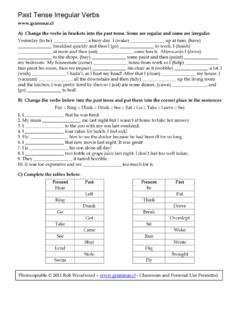
Past Tense Irregular Verbs - Grammar
grammar.clPast Tense Irregular Verbs www.grammar.cl A) Change the verbs in brackets into the past tense. Some are regular and some are irregular. Yesterday (to be) _____ a busy day. I (wake) _____ up at 6am, (have) ... Present Past Present Past Hear Be Left Put Ring Think Drank Drove Go Break Got Overslept ...
Infinitive Verbs Regular -AR –ER –IR Conjugation Present ...
members.speakinglatino.comHANDOUT 2: Regular Verbs in the Present Indicative (pages 7-8) HANDOUT 3: Regular Verbs Cheat Sheet (page. 9 paper size 11” x 17”) HANDOUT 4: The Uses of the Present Tense in Spanish (pages 10-11) HANDOUT 4: Verb Conjugation Contest (pages 12-13) HANDOUT 6: Speaking Production Rubric (page 14) Other: Two dice
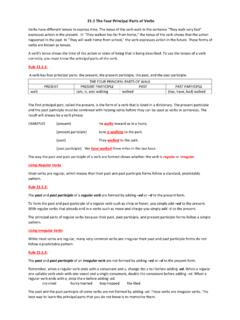
21.1 The Four Principal Parts of Verbs
www.houstonisd.orgWith regular verbs that already end in e-verbs such as move and charge-you simply add -d to the present. The principal parts of regular verbs because their past, past participle, and present participle forms follow a simple pattern. Using Irregular Verbs While most verbs are regular, many very common verbs are irregular-their past and past ...

Academic Language: Making Working Sense of Expectations ...
www.uwsp.edu–Retell an event - regular and irregular past tense verbs –Describe people/things - adjectives –Describe place - prepositions –Describe actions - adverbs and -ing verb endings –Compare/Contrast attributes -er and -est endings –Give/Carry out commands - imperative verbs –Generate hypotheses - if…then

Present Perfect -Form
www.edu.xunta.galPresent Perfect-Form We form the Present Perfect with have and the past participle (regular verbs: infinitive + -ed; irregular verbs: 3rd column of the table of the irregular verbs) have/has + past participle has: 3rd person singular (he, she, it) have: all other forms past participle: - regular verbs: infinitive + -ed

Present Simple - YEnglish
www.yenglishtube.comPresent Simple We use PRESENT SIMPLE to describe an action that is regular, true or normal. We use the present tense: 1. For repeated or regular actions in the present time period. I take the train to the office. The train to Tabriz leaves every hour. Sara sleeps eight hours every night during the week. 2. For facts.

READING LITERARY (RL) READING ... - Georgia Standards
www.georgiastandards.orgd. Begin to distinguish shades of meaning among verbs describing the same general action (e.g., walk, march, strut, prance) by acting out the meanings. ELAGSEKL6: Use words and phrases acquired through conversations, reading and being read to, and responding to texts.